
Online Grocery Market Trends: Digital Adoption, Last-Mile Innovation & Forecast to 2034
How rising smartphone penetration, digital payments, and busy urban lifestyles are accelerating online grocery adoption across developed and emerging consumer markets.

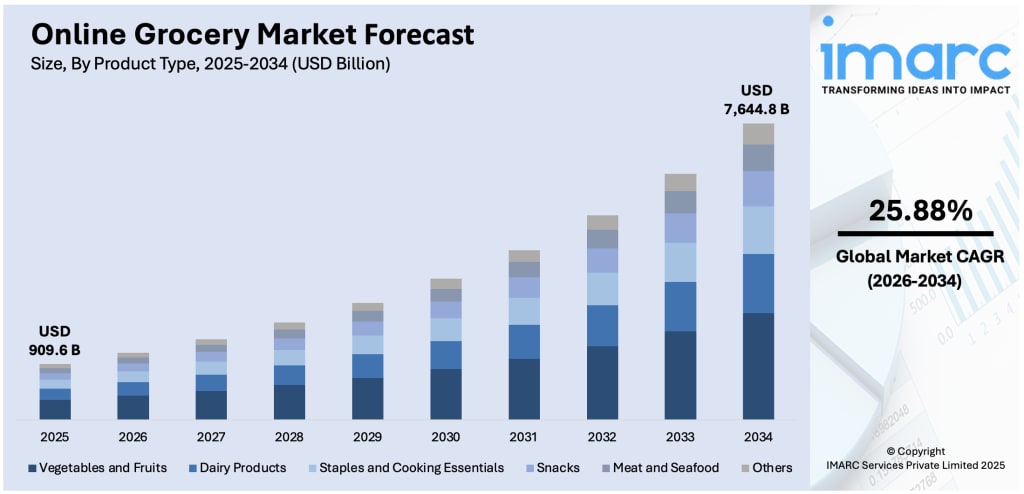
Growing smartphone adoption, demand for convenience, and the rapid expansion of quick-commerce delivery models are fueling online grocery market growth. Digital payment systems, AI-powered platforms, and omnichannel retail strategies are driving widespread consumer adoption. According to IMARC Group's latest data, the global online grocery market was valued at USD 710.10 Billion in 2024. Looking forward, IMARC Group estimates the market to reach USD 6,590.92 Billion by 2033, exhibiting a CAGR of 28.09% from 2025-2033.
The online grocery landscape is evolving rapidly as millions of households make digital shopping part of their weekly routine. By the end of 2024, over 77 million American households were actively purchasing groceries online each month. What started as a convenience during the pandemic has become mainstream behavior. Today's shoppers expect speed, personalization, and seamless experiences whether they're ordering through retailer apps, third-party platforms, or quick-commerce services that promise delivery in under 30 minutes. Mobile apps now account for the majority of orders, with subscription models gaining traction among consumers who want automated replenishment of essentials. Major retailers are investing heavily in micro-fulfillment centers, route optimization technology, and AI-driven recommendations to meet rising expectations and compete for market share.
Online Grocery Market Growth Drivers:
- Smartphone Penetration and Digital Payment Adoption
Widespread smartphone ownership is reshaping how people shop for groceries. Over 90% of Americans now have internet access and approximately 90% own smartphones, creating a massive base of potential online shoppers. Affordable data plans and government-led connectivity initiatives have brought even rural regions into the digital economy. Mobile apps have become the preferred shopping method, offering features like personalized recommendations, one-tap reordering, and real-time inventory updates. Digital payment systems including mobile wallets and contactless payments have made transactions faster and more secure, removing friction from the checkout process. In India, the Unified Payments Interface (UPI) has simplified online transactions dramatically.
- Demand for Ultra-Fast Delivery and Convenience
Busy lifestyles and urbanization are driving explosive demand for quick-commerce models that deliver groceries in 10 to 30 minutes. Traditional weekly shopping trips are being replaced by micro-shopping habits where consumers order small quantities frequently throughout the week. This shift is especially pronounced in urban areas where over 74% of Europeans and similar percentages in Asia Pacific live in cities. Platforms like India's Blinkit and Zepto, Europe's Getir, and North America's Instacart and Gopuff have made ultra-fast delivery a competitive differentiator. Same-day delivery has become table stakes, with many retailers now offering delivery windows measured in hours rather than days.
Claim Your Free “Online Grocery Market” Sample Report Today
- AI-Powered Personalization and Subscription Models
Artificial intelligence and machine learning are transforming the online grocery experience through personalized recommendations, predictive analytics, and automated inventory management. Over 92% of retailers are now using AI to customize shopping and marketing experiences both online and in-store. These technologies analyze purchase history to suggest relevant products, predict when customers will need to reorder staples, and optimize delivery routes for efficiency. Subscription services have gained significant traction, particularly for regularly used products like dairy, pantry staples, and baby care items. Subscription leads the market with around 58% of market share, offering benefits like discounted pricing, free delivery, and automated replenishment.
Online Grocery Market Trends:
- Omnichannel Integration and Channel Fluidity
The lines between online and in-store shopping are blurring as over 90% of consumers now purchase groceries through multiple channels including retailer apps, websites, social media, and third-party marketplaces. Retailers are responding by making it effortless for shoppers to transition between channels mid-purchase. For example, someone might research products on a retailer app, add items to a cart on social media, and then pick up the order in-store. High-quality apps have become crucial, with 41% of online shoppers saying app quality is an important factor when choosing their primary grocery store. Leading platforms are investing heavily in features like digital coupons, shopping lists, customized deals, real-time price updates, loyalty rewards, and purchase histories.
- Rise of Retail Media Networks and First-Party Data
Grocery retailers are building retail media networks to monetize their customer data and on-site inventory, creating a significant new revenue stream. Walmart Connect, Amazon Ads, Target Roundel, Kroger Precision Marketing, and Instacart Ads have all expanded their advertiser participation significantly. These platforms allow consumer packaged goods brands to reach high-intent shoppers with sponsored listings, display ads, and shoppable video at the moment they're making purchase decisions. As privacy regulations tighten and third-party cookies disappear, retailers' first-party data has become invaluable for targeted advertising. Instacart recently partnered with YouTube, allowing viewers to click on ads and order products for same-day delivery directly through the platform.
- Health, Wellness, and Sustainability Focus
Consumer priorities around health and environmental impact are reshaping product offerings and business practices. According to recent research, 46% of consumers identified physical or mental wellness as a top priority, driving demand for organic products, specific dietary options, and items with clear nutritional information. Online platforms are responding with advanced filtering capabilities that let shoppers sort by sustainability criteria, dietary restrictions, or health claims. Some retailers are adopting carbon-neutral delivery options and innovative packaging solutions to reduce waste. The United Nations Environment Programme reported that major grocers are integrating sustainability into online operations through low-emission packaging and optimized last-mile delivery routes.
Recent News and Developments in Online Grocery Market
- December 2025: Instacart announced a strategic partnership with OpenAI to launch an app within ChatGPT, enabling customers to buy groceries directly through the chatbot. This move toward agentic shopping represents a broader industry shift where AI can offer suggestions and ultimately make purchases with minimal human intervention, though the approach carries significant fraud risks that the company is working to address.
- October 2025: Amazon introduced its private-label brand Amazon Grocery, featuring over 1,000 food products with many items priced below USD 5 to attract cost-sensitive shoppers. The selection includes fresh produce, dairy, meats, and pantry staples, available online and in Amazon Fresh stores. This launch positions Amazon to compete more aggressively on price with traditional grocers while expanding its grocery market share.
- October 2025: Indonesian e-commerce leader Blibli launched BlibliFresh, an online grocery service emphasizing freshness, quick delivery, and reliability. The platform addresses common consumer complaints like late deliveries and low product quality by offering one-hour delivery and easy returns, bringing international best practices to the Southeast Asian market.
Note: If you require specific details, data, or insights that are not currently included in the scope of this report, we are happy to accommodate your request. As part of our customization service, we will gather and provide the additional information you need, tailored to your specific requirements. Please let us know your exact needs, and we will ensure the report is updated accordingly to meet your expectations.
About the Creator
Andrew Sullivan
Hello, I’m Andrew Sullivan. I have over 9+ years of experience as a market research specialist.
Keep reading
More stories from Andrew Sullivan and writers in Futurism and other communities.
Higher Education Market Shifts: Public–Private Collaboration & Industry Expansion to 2034
The higher education sector is experiencing significant growth as rising demand for skilled professionals, increasing adoption of online and hybrid learning models, and substantial government investments reshape the educational landscape worldwide. According to IMARC Group's latest data, the global higher education market was valued at USD 28.36 Billion in 2024. Looking forward, IMARC Group estimates the market to reach USD 116.71 Billion by 2033, exhibiting a CAGR of 19.34% from 2025-2033. North America currently dominates the market, holding a market share exceeding 30%.
By Andrew Sullivana day ago in Futurism
Exoplanets That Defy Classification — Even in Theory
In 1990s, many expected them to resemble familiar worlds: rocky planets like Earth, gas giants like Jupiter, or icy bodies similar to Neptune. The assumption was simple—different systems, same basic categories. Reality, however, turned out to be far more imaginative.
By Holianyk Ihor4 days ago in Futurism
Egypt Access Control Market Analysis: Industry Overview, Key Players & Future Outlook
According to IMARC Group's latest research publication, Egypt access control market size reached USD 86.74 Million in 2024. The market is projected to reach USD 194.87 Million by 2033, exhibiting a growth rate (CAGR) of 9.41% during 2025-2033.
By Abhay Rajput7 days ago in Futurism
Foot Bindings
I asked my grandmother how she knew she'd fallen in love. I am not sure I ever did love him, she said. This was before I met my husband. I was naive, a naked spring, a raw nerve of a thing. That cannot ever be me, I knew. Sadness swept in gently like a Moscow thaw. It is no simple thing, looking into a woman's vast soul and seeing its foot bindings. Now, in Italy divorced with my skin singed off, when I say I don't love him mean: I have succeeded at feeling nothing most days and it mostly works. Do you want the comfort of Nothing? Do you want Nothing, too? Be warned: you'll never be free, even when you are nothing. Here is what doesn't work: Accepting the stages of grief. Talking about it. Sitting with the feeling. Missing him—no, the person you were when you believed in death do us part. Writing poetry. That, too. When I say I don't love him I mean: I feel capsized in an endless, starved tide. What sometimes works: selective memory. You must forget ripe tomatoes and his beard and feeling perfectly sheltered in a big blue world. Forget coffee in bed, laughter watching TV, blowing out the candles on the birthday cake and the quiet all-encompassing knowledge that you are chosen. Remember only how love turned to a banal everyday survival act, a trapeze act unsure whether he will catch you, how the warmth stagnated and became sour, remember the foot bindings and remember the resentment boiling in your veins as you stick it out for the kids. Six-hour Netflix binges help, too. A man's fingers tracing your spine. Frozen pizza at 2 a.m. Random trips to the museum just to stand near things that last a while. The realization that crying won’t change anything. Seeing that life is just a dream, and refusing to participate in your own suffering. Bite your fist. Walk on eggshells around joy. When I say I don't love him, I mean he didn’t break my heart, he just stopped touching it and it forgot how to beat right.
By Ella Bogdanova2 days ago in Poets


Comments
There are no comments for this story
Be the first to respond and start the conversation.