
Chapter 1
Nobody can hear a scream in the vacuum of space, or so they say. Right?
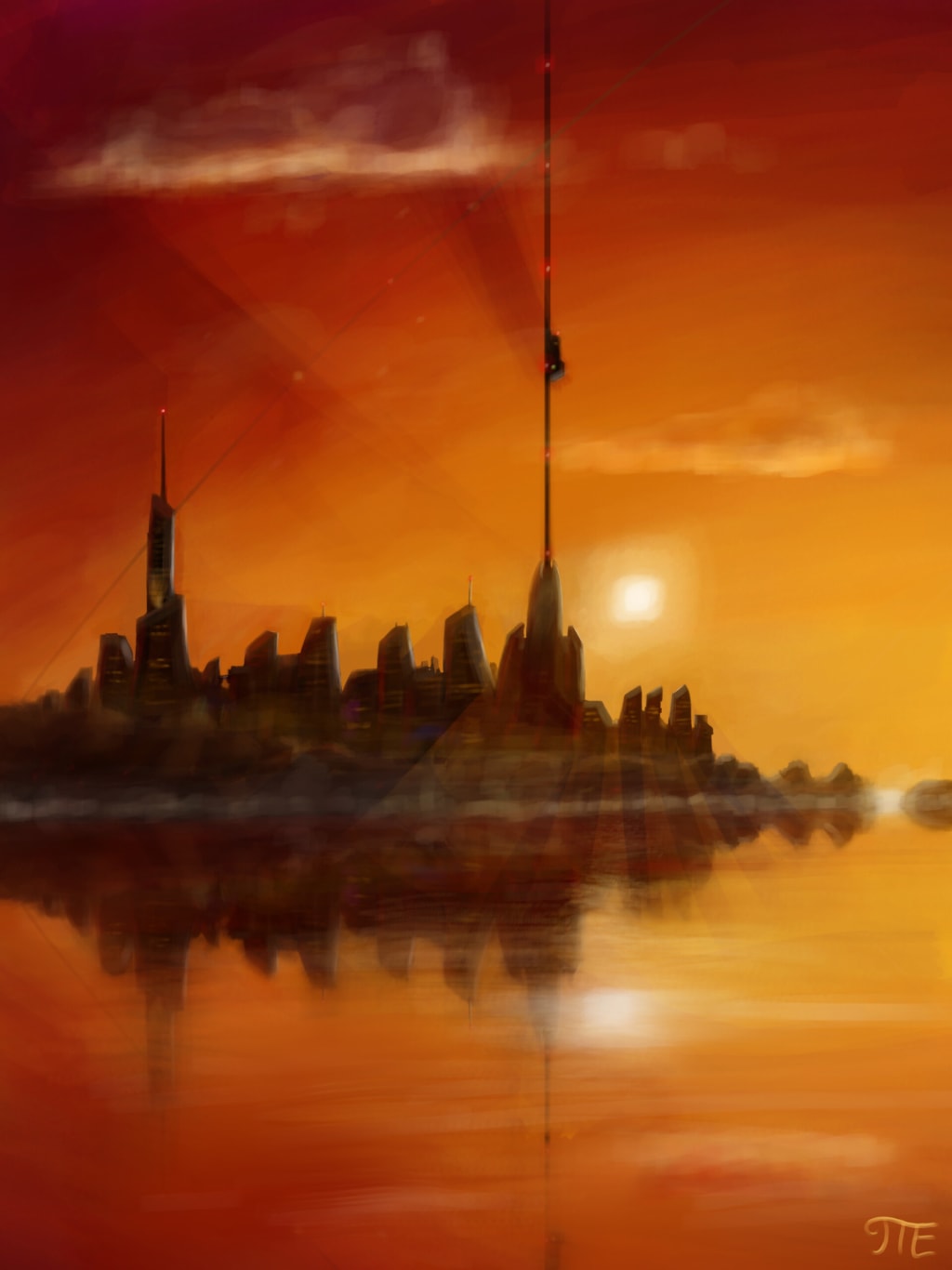
Sofia looked out from the giant sphere thinking that. This was the only home she'd ever known, a colony on Mars.
It was the year 2137, and just as the fortunes of Earth were beginning to fall, the fortunes of Mars were beginning to flourish.
The pioneers, the first colonists to Mars, were not men, but machines. They toiled the land better than any man could, and could create homes and infrastructure so that human settlement could be paved.
The great motivator, the great impulse for this traverse across the stars, was at first global warming, or climate change, as it was sometimes called. For some, warm weather during the colder seasons was seen as a pleasant surprise. But as time moved on the effects of climate change made sure that any feelings of goodwill on some winter days turned into a horrible reality. And when the glaciers finally melted, earlier that expected, the sum of all fears became true.
Sofia thought about that, as she looked out on Earth.
Children her age sometimes were affected by what doctors would call a "malaise terrestria", a feeling of hopelessness, regret and guilt over the events that occurred on the third planet.
Early on, when the first colonist were travelers from Earth, escapes and suicides occurred. Despite trying to screen for such tendencies the burden of events were usually laid on the children. Some would try to get access to the outer walls and attempt to open the hatch's of that kept them safe in the hope, futilely, that some sort of Nirvana would greet them on the other side, but there was no Nirvana. Just death.
Over the years, though, the red planet became green, and the barren lakes brimmed with life.
To be a colonist, that is, to be a human survivor, one had to abide by certain principles. There was no division in any theological thinking, no one race or religion was superior to another, though certain people chose to respect the traditions of their heritage.
The basis of economic inequality, that is, the disparity of income on the bias of technological or intellectual superiority, and in hence, the temptation to use that advantage in an exploitative manner, was also gone. The colonist were not peasants, or famers; nor were they clergies or kings. They were men and women alike. All who worked, all who produced. One, hand in hand, with the other.
In school they taught about how their current society, like all preceding societies which flourished, found a balance within themselves and with nature as a whole, and the basis of this was the principle of men and woman working for each other and for the society at large.
They learned how Earth had been destroyed by this change in balance. That the men at the top had found a way to consolidate all the power, and the men from the bottom suffered not from a lack of products or food, but from a lack of purpose and hope; they were not slaves, not bound by the bonds and chains of the past, but they were inextricably bound by an inability to ever effect the order that had been imposed on them. They were a heard; no more, no less. And eventually, all heards lose their shepherds.
There was a song that Sofia thought about, "Everybody Wants to Rule the World," when she was thought about that period of life on Earth. A race to the top, country and country vying for control; and who was made to suffer, its own people. In her own free time, she loved to go through the catalogues of recorded music and think to herself as she lay in bed, about the musicians with their styles, and instruments; about the cultures that fed that will to create art in their particular style. A world, she imagined, brimming with hope and with possibility.
Despite robotics taking control of much of the agriculture on their colony, they were all taught to cultivate land by hand. This was deemed as part of their education as well; to not labour, and to not instill a sense of the need to labour, was seen as the greatest of 'sins' in the new colony.
It was a utopia, in the most classical sense of the word. Not sprung from an Eden, but build from the exile from heaven, and of their own toiling with the culmination of all human misdeeds.
A Utopia...
Many of the elders thought about that and gave a soft laugh. They thought about the root word of sardonicism, which from the Greek, sardónios, was a plant that when eaten, produced laughter, and then death.
Did they do enough? They would ask. Enough to have prevent it, and also enough to prevent it again? Perhaps it is in man's nature to build themselves towers to Babel, and then, in all shock, see them fall under the weight of their own failures.

Ashirvad Kai was one of the fortunate ones. He got to know Mars and Earth in his lifetime.
A son of a lawyer, who himself was a son of a salesmen, who was also the son of a farmer; he never forgot about being both reverent of his past and to strive to the future.
As a child on earth, his father, Divit, instilled in him a love of knowledge. Baba, as he would call him, would come home from his various trips abroad and always bring home with him a some books for he and his sisters.
It was a privilege to read books in printed form, especially in the part of the world where they came from. But even then, Ashirvad could not imagine a childhood not spent in his father's study, riffling through pages and opening new books, lost in their stories. But childhood veils never hold.

There are times in life when the when one transitions from a child to an adult, and one knows the world around him is not the construct that had been built, but rather, something else. This doesn't happen to all; some have the leisure of always being in the bosom of an eternal youth; their lives always an eternal paradise. Some also fruitlessly chase that dream, error and error incurred, and continue on, despite all the world saying, "this is not meant for you."
It was on a trip to the far north that Divit, Ashirvad's father, was sent with an expedition of scientists, biologists and government policymakers like himself. But this trip was different. A lawyer by trade, Divit Acharya, worked within government, as a liaison between economists, social planners and lawmakers. Generally positions as his were divided by caste in India, still to that day, but everyone on every side saw that he was a man of wisdom and a man of truth. A man who perhaps, would have been a ruler in another day.
As he left to go, Ashirvad saw the worry on his father's face as he said goodbye to his mother. Her giving him a kiss and a prayer, saying to him softly, "Come back safe to me..."
And when he returned, in the dark of the night, his mother telling the children to say in their rooms, Ashirvad watched from the top of the stairs as one of the other men placed his hand on his father's shoulder and said "I'm sorry, I'm so sorry..."

When they were all gone, his mother closed the door behind him, and asked in Hindi, "Is everything alright?"
She asked again, "Divit? Is everything alright??"
And he watched from the stairs, as his father knelt forward into her arms, and wept. And wept.
And wept.

Things changed quickly from then.
The great failure of the 21st Century was perhaps building a wall so high as to imagine that by the very will of mankind, all problems could be solved. That by human ingenuity, we would conquer all.
During that time in India, life became a hell. Not a hell as in a pit of eternal damnation, but a hell as in heat waves of 50°C or 122°F. And when it reached 60°C, and the crops began to catch fire, and the the people rushed the government offices in a vain hope of salvation. And the elders and children died off, cooked almost alive in the villages and countrysides that were affected the most; that was when the world started to notice.
And when those heat waves started to hit other places; Europe, East Asia, Australia, the Americas; when that happened, the TV cameras had no choice but to change their regularly scheduled programs and talk about the horror's that were becoming of Earth.

Ashirvad thought to himself as he did most mornings; tea and meditation, by the window looking out. He thought about when, on those hot days when he lived on Earth, when he would sit with his mother and sisters, in an air conditioned home, and when he would slip out on to his roof, to try to open a door and see how hot it really was, and then the blast of air, so hot and powerful, and of his father catching him there, and screaming at him to get off the roof and get back inside. Ashirvad knew then, what perhaps all those days in school and childhood dances and class trips didn't teach him; that many would perish. And that was the first time, despite his father's repeated lessons, that the he understood his magnitude of his good fortune, and the humbleness that it entailed.
Many would die. There would be many screams across that void. But the illusion of normality would have to be kept.

When does one stop counting age? At 70? 90? 110? At 35, when one's age is no longer a matter to oneself? When he was at the university studying science he imagined what life would have been like for those past generation's of students who could take classes and be unconcerned with the world at large.
But all those thoughts were aside him now. He had come, he had found a wife here on this Martian soil, beared children; and they grandchildren.
It's unjust to take favorites in ones children or grandchildren, but no matter how much ones tries, there's always one that makes you smile no matter what. Sofia was one of those.
Perhaps it's the one that remind you of yourself the most. Although his own children always had the same reverence to him that he did to his father, she was different.
As a child she was always asking questions about everything, he would joke with her when she was younger and say as they would walk in their gardens, "You're a Martian," to which she replied, "I'm not a Martian; I'm me." To which he could only nod, and say, "That is true."
Although he was not of the first colonist's chosen to travel to Mars, he had been essential to writing up the social framework for the civilization what was to become the greater Mars colony. And the first test of his creation was the world in which Sofia was to be born into. They were the first generation of exiles from the proverbial Egypt, born after their toil in the desert.
What would become of her, and her peoples? They would be the direct byproduct of the design of his generation. Their grand social experiment. And although life did not always go perfect, he saw in her hope, and love, and much hope.
About the Creator
Keep reading
More stories from writers in Futurism and other communities.
Saudi Arabia Asphalt Pavers Market: Infrastructure Boom, Smart Paving & Growth Outlook
Market Overview According to the latest report by IMARC Group, the Saudi Arabia asphalt pavers market was valued at USD 22.7 Million in 2025. The market is expected to reach USD 32.8 Million by 2034, expanding at 4.18% annually from 2026 to 2034. This growth momentum is being driven by massive infrastructure investments, the emergence of mega projects like NEOM and Qiddiya, and increasing adoption of technologically advanced paving machinery equipped with GPS controls, automated systems, and digital monitoring capabilities that help contractors meet strict quality standards and tight project timelines.
By Jeffrey Wilson4 days ago in Futurism



Comments
There are no comments for this story
Be the first to respond and start the conversation.