
North America Customer Relationship Management Market Size and Forecast 2025–2033
How AI, Cloud Solutions, and Digital Commerce Are Defining the Future of CRM Across North America


The North America Customer Relationship Management (CRM) Market is on track to witness one of its most transformative decades. According to Renub Research, the market is projected to reach US$ 72.06 billion by 2033, rising from US$ 27.16 billion in 2024, advancing at a robust CAGR of 11.45% from 2025 to 2033.
CRM—which began as a simple customer database—has evolved into the backbone of business operations in North America. Today, CRM systems integrate AI, analytics, automation, cloud computing, mobile accessibility, and omnichannel engagement, redefining how companies acquire, understand, and retain their customers. With rapid digital transformation across industries, enterprises in the U.S. and Canada are prioritizing CRM technologies to drive personalization, customer loyalty, and operational efficiency.
In this editorial-style deep dive, we explore the market outlook, growth drivers, challenges, regional insights, competitive landscape, and future opportunities that define North America’s CRM industry.
North America Customer Relationship Management Market Overview
Customer Relationship Management (CRM) refers to the set of technologies, tools, and strategies businesses use to manage interactions with customers and prospects. Modern CRM platforms consolidate vast amounts of customer data—including communications, purchase behavior, service history, and preferences—into centrally accessible dashboards.
A modern CRM ecosystem supports:
Sales automation
Customer service workflows
Marketing campaign orchestration
Predictive analytics
Real-time communication
Reporting and forecasting
Data-driven decision-making
In North America, CRM adoption continues to surge as organizations shift toward customer-centric business models. From healthcare and banking to manufacturing and retail, industries rely on CRM to improve customer satisfaction, enhance revenue generation, and maintain competitive agility.
Meanwhile, the integration of AI-powered assistants, machine learning (ML), chatbots, and automation tools is redefining how CRM works—moving from reactive data storage to proactive customer engagement.
Market Drivers Fueling CRM Growth in North America
1. Rapid Digital Transformation
North America’s accelerated shift toward digital tools and advanced enterprise management systems has made CRM indispensable. Businesses today require:
Centralized customer data
Automated workflows
Connected sales, marketing, and service teams
Real-time dashboards
Predictive insights for better decisions
In June 2023, Oracle’s acquisition of DataWeave, a data integration company, further strengthened its CRM capabilities by enhancing consumer insights and predictive analytics. Such strategic investments highlight the region’s commitment to leveraging data as a strategic asset.
Digital transformation initiatives—especially those focused on automation, personalization, and omnichannel interaction—remain one of the strongest market growth engines.
2. Massive Cloud CRM Adoption
While on-premises CRM systems still exist, the market has overwhelmingly shifted toward cloud-driven platforms due to their:
Scalability
Lower upfront costs
Seamless deployment
Remote accessibility
Automatic updates
Reduced IT dependency
In June 2023, Microsoft rolled out a major upgrade to its Dynamics CRM, improving its integration with Power BI and creating a unified user experience. This aligns with enterprises’ growing need for connected systems and real-time insights.
As hybrid and remote workforces become standard across North America, the demand for cloud CRM and SaaS platforms continues to soar—especially among small and medium-sized enterprises (SMEs) seeking cost-effective solutions.
3. E-commerce and Mobile Commerce Expansion
The U.S. and Canada are experiencing unprecedented growth in e-commerce and mobile commerce volumes. This surge has forced companies to adopt CRM systems to:
Manage high transaction volumes
Segment consumer data
Personalize marketing outreach
Offer tailored promotions
Track omnichannel journeys
Strengthen customer loyalty programs
Mobile CRM platforms, in particular, allow sales teams and service representatives to stay connected anytime, anywhere.
As retail, hospitality, logistics, and service-based industries go digital, CRM becomes a mandatory operational tool.
Key Challenges Affecting the Market
Despite significant growth, several hurdles still pose challenges for North American enterprises.
1. Data Privacy and Security Concerns
CRM platforms house sensitive customer information, creating vulnerabilities around:
Data breaches
Cyberattacks
Compliance mandates
Regulatory obligations such as:
California Consumer Privacy Act (CCPA)
General Data Protection Regulation (GDPR) (impacting multinationals)
PIPEDA in Canada
…require strict security protocols. Organizations must invest heavily in encryption, authentication, access control, and monitoring to ensure their CRM systems remain compliant and secure.
2. Integration Complexities
Many companies—especially established enterprises—operate using multiple legacy systems and disconnected databases. Integrating these with modern CRM solutions often leads to:
High implementation costs
Technical complexity
Workflow disruptions
Data inconsistencies
Longer deployment timelines
Organizations also face challenges integrating CRM data across departments such as sales, marketing, and customer support. Without seamless integration, companies cannot realize the full potential of a 360-degree customer view.
Country-Level Insights
United States CRM Market
The United States remains the largest and most mature CRM market globally, driven by:
Early digital adoption
High e-commerce penetration
Strong cloud infrastructure
Enterprise investment in AI and analytics
Concentration of global CRM leaders (Salesforce, Microsoft, Oracle)
Industries like BFSI, retail, healthcare, IT & telecom, and manufacturing intensively rely on CRM systems to enhance efficiency and streamline customer interactions.
However, compliance with stringent data privacy laws (notably CCPA) and integration challenges continue to pose barriers. Still, the U.S. leads innovation in CRM technologies, especially in artificial intelligence and automation.
Canada CRM Market
Canada’s CRM market, while smaller, is gaining momentum due to rising adoption among SMEs and customer-driven organizations. Key growth trends include:
Increased digital commerce
Growing cloud migration
Mobile CRM usage
AI-powered customer insights
SaaS adoption across retail, financial services, telecom, and healthcare
However, Canadian companies must navigate strict privacy frameworks like PIPEDA, which can slow down CRM deployments and increase compliance costs. Despite this, Canada’s accelerating digital transformation ensures steady market expansion through 2033.
Recent Developments Shaping the CRM Landscape
The North American CRM industry has witnessed several strategic partnerships, product launches, and innovations, including:
July 2025: Rocket CRM, a U.S.-based CRM provider, launched an advanced automation system to streamline lead tracking, contact management, and repetitive workflows.
February 2025: SCCG Management partnered with Smartico to bring Smartico USA—a gamification and CRM platform—to the U.S. market.
September 2023: Salesforce unveiled the next generation of Einstein Copilot, an AI-powered conversational assistant for CRM applications.
June 2023: SugarCRM and sales-i collaborated to elevate B2B sales performance using AI and machine learning, optimizing analytics for manufacturing and distribution sectors.
These developments reflect a strong future where CRM integrates automation, gamification, AI, predictive insights, and analytics to deliver deeper value.
North America CRM Market Segmentation
By Platform Type
Customer Service
Analytics
Customer Experience Management (CXM)
Salesforce Automation
Marketing Automation
Social Media Monitoring
Others
By Deployment Type
Cloud
On-Premises
By Enterprise Type
Large Enterprises
Small & Medium Enterprises (SMEs)
By End Use
BFSI
Retail
Discrete Manufacturing
Healthcare
Telecom & IT
Government & Education
Others
By Country
United States
Canada
Key Companies Covered
Each of the following companies is covered from five strategic viewpoints: Company Overview, Key Persons, Recent Developments & Strategies, SWOT Analysis, and Sales Analysis.
SAP AG
Salesforce.com, Inc.
Oracle (NetSuite Inc.) Corporation
Adobe Systems Inc.
Microsoft Corporation
Infor, Inc.
The Sage Group Plc.
IBM Corporation
SYNNEX Corporation
These market leaders continue to redefine CRM through AI tools, predictive insights, advanced analytics, cloud solutions, and integrated enterprise platforms.
Final Thoughts
The North America Customer Relationship Management (CRM) Market is entering a new era of data-driven engagement, automation, and hyper-personalization. As businesses across the U.S. and Canada face rising customer expectations, CRM becomes the central nervous system of organizational strategy.
From AI-driven assistants like Salesforce Einstein Copilot to cloud-powered platforms from Microsoft and Oracle, North America is shaping the future of customer engagement technologies. The decade ahead promises CRM solutions that are:
More intelligent
More predictive
More automated
More user-friendly
More integrated
With a projected valuation of US$ 72.06 billion by 2033, the North American CRM market is not just growing—it is fundamentally transforming how companies operate and connect with their customers.
About the Creator
Keep reading
More stories from Aaina Oberoi and writers in Futurism and other communities.
Application Specific Standard Product (ASSP) Market Size & Forecast 2025–2033
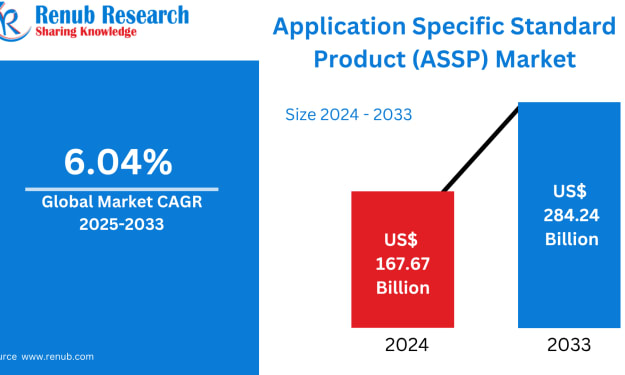
The global semiconductor landscape is undergoing rapid transformation—and at the center of this shift lies the Application Specific Standard Product (ASSP) Market, a sector uniquely positioned between fully customized ASICs and off-the-shelf integrated circuits. According to Renub Research, the ASSP Market is expected to grow from US$ 167.67 billion in 2024 to US$ 284.24 billion by 2033, expanding at a CAGR of 6.04% from 2025 to 2033.
By Aaina Oberoi2 months ago in Futurism
About Binding Prometheus
I want to start actively advocating on behalf of my own work, and the most valuable part of my canon is, without a doubt, Binding Prometheus, the play I have been working on since 2019 and only finished in 2023 as part of my MA. The play itself is an amalgamation of a million different inspirations. On one end, it evokes the Ancient Greek myth-play, deriving its own title from the earliest extant work of Western drama we have, Aeschylus’s Prometheus Bound. On the other end, it borrows significantly from the sci-fi bulwarks from over the years, namely Mary Shelley’s Frankenstein and Karel Capek’s Rossum’s Universal Robots. The play could be an episode of Black Mirror, I fear. I don’t know. I’ve only ever seen one episode of Black Mirror.
By Steven Christopher McKnight11 days ago in Futurism
Saudi Arabia Trade Finance Market: Vision 2030, Export Diversification & Banking Innovation
According to IMARC Group's latest research publication, the Saudi Arabia trade finance market size reached USD 514.0 Million in 2024. The market is projected to reach USD 693.7 Million by 2033, exhibiting a growth rate (CAGR) of 3.14% during 2025-2033.
By Jeffrey Wilson4 days ago in Futurism
A Failed Artist, A Disillusioned Poet, An Underpaid Game Show Host
I took my son and niece to Gori, a small town in Georgia where Joseph Stalin was born. They talked me into visiting the Stalin's Museum, the largest in the post-Soviet space. I had resisted going there because I just can't stand the monster and know enough about him, or so I thought.
By Lana V Lynx6 days ago in FYI



Comments
There are no comments for this story
Be the first to respond and start the conversation.