
NASA’s Perseverance Rover Captures First Visible-Light Auroras on Mars: A New Frontier in Martian Exploration.
NASA's Perseverance rover has made a groundbreaking discovery by capturing the first-ever visible-light auroras on Mars. This event occurred on March 18, 2024, following a significant solar storm that sent a coronal mass ejection (CME) toward the Red Planet. The CME's charged particles interacted with Mars' thin atmosphere, producing a faint green glow. Unlike previous detections, which were only observable in ultraviolet light from orbit, this aurora was captured in visible light from the planet's surface using the rover's Mastcam-Z and SuperCam instruments .

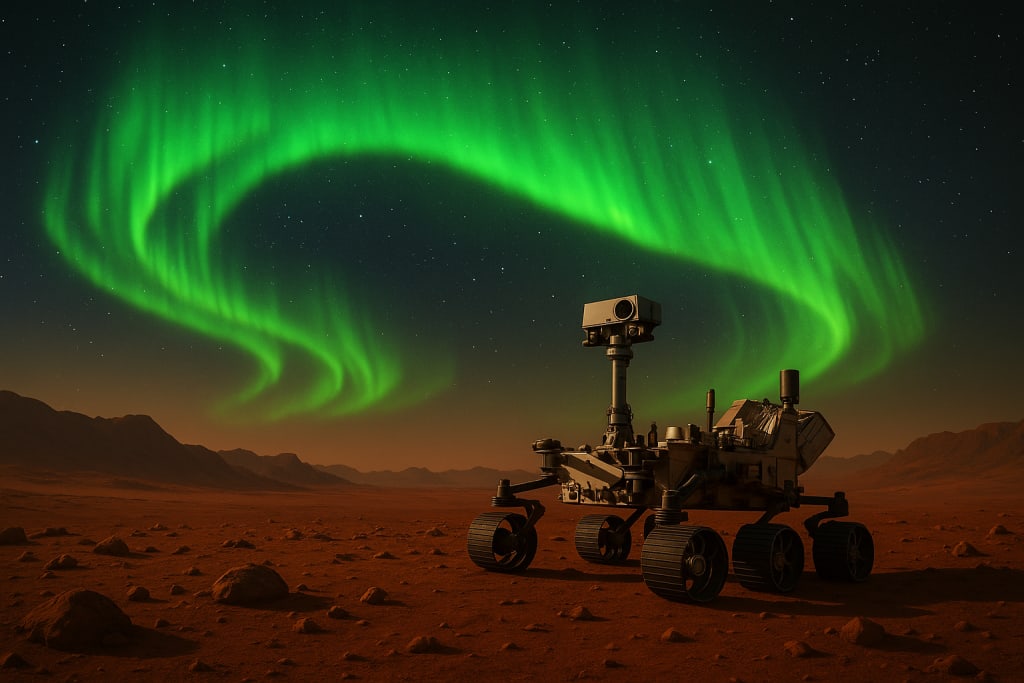
Mars has long fascinated scientists and space enthusiasts alike, with its rusty red landscape and the possibility that life once existed on the planet. Now, NASA’s Perseverance rover has added an incredible new chapter to Mars exploration by capturing the first-ever visible-light auroras on the Red Planet. This remarkable discovery, made on March 18, 2024, after a powerful solar storm, sheds light on the dynamic interactions between Mars’ atmosphere and the Sun’s activity. It opens exciting new opportunities for understanding the Martian environment and preparing for future human missions.
What Are Auroras and Why Are They Important?
Auroras are natural light displays typically seen near the poles of Earth, often called the Northern or Southern Lights. These dazzling lights occur when charged particles emitted by the Sun collide with a planet’s atmosphere and magnetic field, causing the atmosphere to glow. On Earth, auroras are guided by our planet’s global magnetic field toward the polar regions, creating spectacular and structured light shows.
However, Mars is very different. The Red Planet lacks a global magnetic field, having lost it billions of years ago. Instead, it has patches of localized magnetic fields scattered across its crust. As a result, auroras on Mars tend to be more chaotic, diffuse, and widespread. Previously, scientists had only detected Martian auroras in ultraviolet light from orbiting spacecraft, which are invisible to the human eye. The recent observations from Perseverance are the first to reveal auroras in visible light directly from the surface, a historic milestone.
The Solar Storm That Made It Possible
On March 18, 2024, the Sun unleashed a massive solar storm, sending a coronal mass ejection (CME) — a powerful burst of charged particles — hurtling through space. When this CME reached Mars, the charged particles interacted with its thin atmosphere, igniting a faint green glow in the sky. Perseverance’s cameras were perfectly positioned to capture this rare event.
Solar storms like CMEs are common, but their effects on Mars differ from Earth due to its thin atmosphere and lack of a strong magnetic field. This interaction can lead to atmospheric loss and impacts on the planet’s climate and habitability. Studying these events helps scientists better understand how solar activity influences Mars and how it may affect future explorers.
Perseverance’s Cutting-Edge Instruments
The Perseverance rover, which landed on Mars in February 2021, is equipped with advanced instruments designed for geology, atmospheric studies, and even searching for signs of past life. Among these instruments, Mastcam-Z and SuperCam played a critical role in capturing the visible-light aurora.
Mastcam-Z is a sophisticated camera system capable of high-resolution, color imaging and zooming capabilities, while SuperCam can analyze the composition of rocks and the atmosphere using laser and spectrometry techniques. During the solar storm, scientists directed these instruments to look toward the Martian sky, hoping to detect any auroral activity. After several attempts, Perseverance successfully photographed the faint green aurora, confirming predictions made by NASA’s space weather models.
Why This Discovery Matters for Future Mars Missions
Visible-light auroras on Mars are not just a fascinating spectacle — they have practical implications for upcoming human missions to the planet. Understanding how solar particles interact with Mars’ atmosphere helps scientists assess radiation risks that astronauts may face on the surface. Solar storms can expose explorers and equipment to harmful radiation, making accurate forecasting essential for mission safety.
Moreover, these auroras offer a unique window into the planet’s atmospheric composition and dynamics. Monitoring auroral activity could help researchers track changes in Mars’ atmosphere over time and study how solar events influence atmospheric loss. This knowledge is crucial for developing strategies to protect future habitats, electronics, and astronauts on Mars.
What Experts Are Saying
Dr. John Clarke, a leading space physicist involved in the study, explains, “This is a landmark moment in Mars exploration. Seeing visible auroras from the surface confirms that the Martian atmosphere is more dynamic than we imagined. It also means astronauts will be able to witness these stunning light displays in person during intense solar events.”
NASA’s Mars exploration team views this discovery as a stepping stone toward understanding Mars as a complex, evolving world. Each new insight into the planet’s atmosphere brings humanity closer to the goal of establishing a sustainable presence there.
The Bigger Picture: Mars, Solar Activity, and Space Weather
Mars serves as a natural laboratory for studying space weather — the varying conditions in space caused by the Sun’s activity. Since Mars lacks Earth’s protective magnetic shield, it offers scientists a unique perspective on how solar storms impact planetary atmospheres and surfaces.
These insights not only benefit Mars missions but also improve our understanding of how solar activity affects other planets, including Earth. By studying Mars’ auroras and atmospheric responses, scientists gain valuable data for predicting and mitigating space weather hazards in the broader solar system.
Conclusion: A Bright Future for Mars Exploration
NASA’s Perseverance rover’s capture of the first visible-light auroras on Mars marks a monumental achievement in planetary science. This discovery illuminates the complex interactions between the Sun and Mars, providing essential knowledge for future exploration and colonization efforts.
As we prepare to send humans to Mars, understanding phenomena like auroras will help ensure the safety and success of those missions. Beyond the scientific implications, the thought of astronauts witnessing glowing lights dancing across the Martian sky adds a poetic touch to humanity’s quest for discovery.
With each new finding, Mars becomes less a distant world and more a place we can someday call home.
About the Creator
Tech Horizons
Exploring the future of technology, AI, gadgets, and innovations shaping tomorrow. Stay updated with Tech Horizons!
Keep reading
More stories from Tech Horizons and writers in Futurism and other communities.
The Brain’s Inner GPS: How Specialized Neurons Help Predict What Happens Next
In a world filled with constant change and unpredictability, one of the most vital human abilities is prediction. Whether you're catching a ball, reading a sentence, or following the steps of a recipe, your brain is always forecasting what comes next. But what allows the brain to make such fluid predictions, especially in situations it's never encountered before?
By Tech Horizons10 months ago in Futurism
5G Enterprise Market to hit USD 152.7 Billion By 2035
5G Enterprise Market Overview The Global 5G Enterprise Market is projected to reach approximately USD 152.7 Billion by 2035, rising from USD 7.3 Billion in 2025, reflecting a strong CAGR of 35.5% during the forecast period from 2026 to 2035.
By Roberto Crum4 days ago in Futurism
Saudi Arabia Power Rental Market: Infrastructure Projects, Temporary Power Demand & Growth Outlook
According to IMARC Group's latest research publication, Saudi Arabia power rental market size was valued at USD 213.5 Million in 2025. The market is projected to reach USD 351.6 Million by 2034, exhibiting a growth rate (CAGR) of 5.70% during 2026-2034.
By Shubham Sharma 3 days ago in Futurism
My First Time Skiing and I Got Lost, Alone, in the French Alps
Looking back, I can trace some of my life’s biggest adventures to a simple action from my sister. She’d introduced me to Tommy (a very long time ago), a colleague of hers, who had overshared his penchant for Italian-looking women, and I ticked that box.
By Chantal Christie Weiss2 days ago in Humans


Comments
There are no comments for this story
Be the first to respond and start the conversation.