
Nanotechnology-Thinking Big Working Small
What Is Nanotechnology and What Can It Do?


Do you want to discover the great power of small?. You will be amazed to know the incredibly powerful world of Nanotechnology.
What Is Nanotechnology?
Nanotechnology is novel science, engineering, and technology, which manipulates materials at the nanoscale (1-100 nm). Nanotechnology is about looking at the world on such a tiny scale that we can not only see the atoms, but we can fabricate and move those atoms around and create new things.
Nanoscience and nanotechnology are the study and applications of extremely small things and are applicable to all other scientific fields, such as chemistry, biology, physics, materials science, and engineering.
How It Started?

Long before the term "nanotechnology" was coined, on December 29, 1959, physicist Richard Feynman gave a lecture titled
"There's Plenty of Room at the Bottom"
at an American Physical Society meeting held at the California Institute of Technology (CalTech). In his lecture, Feynman described a method through which researchers will be able to control and manipulate individual atoms and molecules.
Professor Norio Taniguchi introduced the term "nanotechnology" more than ten years later while researching ultraprecision machining. Modern nanotechnology didn't start until 1981, with the invention of the scanning tunnelling microscope, which could "see" individual atoms.
Why Does Nanotechnology Matter?
At the nanoscale, materials can exhibit unusual physical, chemical, and biological characteristics. These characteristics could be fundamentally different from those of bulk materials and individual atoms or molecules.
Adding nano components frequently causes significant changes in the bulk characteristics of materials. Nano-sized ceramic or metal particles that are used to make composite materials can unexpectedly become significantly stronger than what is predicted by current materials science models.
For instance, metals with so-called grains that are as much as seven times tougher and harder than their common counterparts with grains that are hundreds of nanometers in size are those with so-called grains that are approximately 10 nanometers.
These abrupt shifts are the result of strange phenomena in the field of quantum physics. Any material's bulk characteristics are essentially the average of all the quantum forces acting on every atom. Eventually, the average stops working as you continue to make things smaller and smaller.
At the nanoscale, materials' characteristics can be different for two basic reasons.
Surface Area
First, compared to the same mass of material generated in a bigger form, nanoparticles have a considerably larger surface area. This may alter the strength or electrical characteristics of the material and increase its chemical reactivity (in certain situations, materials that are inert in their bulk form become reactive when created in their nanoscale form).
Quantum Size Effects
Second, quantum effects can begin to dominate the behavior of matter at the nanoscale – particularly at the lower end – affecting the optical, electrical and magnetic behavior of materials. This effect describes the physics of electron properties in solids with great reductions in particle size.
This effect becomes dominant when the nanometer size range is reached.l.The fascination with nanotechnology originates from these unique quantum and surface phenomena that matter exhibits at the nanoscale.
They improve existing industrial processes, materials and applications in many fields – and allows entirely new ones.
Nanoparticles
The term nanoparticle is a mixture of the words ìnanosî (Greek: dwarf) and ìparticulumî (Latin: particle). Nanoparticles are ultrafine structures with dimensions less than 100 nm. Nanoparticles had been used since long in history. In the fourth- century A. D. Roman glass makers fabricated glass using metallic nanoparticles.

An artifact called the Lycurgus cup placed in the British museum in London belongs to that period. This cup was made by sodalime glass which was stained by silver and gold nanoparticles. The cup changes its color from green to deep red when it is illuminated.

The beautiful colors of the windows of the medieval cathedral churches is because of the presence of different metallic nanoparticles.Although medieval artisans didn’t know they were using it, nanotechnology played a key part in creating stained-glass windows. Medieval stained-glass was created by trapping gold nanoparticles in the 'glass matrix' to create a red colour. Silver nanoparticles, meanwhile, gave it a deep yellow colour.
Why Nanoparticles are Unique?
When the size of the particles is less than 70 nm van der waals force is developed which gives nanoparticles unique features . Gecko can climb the walls and walk on ceilings because of the presence of minute hair much less than 100 nm on their limbs. Because of these very thin hair, adhesion is achieved.

Bulk gold is yellow in color but gold nanoparticles are of blue to wine red colour.Aluminum nanoparticles are extremely reactive when their size is less than 20 nm.
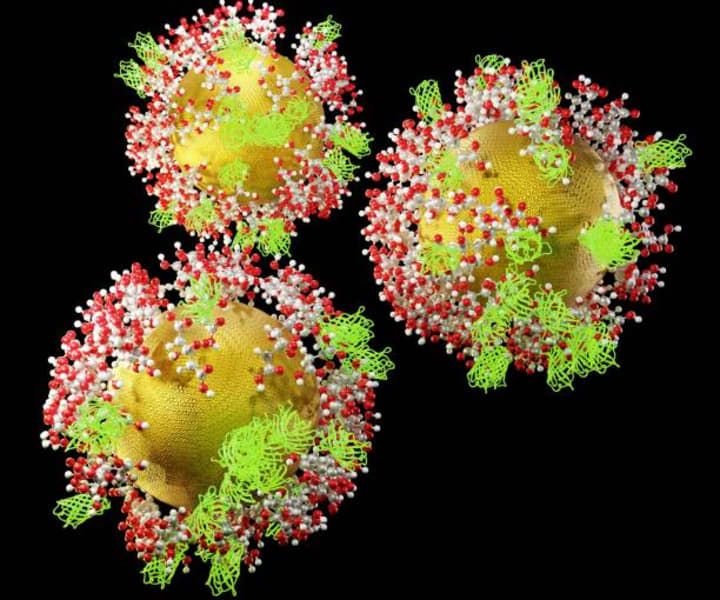
The fascinating aspect of nano is change in properties of particles when they are very small.Because of unique properties nanoparticles have promising applications that will revolutionize the world.
Don’t forget to follow me to read more of my stories.
*********************************************************************
Originally published on medium:https://medium.com/@aishashamim009/nanotechnology-70d7c01f99a1
About the Creator
Aisha Shamim
I am Aisha Shamim, a professional teacher, researcher, and content writer specializing in pets, fitness, and science. My work blends research and creativity to produce engaging, SEO-optimized content.
Keep reading
More stories from Aisha Shamim and writers in Futurism and other communities.
Graphene- A Revolutionary Wonder Material
Graphene- What Is It? There is a new wonder material in a town, its name is Graphene, This miracle material has been sparking the interest of material scientists since its discovery. Graphene is hugely recognized as a “wonder material” due to the myriad of its astonishing properties.
By Aisha Shamim 4 years ago in Futurism
Australia Construction Equipment Market: Infrastructure Growth, Urban Development & Technology Adoption
According to IMARC Group, the Australia construction equipment market reached USD 1.9 Billion in 2024 and is projected to expand to USD 2.4 Billion by 2033, exhibiting a compound annual growth rate (CAGR) of 2.50% during 2025–2033. This steady growth reflects sustained infrastructure expansion and urban development across Australia. Construction equipment—including excavators, loaders, cranes, bulldozers and road-building machinery—plays a critical role in delivering transportation networks, residential housing, commercial developments and mining operations. As Australia invests in modernization and sustainability, demand for advanced and eco-friendly equipment solutions continues to evolve.
By Kevin Cooper6 days ago in Futurism
Bioherbicides Market Outlook: Sustainable Weed Management and Agricultural Growth Opportunities
According to IMARC Group's latest research publication, The global bioherbicides market size reached USD 3.3 Billion in 2025. Looking forward, IMARC Group expects the market to reach USD 8.1 Billion by 2034, exhibiting a growth rate (CAGR) of 10.01% during 2026-2034.
By James Whitman6 days ago in Futurism




Comments
There are no comments for this story
Be the first to respond and start the conversation.