
MUSLIM VEILING: HIJAB, NIQAB, HISTORY AND INTERPRETATIONS OF THE QUR'AN
ISLAM, FEMININE MODESTY AND VEILS 20120510-BurqaBersheba_dress.jpg Burqa in Bersheba Islam teaches feminine modesty, and this is interpreted in different ways, from a women covering every inch of her body and face, to covering her hair and most of her body, to not dressing like a prostitute. “Hejab” (“hijab” , “Islamic Dress”) is a generic term for modest dress worn by Muslim women. The only parts of the body allowed to be exposed are the hands, feet and face. Sometimes “ hijab” is used to describe a scarf that wraps around the head. The hair is covered partly because it is regarded as erotic.
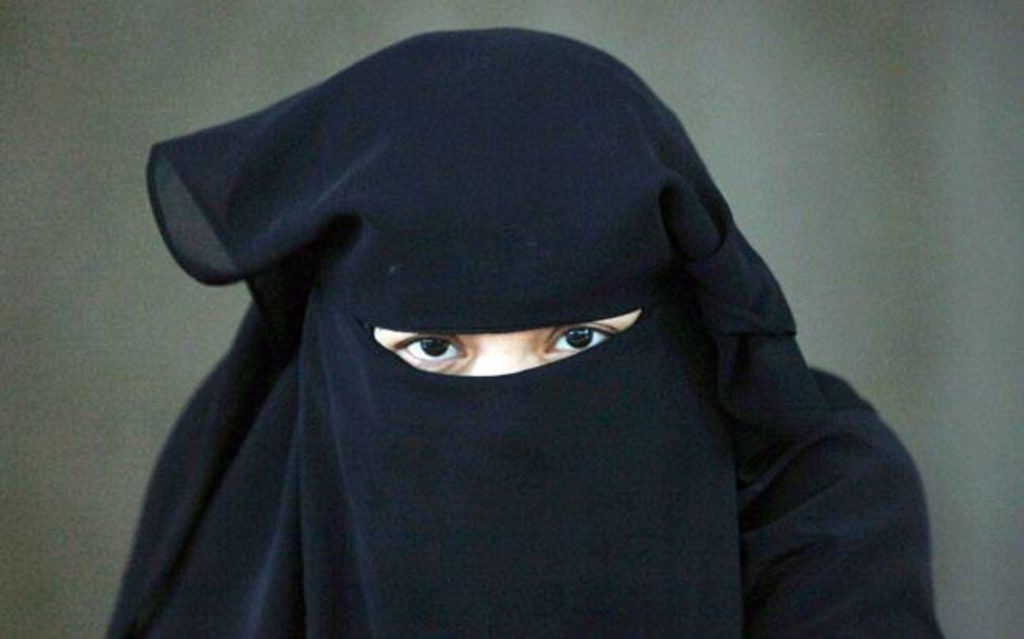
In some Muslim societies women cover all or part of their face with a veil or some other covering. These veils and head coverings scarves go by different names in different places. Girls generally begin wearing them after reaching puberty. Veiling also extends to behavior. Women instinctively cover their faces with their veils or head scarves when they speak. When a man enters a room they are in they instinctively turn away or cover their faces.
In many Muslim societies women are forbidden from exposing their heads, hair, neck and the curves of their body in public. Even in the hottest places women are supposed to wear long sleeves, and long billowing non-transparent skirts and dresses that hide the curves of their body and make even women with the nicest fugues look overweight. Doctors in Iran have linked covering the body to shortages in Vitamin D, usually derived from sunlight, and increases in osteoporosis.
Figure-concealing garments often vary and have different names in different places. The “abaya” or “chador” is cloak that covers a woman from head to toe. It can be combined with separate pieces that covers the face — "nikab” — or a tent-like covering — “burqa”. The jilbab is a loose, dress-like out garment designed to cover the wearer’s clothes.
Cosmetics, jewelry and perfume and anything that makes a woman alluring are also discouraged. One reason women veil themselves is so that they will not tempt men and maintain their chastity and honor and the chastity and honor of the men around them.
Websites and Resources: Islam Islam.com islam.com ; Islamic City islamicity.com ; Islam 101 islam101.net ; Wikipedia article Wikipedia ; Religious Tolerance religioustolerance.org/islam ; BBC article bbc.co.uk/religion/religions/islam ; Patheos Library – Islam patheos.com/Library/Islam ; University of Southern California Compendium of Muslim Texts web.archive.org ; Encyclopædia Britannica article on Islam britannica.com ; Islam at Project Gutenberg gutenberg.org ; Islam from UCB Libraries GovPubs web.archive.org ; Muslims: PBS Frontline documentary pbs.org frontline ; Discover Islam dislam.org
Books: “ Qu’ran and Women” by Amina Wadud, professor of Islamic Studies at Virgina Commonwealth University; “ Standing Alone in Mecca” by Asra Nomani (HarpersSan Francisco); “Women and Gender in Islam” by Leila Ahmed; Nine Parts of Desire: “The Hidden World of Islamic Women” by Geraldine Brooks was read by U.S. President George Bush.
Hijab
Hijab on the left, niqab on the right
Hijab is the principle of modesty in Islam and includes behaviour as well as dress for both males and females. According to the BBC: “Hijab is an Arabic word meaning barrier or partition. In Islam, however, it has a broader meaning... The most visible form of hijab is the head covering that many Muslim women wear. Hijab however goes beyond the head scarf. In one popular school of Islamic thought, hijab refers to the complete covering of everything except the hands, face and feet in long, loose and non see-through garments. A woman who wears hijab is called Muhaajaba. [Source: BBC, September 3, 2009 |::|]
“Muslim women are required to observe the hijab in front of any man they could theoretically marry. This means that hijab is not obligatory in front of the father, brothers, grandfathers, uncles or young children. Hijab does not need to be worn in front of other Muslim women, but there is debate about what can be revealed to non-Muslim women. |::|
“Modesty rules are open to a wide range of interpretations. Some Muslim women wear full-body garments that only expose their eyes. Some cover every part of the body except their face and hands. Some believe only their hair or their cleavage is compulsory to hide, and others do not observe any special dress rules. |::| “In the English speaking world, use of the word hijab has become limited to mean the covering on the head of Muslim woman. However, this is more accurately called a khimaar. The khimaar is a convenient solution comprising usually one, but sometimes two pieces of cloth, enabling Muslim women to cover their hair, ears and neck while outside the home. |Hijab, in the sense of veiling, can also be achieved by hanging a curtain or placing a screen between women and men to allow them to speak to each other without changing dress. This was more common in the early days of Islam, for the wives of the Prophet Muhammad. |::|
The Qur'an gives these general rules, which may help in understanding how to interpret dress and other rules in modern times. “O ye Children of Adam! We have bestowed raiment upon you to cover your shame, as well as to be an adornment to you. But the raiment of righteousness,- that is the best. Such are among the Signs of Allah, that they may receive admonition!” — Qur’an 7:26 So clothing does not have to be drab: it is all right for both sexes to use clothing to enhance beauty as well as to cover nakedness. The most important thing is to be modest and righteous.
Origin of Veiling
20120510-BurqaAfghan_lady_in_Kabul.jpg
Afghan lady in Kabul There is some debate as to when the custom of Muslim veiling began and where the custom originated . Some conservative Muslims have insisted that veiling was practiced in Muhammad’s time and Muhammad’s wives veiled themselves. There is little evidence of this though. Some say the custom of veiling was adopted by Muslims about three of four generations after Muhammad’s death and is believed to have been copied from the Byzantines or perhaps from India or Persia. Veiling has also been practiced for a long time by Hindus from India, where women seclude and veil themselves through a custom called purdah, which was originally adopted by the upper classes and became a status symbol.
In any case the custom of veiling predates Islam. In antiquity it was a sign of high status. Jewish and Christian women adopted the custom to symbolize a retreat from public life. The Iranian term chador, meaning “tent.” is derived from the personal custom of very wealthy women traveling around in covered sedan chairs. Some people have said the Western custom of brides wearing veils come from Muslim countries. More likely it comes from ancient Greece. The veiling and segregation of women was common practice among women in ancient Greece, Rome and Byzantium.
“When the Qur'an first mentioned the concept of hijab, it was not as a veil or headscarf. Hijab was used in the context of a barrier or screen as in this Qur'anic verse: ‘(...) And when ye ask (the Prophet's wives) for anything ye want, ask them from before a screen: that makes for greater purity for your hearts and for theirs.’ — Qur’an 33:53
“Taken in historical context, this verse seems to have been primarily intended to give the Prophet's wives some protection against nuisance visitors and people who were looking for gossip about them. Gossip and slander were a great concern at the time the verses relating to hijab were revealed. One set of verses (24:1 onwards) came immediately after the Prophet's wife Aisha was accused and acquitted of adultery.
History of Veiling
In the old days veiling was more common in the cities than in villages, presumably because city women were more likely to be secluded and pampered than rural women who needed to work in the fields and veiling and covering themselves made such work more difficult. In the cities it seems that women often were the ones that demanded they be veiled as a means of escaping harassment and showing their status.
Lynn Reese wrote in “Women in the Muslim World,” “Muslims in their first century at first were relaxed about female dress. When the son of a prominent companion of the Prophet asked his wife Aisha bint Talha to veil her face, she answered, "Since the Almighty hath put on me the stamp of beauty, it is my wish that the public should view the beauty and thereby recognized His grace unto them. On no account, therefore, will I veil myself." “As Islam reached other lands, regional practices, including the covering of the faces of women, were adopted by the early Muslims. Yet it was only in the second Islamic century that the face veil became common, first used among the powerful and rich as a status symbol. [Source:“Women in the Muslim World,” ed. Lynn Reese, 1998]
20120510-BurqaUS_Army_Afghanistan.jpg
Burqa in Afghanistan Various forms of veiling and head covering was the norm throughout the Muslim world until social customs began liberalizing under European rule and the nationalist movements in the 20th century. In 1934, Turkey under Mustafa Kemal Ataturk, became the first Muslim country to ban the veil in his attempt to modernize his country. In 1936 in Iran, Reza Shah Pahlavi ordered the mass unveiling of women and ordered police to literally tear the veils off women on the streets. Although some women welcomed the changes other were adamantly against it, staging sit ins and protests and refusing to leave their homes until eventually the ban being rescinded in 1941.
Still in the 1960s and 1970s veiling was not widely practiced by urban women in places like Iraq, Iran, Lebanon, Egypt and the Palestinian territories. The custom made a come back with the revival of Islamic sentiments after the Iranian Revolution in 1979 and the Intafadeh in the Palestinian territories in the 1990s and was embraced more strongly when anti-Western sentiments grew after the invasion of Iraq in 2003.
A women in Florida was denied a driver’s license because she refused to be a photographed without her face veiled. After the attack on the World Trade Center in New York on September 11, 2001 she was told had to have her photograph taken without a veil or the licence would be revoked. Instead of complying she sued on the basis of freedom of religion.
About the Creator
About Binding Prometheus
I want to start actively advocating on behalf of my own work, and the most valuable part of my canon is, without a doubt, Binding Prometheus, the play I have been working on since 2019 and only finished in 2023 as part of my MA. The play itself is an amalgamation of a million different inspirations. On one end, it evokes the Ancient Greek myth-play, deriving its own title from the earliest extant work of Western drama we have, Aeschylus’s Prometheus Bound. On the other end, it borrows significantly from the sci-fi bulwarks from over the years, namely Mary Shelley’s Frankenstein and Karel Capek’s Rossum’s Universal Robots. The play could be an episode of Black Mirror, I fear. I don’t know. I’ve only ever seen one episode of Black Mirror.
By Steven Christopher McKnight11 days ago in Futurism
Test Preparation Market Outlook: Trends, Growth & Demand
📊 Test Preparation Market Overview The global test preparation market encompasses a wide range of services and solutions designed to help learners prepare for academic, professional, and language proficiency exams. These include standardized tests like SAT, ACT, GRE, GMAT, TOEFL, and IELTS, as well as certification and licensing assessments across industries. Traditionally dominated by in-person coaching and printed study materials, the market has shifted significantly toward online delivery, mobile apps, and technology-enhanced instruction. Digital platforms now account for a growing share of user engagement due to flexibility, convenience, and scalable access to resources.
By James Smith3 days ago in Futurism
If You Love Me, You'll Do It
I met Jason when I was five years old. I could say that I loved him from the moment I saw him. He was so handsome to me and I felt in awe by his presence. When they introduced him as the new kid in school, I wanted to be his friend right away. I remember it like it was yesterday. I remember his smile and how he didn't seem shy. He appeared confident and ready to learn. I waved at him and said "hello," before anyone else could even say a word. He sat next to me, and I asked him if he wanted to be friends. He looked so happy as he said, "Yes!"
By Sidney Smith (Sid Smith)6 days ago in Fiction


Comments
There are no comments for this story
Be the first to respond and start the conversation.