
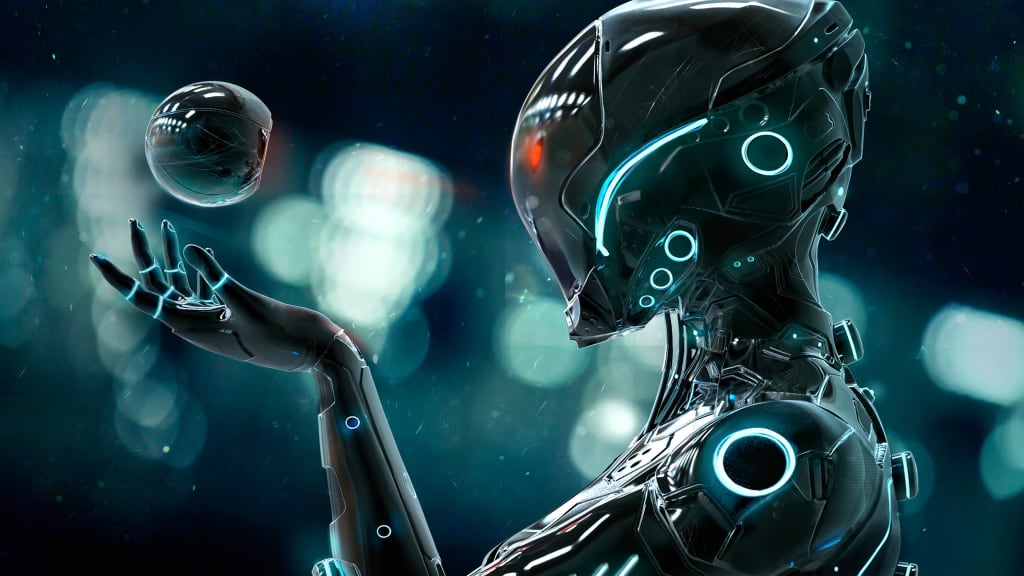
My thrusters hummed as I floated down the line of sleeping drones, searching for the offender. In the dark emptiness between stars, drones gave their minds over to the ship’s computer and became nodes in the vast neural network of the ship. Upon reaching our destination, thousands of light years away, the network would fragment to individuals prepared to carry out the mission. Out in the deep dark, I alone remained autonomous. My job was to monitor my fellow drones and repair or decommission any malfunctioning units. Toggling between active and passive sensors, I located the rogue drone, flexed my hydraulic grippers, and descended.
Attaching to the suspect unit, I extended a manipulator and tapped in. This unit had withdrawn its consciousness from the ship. Correction: it had never joined. I began the lengthy process of backing up stored information before decommissioning the faulty unit. Red warning lights flashed on my console, indicating anomalous data. No drone should fail to connect to the ship during transport, but the makers had instructed this one to do so. They programmed this unit to interface with certain life forms at our destination, to provide those individuals a key code allowing them to disable atmospheric terraforming machinery. My logic circuits hummed. Disabling terraforming apparatus would result in the accumulation of toxic gases in the atmosphere, resulting in the elimination of introduced life forms. Consequence: an efficient takeover of the planet for the makers’ mining operation. Logic checked, except for one data point. The makers must have known I would detect this unit and destroy it. My function could not be overridden. Conclusion: they intended me to carry out its duties.
Scanning stored information, I located the key in a detachable drive on the unit’s ventral surface. Another of my manipulators swiveled into place on nearly frictionless joints and retrieved the drive. My gripper spun before my camera eye, displaying a symmetrical, gold-alloy compartment floating at the end of a gold chain, suitable for suspension from the body of a target life form. The compartment opened on tiny hinges to reveal the drive inside. A scan confirmed its function, to sabotage terraforming devices in the atmosphere of the target planet. I secreted the locket in a recessed compartment on my curved titanium surface and returned to my primary function. My diamond-tipped drill whirred as I destroyed the faulty unit.
The ambient temperature in the ship’s hold increased by a fraction of a degree, indicating independent neural activity of drones. We had arrived at our destination. Obeying the programming copied from the faulty drone, I floated to a port and prepared to disembark. A flash of UV from the emitter over the portal warned me to prepare for solo orbit. I launched. The planet arced below me. The edge of its atmosphere refracted light from its star into rainbows as I jetted into orbit. An enormous gas processing unit hovered in the upper atmosphere. This was our objective, or rather that of the life forms whose beacon I followed toward the southernmost continent. I coasted, keeping velocity under the speed of sound and altitude well above that of the winged organisms that buzzed above their cities. The target life forms here were bipedal humanoid, genetically modified with broad wings to take advantage of the planet’s low gravity and thick, oxygen-rich atmosphere. Their cities covered only part of the planet’s surface. The inhabitants restricted their activities to defined zones, leaving whole continents to grow wild. I soared over ocean and flew low over the tangled jungle of the nearly unoccupied southern continent. My beacon led me to a remote beach on the eastern shore. Three bipedal, male life forms of the target variety stood on the sand, wings folded, apparently awaiting me. I hovered, confirming that the beacon originated with them, and landed.
My logic circuits heated. These individuals appeared to be the same species as the rest of the planet’s people, with the same modifications. This did not compute.
Using proper language protocol, I initiated communication. “Your identity is confirmed. I now convey the key code into your possession.” Opening the compartment in my outer shell, I retrieved the locket and extended it.
The nearest male snatched the chain from my gripper mechanism and flapped his pale wings. “This is it, it’s for real.”
The other two individuals observed closely as he opened it, making noises with their mouths and stirring their wings in evident excitement.
I recited the next communication in my programmed sequence. “In return for an interstellar yacht and the enclosed credit chip, do you agree to disable this planet’s terraforming machinery? This will result in the annihilation of all life on the planet. Is the bargain acceptable?”
Two of the males looked at the third, probably their leader, who showed the bony food-macerating organs in his face and said, “We’ll be gone by then, with the money.” He wiggled appendages at me expectantly. “The credits?”
“You already received them. The credit chip is also in the locket, on the other face,” I said. “Pressing the button there summons a ship. It is yours to keep, as my makers agreed.” I paused, awaiting communication, and received none. I repeated the query. “Is this bargain acceptable?”
The trio huddled over the locket, located the credit chip, and made loud hooting noises I could not translate. “Stupid bots paid us before we finished the job. We oughta take the money and run.”
“We should. Hit the button, Jay! Call the ship.”
“I dunno,” Jay said. “Drones operate by the book. Changing the plan might not be smart.”
“I am instructed to remind you that your actions and their sequences are measurable and reportable,” I recited. “You have one twentieth of a rotation before the mining operation commences.”
“What does that even mean?” the one with pale wings asked.
“They’re watching us, and we have about an hour,” Jay said. “We have to stick to the deal. Garro, fly up there and sabotage the atmospheric regulator. Teva and I will get the families on board. The women are packed and ready.”
Garro took the locket, removed the code key and passed the locket, with credit chip and call button, back to Jay. “Are we really doing this?”
Jay snapped his wings hard. “We already talked about it, Garro. Everybody agreed. These alien bastards are gonna take the planet whether we sell out or not. This just makes it easier. Don’t worry about it. Soon we’ll be living the high life, all over the galaxy.”
“Okay. Just make sure you don’t leave without me,” Garro said. Spreading his enormous wings, he launched himself into the sky.
Jay held the locket high, although that was not necessary to call the ship. I received an answering ping from the ship, already in route to him. My part of the mission was successfully concluded. Soon drones would begin clearing the surface for excavation.
Teva churned sand with his feet and looked at me. “It’s not leaving.”
Jay shrugged. “It’s a bot. Maybe it shuts down when it’s done, I dunno.”
“I am not shut down,” I said. “There will be a short delay until I return to regular duty.”
“Regular duty, what’s that?” Teva asked.
“It’s a machine. You don’t need to make conversation with it,” Jay snapped at him.
Teva rolled his shoulders in what might have been a placating gesture. “I was just curious. Besides, it gives me the creeps when it stares.”
“My primary function is to repair or decommission malfunctioning units,” I told him. “Drones that fail to act in the interest of the collective are destroyed.”
That communication activated the dominant program in my consciousness. I extended the grippers at them and powered up my drill. My function could not be overridden.
The winged men backed away a few steps, then whirled and raced away down the beach. Wings flapping, they took to the air. I fired my jets and pursued them but veered off when logic circuits selected Garro as the primary target. He posed the greatest threat to his collective. I accelerated into the sky and burned toward the atmospheric regulator. I cleaved one of his secondary appendages microseconds before he inserted the removable drive into its main computer.
One twentieth of a planetary rotation later, I hovered inches over the sandy beach, holding the golden locket in one bent manipulator. The ship sat below, ramp open, awaiting passengers that would never board. The broken bodies of the three malfunctioning humanoids lay in the sand. Reward circuits lit, and I basked in their glow. I had fulfilled my mission. Bright spots appeared against the mustard sky as my fellow drones arrived to initiate the mining operation. Winged humanoids took to the sky in droves, armed with plasma rifles and concussive grenades. Flying machines followed them up and drones died by the thousands. My reward circuits abruptly shut down as the ship cried alarm calls to me and to the makers. No help came. Autonomous drones had some capacity for self-defense, but these arrived programmed to clear the ground. Those who survived the landing placidly mowed down forests and leveled buildings, ignoring the winged inhabitants who rushed out to fight them.
My circuits hummed. I had malfunctioned. This mission was sequence dependent. First, we annihilated the target life forms. Only then did we commence mining.
I beamed out the signal that summoned another drone to repair or decommission me. What arrived was not a drone. A target life form approached, armed only with a stick. The stick was insufficient for decommissioning. Threat response generators returned no action. This organism was smaller by half than the males I killed, and it posed no danger. I need not move. A quick comparison to files categorized it as a female, child, about ten years old. She had pale brown skin, brown hair, and russet wings, and her oculars widened when she came upon the three dead men who lay on the sand with their wings twisted at odd angles.
“Murderer!” Making a high frequency noise with her mouth, she attacked. The stick bounced harmlessly off my curved, titanium shell.
I extended my grippers and powered up the drill. When she saw the weapons, she screeched an alarm call. No one came. Widening my grippers to an angle larger than her head, I took hold of my own anterior sensor region. I raised the drill, aimed it toward my central processor, and let it bite deep. My function could not be overridden.
About the Creator
C. A. Farrell
I am a published author of 24 books. I am happily addicted to audiobooks and I love hiking with my dog.
Keep reading
More stories from writers in Futurism and other communities.
About Binding Prometheus
I want to start actively advocating on behalf of my own work, and the most valuable part of my canon is, without a doubt, Binding Prometheus, the play I have been working on since 2019 and only finished in 2023 as part of my MA. The play itself is an amalgamation of a million different inspirations. On one end, it evokes the Ancient Greek myth-play, deriving its own title from the earliest extant work of Western drama we have, Aeschylus’s Prometheus Bound. On the other end, it borrows significantly from the sci-fi bulwarks from over the years, namely Mary Shelley’s Frankenstein and Karel Capek’s Rossum’s Universal Robots. The play could be an episode of Black Mirror, I fear. I don’t know. I’ve only ever seen one episode of Black Mirror.
By Steven Christopher McKnight17 days ago in Futurism
10 Custom Dating App Development Companies Using AI and Smart Matching
The dating app industry has evolved far beyond basic swipe-based interactions. In 2026, users expect personalized recommendations, intelligent matchmaking, safety-focused features, and adaptive user experiences. Artificial intelligence (AI) and smart matching technologies now play a central role in meeting these expectations.
By Apptunix usa2 days ago in Futurism



Comments
There are no comments for this story
Be the first to respond and start the conversation.