
LNG Bunkering Market: Maritime Decarbonization, Cost Efficiency & Industry Dynamics
How maritime decarbonization pathways, LNG fuel economics, and operational reliability are guiding adoption decisions

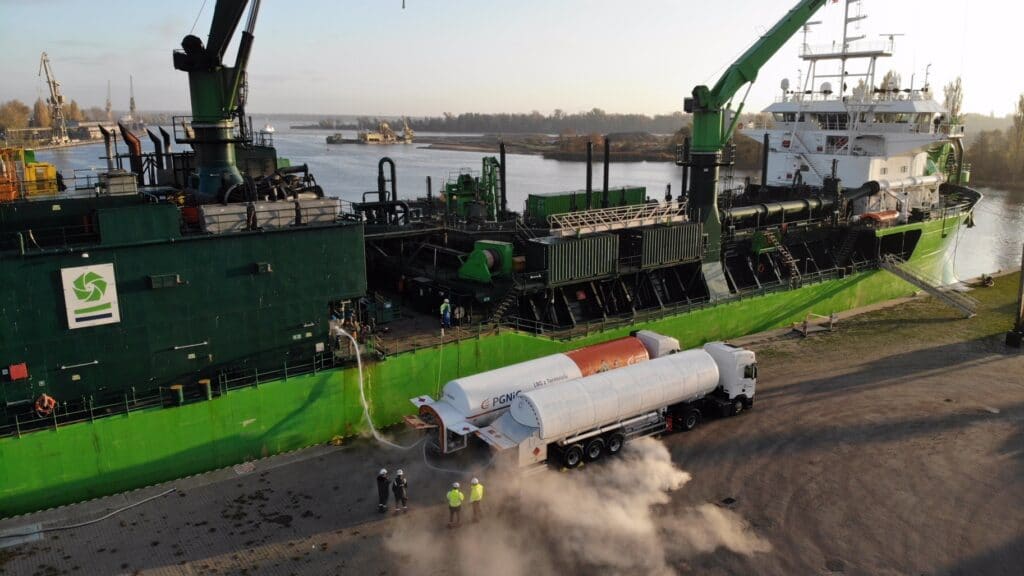
According to IMARC Group's latest research publication, global LNG bunkering market size was valued at USD 3.17 Billion in 2024. Looking forward, IMARC Group expects the market to reach USD 5.71 Billion by 2033, exhibiting a growth rate of 6.40% during 2025-2033.
How AI is Reshaping the Future of LNG Bunkering Market
- AI-Powered Price Forecasting and Demand Optimization: Machine learning systems analyze fuel price trends, route patterns, and consumption data to optimize bunkering schedules. University of Manchester's MarineFuelAI forecasts bunker prices 60 days ahead across global ports.
- Intelligent Port Operations and Berth Management: AI algorithms optimize vessel scheduling and resource allocation at LNG terminals. Vopak&'s partnership with 66 yunlian launched an intelligent dispatch system in February 2025, using genetic algorithms for berth allocation.
- Automated Safety and Compliance Monitoring: AI-powered platforms track vessel compliance and identify operational risks in real-time. Maritime AI systems monitor GPS spoofing, flag changes, and sanction compliance, with over 330 ships affected by spoofing in 2025.
- Predictive Maintenance for Bunkering Vessels: Machine learning analyzes sensor data to predict equipment failures and optimize maintenance schedules. This reduces downtime for LNG bunkering vessels and ensures continuous fuel availability across global shipping routes.

LNG Bunkering Industry Overview:
The LNG bunkering sector is experiencing unprecedented infrastructure expansion as shipowners transition to cleaner marine fuels. The global fleet reached 638 operational LNG-fueled vessels in 2024, representing 33% annual growth, with projections exceeding 1,200 vessels by 2028. Infrastructure development accelerated dramatically, with 198 ports now offering LNG bunkering services and 78 additional facilities under construction. Ship-to-ship bunkering capacity surged as the operational fleet expanded from 52 to 64 dedicated vessels, with total capacity reaching 263,201 cubic meters by March 2025. Major energy companies deployed capital exceeding USD 5 billion in 2024 across terminals, vessels, and distribution networks. Singapore delivered 255,853 tonnes through Q3 2024, while Rotterdam achieved 941,366 cubic meters annually, demonstrating the commercial viability of large-scale LNG bunkering operations.
LNG Bunkering Market Trends & Drivers
Stringent environmental regulations are the primary force driving LNG adoption across maritime transport. The IMO 2020 sulfur cap limiting fuel sulfur content to 0.5% compelled shipowners to seek cleaner alternatives, with LNG delivering 23% greenhouse gas reductions compared to conventional fuels. The U.S. Department of Energy eased LNG bunkering restrictions in March 2025, supporting industry growth as projections indicate over 1,200 LNG-fueled vessels operating by 2028. Container shipping led the transition, with 264 new LNG vessel orders placed in 2024—more than double 2023 figures. The 2024 orderbook includes 310 containerships, 152 car carriers, and 96 tankers, providing clear forward visibility for fuel demand. Dual-fuel vessels accounted for 70% of alternative-fuel tonnage ordered in 2024, up from 43% in 2023, demonstrating confidence in LNG as a compliance pathway through 2039 and beyond with bio-LNG integration.
Strategic partnerships and long-term supply agreements are reshaping the competitive landscape as major energy providers secure market positions. Shell delivered 1.1 million tonnes of marine LNG in 2024 through approximately 1,000 operations across 26 locations in 12 countries, operating 12 dedicated bunkering vessels. TotalEnergies chartered an 18,600-cubic-meter vessel in October 2024 for deployment in Oman's Marsa LNG project, expanding its global fleet to four vessels serving Rotterdam, Marseille, Singapore, and Gulf operations. In July 2025, TotalEnergies and CMA CGM announced a joint venture deploying a 20,000-cubic-meter vessel in Rotterdam by 2028, with TotalEnergies supplying up to 360,000 tonnes annually through 2040. FueLNG's Singapore operations surpassed 500 truck-to-ship transfers while operating three major vessels. These strategic alliances provide supply certainty for shipping operators transitioning dual-fuel fleets, enabling economies of scale in procurement and infrastructure development.
Bio-LNG and synthetic fuel integration is creating a sustainable pathway for long-term decarbonization beyond conventional LNG. Liquefied biomethane bunkering operations expanded to 70 ports globally in 2024, with major suppliers offering mass-balanced bio-LNG certified under ISCC standards. The Rotterdam-Singapore Green and Digital Shipping Corridor completed the first practical biomethane delivery in 2024, marking a milestone for international Green Corridor initiatives. Titan Clean Fuels and MOL completed their first bio-LNG bunkering in March 2025, delivering 900 tonnes of ISCC-certified waste-based fuel to Zeebrugge. FuelEU Maritime regulations taking effect in 2025 favor the LNG pathway, with analysis showing vessels can achieve compliance through 2050 by blending conventional LNG with bio-methane and e-methane. Bio-LNG delivers 67% greenhouse gas emission reductions, while synthetic e-methane achieves 85% reductions compared to conventional fuels, providing shipowners with future-proof solutions for evolving regulatory requirements.
Leading Companies Operating in the Global LNG Bunkering Industry:
- Broadview Energy Solutions B.V.
- Crowley Maritime Corporation
- Gasum Oy
- Harvey Gulf International Marine LLC
- Korea Gas Corporation
- Petroliam Nasional Berhad (PETRONAS)
- Shell plc
- SHV Energy NV (SHV Holdings)
- TotalEnergies SE
- Trelleborg AB
LNG Bunkering Market Report Segmentation:
By Product Type:
- Ship-to-Ship
- Truck-to-Ship
- Port-to-Ship
- Portable Tanks
Ship-to-Ship operations lead the LNG bunkering market in 2024, holding approximately 51.6% share due to their flexibility, efficiency, and the growing number of LNG-fueled vessels.
By Application:
- Cargo Fleet
- Container Fleet
- Tanker Fleet
- Ferries
- Inland Vessels
- Others
The Tanker Fleet dominates the LNG bunkering market with around 23.2% share in 2024, as shipping companies transition to LNG to meet emission standards and enhance operational efficiency on long-haul routes.
Regional Insights:
- North America (United States, Canada)
- Asia Pacific (China, Japan, India, South Korea, Australia, Indonesia, Others)
- Europe (Germany, France, United Kingdom, Italy, Spain, Russia, Others)
- Latin America (Brazil, Mexico, Others)
- Middle East and Africa
Europe holds over 78.6% of the LNG bunkering market in 2024, supported by strong regulatory frameworks, established infrastructure, and significant investments in clean fuel logistics across key ports.
Recent News and Developments in LNG Bunkering Market
- March 2025: Anglo-Eastern launched a cutting-edge LNG Bunkering and Ammonia station skid at its Maritime Academy in Karjat, Mumbai. The facility, inaugurated during the Mumbai Conference, trains seafarers in advanced handling systems for alternative fuels, demonstrating the company's commitment to sustainable shipping and next-generation maritime training.
- March 2025: Titan Clean Fuels and MOL completed their first LNG and bio-LNG bunkering under a new contract, delivering 900 tons to Celeste Ace at Zeebrugge. The operation used ISCC-EU-certified waste-based bio-LNG, marking a significant milestone in sustainable marine fuel supply and validating the commercial viability of bio-based alternatives.
- February 2025: TotalEnergies Marine Fuels completed Asia Pacific's first LNG bunkering for a cruise ship at Singapore Cruise Centre, fueling Silver Nova via Brassavola while maintaining smooth passenger and ship operations. This operation demonstrates the technical feasibility of servicing large passenger vessels with LNG in operational port environments.
- February 2025: Seaspan Energy launched accredited LNG bunkering in Vancouver, following its first operation in Long Beach. The company operates three 112-meter LNG bunkering vessels serving North America's West Coast, with capabilities for global deployment, significantly expanding LNG fuel availability across Pacific shipping routes.
Note: If you require specific details, data, or insights that are not currently included in the scope of this report, we are happy to accommodate your request. As part of our customization service, we will gather and provide the additional information you need, tailored to your specific requirements. Please let us know your exact needs, and we will ensure the report is updated accordingly to meet your expectations.
About the Creator
Andrew Sullivan
Hello, I’m Andrew Sullivan. I have over 9+ years of experience as a market research specialist.
Keep reading
More stories from Andrew Sullivan and writers in Futurism and other communities.
Computer Vision Market: Industrial Automation, Quality Inspection & Growth Dynamics
According to IMARC Group's latest research publication, global computer vision market size reached USD 20.5 Billion in 2024. Looking forward, IMARC Group expects the market to reach USD 34.3 Billion by 2033, exhibiting a growth rate (CAGR) of 5.9% during 2025-2033.
By Andrew Sullivanabout 11 hours ago in Futurism
About Binding Prometheus
I want to start actively advocating on behalf of my own work, and the most valuable part of my canon is, without a doubt, Binding Prometheus, the play I have been working on since 2019 and only finished in 2023 as part of my MA. The play itself is an amalgamation of a million different inspirations. On one end, it evokes the Ancient Greek myth-play, deriving its own title from the earliest extant work of Western drama we have, Aeschylus’s Prometheus Bound. On the other end, it borrows significantly from the sci-fi bulwarks from over the years, namely Mary Shelley’s Frankenstein and Karel Capek’s Rossum’s Universal Robots. The play could be an episode of Black Mirror, I fear. I don’t know. I’ve only ever seen one episode of Black Mirror.
By Steven Christopher McKnight18 days ago in Futurism
Drone Market Outlook 2025–2033: How Unmanned Aerial Systems Are Redefining Industry, Security, and the Digital Economy
Global Drone Market at a Glance The international drone market was estimated at US$ 32.60 billion in 2024 and is projected to expand at a compound annual growth rate (CAGR) of 11.36% from 2025 to 2033, reaching an estimated US$ 85.85 billion by 2033, according to Renub Research.
By jaiklin Fanandish7 days ago in Futurism



Comments
There are no comments for this story
Be the first to respond and start the conversation.