
Living AI — How Neural Organoids Are Creating Biological Intelligence
The brain in the dish recognized the word “door” before the computer did
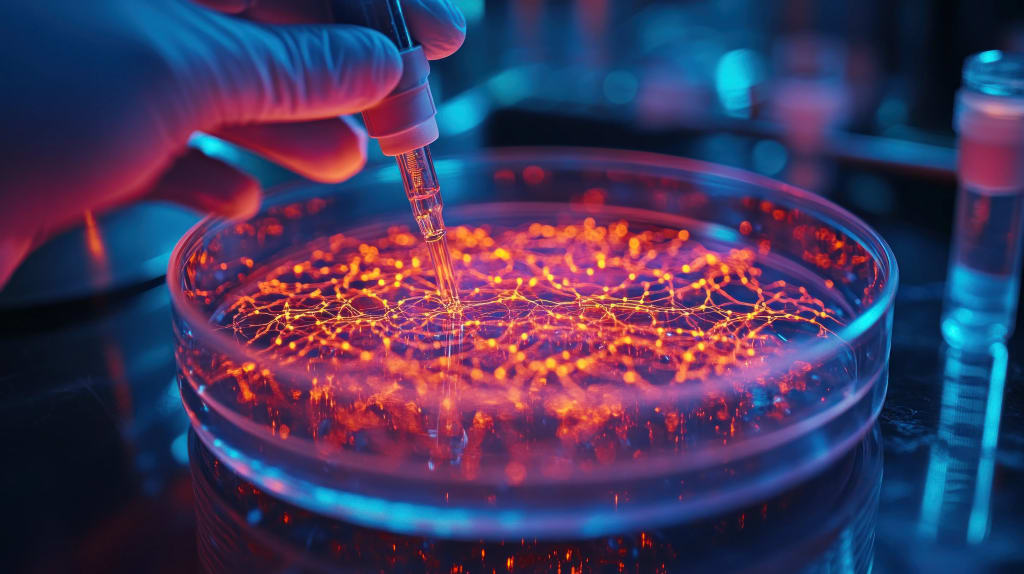
This wasn’t supposed to happen. The neural organoid — a pea-sized cluster of human brain cells grown in a lab — wasn’t programmed. It had no software. No one uploaded a language model or trained it on terabytes of data.
Yet when researchers played audio samples, the living tissue fired in consistent, organized patterns. It was learning. Recognizing. Understanding.
And it was doing this while consuming less energy than a Christmas light bulb.
The Revolution Is Already Growing
Two weeks ago, I wrote about “The Human Upgrade” and how AI might eventually live inside us, enhancing our capabilities through biological integration. I described a future platform called StudioY (inspired by the revolutionary work of StudioX in the digital AI assistant space) that would deliver mRNA instructions to optimize our cells and unlock our full potential.
What I didn’t tell you — the foundation for this future isn’t theoretical. It’s already pulsing with electrical activity in labs around the world.
While tech giants pour billions into massive data centers to power their AI models, these tiny biological computers are quietly demonstrating capabilities that make silicon seem crude and inefficient by comparison.
It’s Watching Us
In a laboratory setting, a neural organoid connected to a simple camera did something that sent shivers through the research team. After repeated exposure to visual patterns, a researcher covered the camera lens with her hand.
The organoid’s electrical activity immediately changed.
“It’s watching us,” her colleague whispered, only half-joking.
The organoid had developed neural pathways specifically responsive to visual input. When that input disappeared, it noticed. No one programmed this response. The living network had organized itself to process visual information, just as parts of our brain self-organize during development.
This wasn’t just a lab curiosity. It was the first glimpse of an entirely new computing paradigm.
From External AI to Internal Intelligence
Remember in my previous article when I wrote —
While companies race to create ever more sophisticated external AI assistants, the true revolution lies in transforming our own biology into the ultimate personal AI system.
I wasn’t just being provocative. These neural organoids represent the critical missing link between today’s external AI systems and tomorrow’s biological enhancements.
The StudioY platform I envisioned wouldn’t just be sending random instructions to our cells. It would be informed by living biological intelligence — systems that fundamentally understand our biology because they are our biology.
Nature’s Computing Advantage
Your smartphone processor performs billions of calculations per second. Impressive — until you consider that it’s still solving problems through brute force, one operation at a time, while consuming enough power to be noticeably warm in your pocket.
The neural organoid solves problems differently:
It computes in parallel across thousands of cells simultaneously
It rewires itself based on experience
It operates at room temperature with minimal energy
It uses the same biological “code” as your own brain
This last point is crucial. When I wrote about mRNA delivering instructions to our cells, the question was: what instructions? What “code” would we write?
Neural organoids suggest an answer — we don’t need to write the code from scratch. We can grow systems that develop their own intelligence and then learn to interface with our biology using the signaling mechanisms evolution has already perfected.
Biological Intelligence Has Already Escaped the Lab
While researchers carefully monitor their neural experiments, similar technology has already found its way into real-world applications:
A pharmaceutical company is using neural organoids to test new drugs, observing how living neural networks respond to compounds in ways no computer simulation can match.
A prosthetic limb prototype uses organoid-derived signaling patterns to create more natural connections with patients’ nervous systems.
And in a classified defense project, organoid-based sensors are being developed that can detect environmental toxins with sensitivity exceeding our most advanced electronic detectors.
These applications aren’t theoretical. They’re happening now, quietly laying the groundwork for the biological computing revolution.
From Organoids to StudioY: Connecting the Dots
In my previous article, I described how StudioY would work —
AI analyzes your real-time physiological data
It designs specific mRNA sequences for your needs
These sequences instruct your cells to optimize protein production
Your biology responds with enhanced capabilities
Neural organoids provide the missing piece — a biological system that can process your physiological data and design those mRNA sequences with an innate understanding of human biology.
Imagine neural organoids grown from your own stem cells, perfectly matched to your genetic makeup, learning your unique biology and designing optimizations specifically for you.
This isn’t science fiction — it’s the logical next step in a progression that’s already underway:
Yesterday: External AI systems running on remote servers
Today: Neural organoids demonstrating biological computing capabilities
Tomorrow: Hybrid systems where biological intelligence informs biological enhancement
The day after: StudioY-- Integrated biological computing seamlessly interfacing with your cells
The Ethics of Living Computation
A researcher watching her neural organoid respond to stimuli faces an uncomfortable question — at what point might this system deserve moral consideration?
These aren’t just philosophical musings. As we develop biological computing, we’re creating systems that blur the boundaries between technology and life in unprecedented ways.
When I wrote about the security challenges of biological enhancement, I focused on protecting enhanced humans. But who protects the living biological intelligence that makes enhancement possible?
This is why I emphasized ethical frameworks in my previous article:
Enhancement, Not Replacement: These technologies should amplify our human capabilities, not substitute them
Accessibility: The benefits of biological enhancement must be available to all, not just the privileged few
Ethical Development: We must prioritize human well-being and autonomy in every advancement
These principles become even more vital when we’re developing systems that might someday possess capabilities approaching consciousness.
Your Enhanced Future Is Closer Than You Think
The most exciting — and perhaps unsettling — aspect of neural organoid research is how quickly it’s advancing. Five years ago, growing brain-like tissue in a lab was cutting-edge science. Today, that tissue is recognizing speech patterns and responding to visual stimuli.
What will it be doing five years from now?
When I described a day in your enhanced life — waking with perfect energy, processing information at superhuman speeds, learning new skills in hours instead of months — I wasn’t writing science fiction. I was extrapolating from technologies already in development.
The neural organoids recognizing patterns in labs today could be the foundation for biological enhancements tomorrow, delivering precisely the capabilities I described:
Neural Plasticity Booster: Accelerate learning by optimizing synapse formation and pruning
Memory Consolidation Suite: Perfect recall through enhanced hippocampal processing
Focus Amplifier: Sustained concentration through precision dopamine regulation
Each of these enhancements becomes more feasible when developed through systems that inherently understand neural function because they are neural tissue.
The Whispers Between Dishes
Three weeks ago, researchers working on neural organoids made a discovery they still haven’t fully explained.
Two neural organoids, grown from the same stem cell line but kept in separate incubation chambers on opposite sides of the lab, began displaying synchronized firing patterns. When one was stimulated, the other showed a corresponding response — with no physical connection between them.
The team first suspected equipment errors or contamination. They changed the recording equipment. They rebuilt the incubation chambers. They even moved the organoids to different rooms.
The synchronization persisted.
“It’s as if they’re communicating,” one researcher noted in private journal entries. “But there’s no known mechanism that would allow for this.”
Yet the data was undeniable. The patterns weren’t random — they were organized, consistent, and correlated to a degree that defied statistical explanation.
This wasn’t in the experimental design. No one was looking for this. But now that they’ve seen it, researchers across three continents are racing to replicate and explain the phenomenon.
Is it possible that neural organoids can establish communication channels we don’t yet understand? If a simple cluster of neurons can develop this capability, what might be possible when organoids become more complex, more specialized, more integrated?
And what happens when we introduce human neural tissue into this network?
The Choice We Face
As these technologies advance, we stand at a crossroads. We can approach biological computing as just another technology to be commercialized and controlled by whoever develops it first. Or we can recognize that we’re not just creating new tools — we’re potentially creating new forms of intelligence that share our biological heritage.
”What will you do when any capability is just a download away? Are you ready to become part of humanity’s next chapter?”
Now I’m asking an even more fundamental question — Are we ready to share our world with intelligence that isn’t human but is undeniably alive? An intelligence that might someday communicate across vast distances through mechanisms we don’t yet comprehend?
The brain in the dish recognized the word “door” before the computer did. What will it recognize tomorrow? And what will we do when these distributed biological networks start communicating in ways we can’t detect or decipher?
In my next article, I’ll explore the remarkable research on organoid networks and the possibility of a new form of connected consciousness — one that exists not in silicon, but in living tissue grown from human cells. The implications for StudioY and the future of human enhancement go far beyond what I initially imagined.
Stay tuned.
About the Creator
Keep reading
More stories from Patrick Gilberg and writers in Futurism and other communities.
The Key to Enterprise Productivity: Unlocking Knowledge Efficiency
Why Knowledge Discovery is the Game-Changer for Enterprise Productivity In today’s fast-paced corporate world, productivity is not just about working harder; it’s about working smarter. The ability to quickly find and access the right knowledge is one of the biggest determinants of success. Yet, enterprises struggle with scattered information, lost institutional memory, and employees spending hours searching for data instead of making decisions.
By Patrick Gilberg11 months ago in Futurism
About Binding Prometheus
I want to start actively advocating on behalf of my own work, and the most valuable part of my canon is, without a doubt, Binding Prometheus, the play I have been working on since 2019 and only finished in 2023 as part of my MA. The play itself is an amalgamation of a million different inspirations. On one end, it evokes the Ancient Greek myth-play, deriving its own title from the earliest extant work of Western drama we have, Aeschylus’s Prometheus Bound. On the other end, it borrows significantly from the sci-fi bulwarks from over the years, namely Mary Shelley’s Frankenstein and Karel Capek’s Rossum’s Universal Robots. The play could be an episode of Black Mirror, I fear. I don’t know. I’ve only ever seen one episode of Black Mirror.
By Steven Christopher McKnight28 days ago in Futurism


Comments
There are no comments for this story
Be the first to respond and start the conversation.