

Keala’ola:
The Path Through Hell for Healing
By Demetra Adams-Kane
“Number 443729. It’s time. Get up.”
The one called 443729 opened her eyes to a dark cell. The guard casting a silhouette in its doorway was the only form she could discern around her. Forgotten upon waking, her dreams abandoned her to a starkness that could only contrast with the soft remnant of feeling left clinging to her eyelashes, a vague nostalgia. Hope seemed to fall from her clothes like dust as she staggered toward the cell door. The only solace that still clung to her as she emerged into the harsh lights of the prison corridor, now remembering herself, was the heart-shaped locket strewn around her sore neck. It was her last possession, and her last grip on her sense of self. She would need that for the task ahead.
By the time she was seated in the dizzyingly tall chair of guilt in the chamber room, a sea of angry faces swimming around her, she was as poised and clear-headed as she had ever been. That was saying a lot for the former CEO of Biotech Innovations Inc. She may not have ever been a good person, she mused, but she had certainly been good at what she did. She was among the 1% for a reason, because she was the best, and she had proved her superiority with every head she had stepped on the get there.
“By your own account,” croaked a council member, “inform us of your part in the counter-revolution.”
She cleared her throat, unafraid. “My name is Keala’ola Medina. I was born in Hawaii on March 18th, 2018, which makes me fifty-two. Fifty years ago, the public didn’t really believe in climate change. There was some talk, and scientists (those who weren’t bought off) predicted catastrophe, but the crash-and-burn trajectory set by the industrial revolution had now accelerated to such speed that no one could stop it, and those who tried were mowed down. Corporate interests were running the country, had completely overtaken the political system, and individuals, who were becoming poorer and harder worked, couldn’t find the unity or the energy to rebel. There was mass denial, and a defeatist sense of complacency manufactured by the mass media which was controlled by those same corporate interests who were behind the-”
“Ms. Medina, I asked you to describe your part in the counter-revolution,” the annoyed tone of the council member sharply cut in.
“Yes, I’m getting to that.” If these idiot revolutionary youths wanted to truly understand how she came to do what she did, they were going to get a history lesson. “My parents, though working class, were self-educated and quite smart. Through their late-night discussions, even in early childhood I picked up a lot about the totalitarian regime whose shadow was slowly creeping over the United States, the culture of mass-surveillance and suppression of free-thinking. Journalists began to be persecuted, as well as intellectuals and political dissidents, in plain sight. When North Korea fired that missile and the Third World War began, the media wasn’t talking about climate change at all anymore. But people like my parents knew the truth. There was no public support for that war, as it was known by everyone to all be a cover for the global fight over dwindling oil reserves. Finally, the people said enough. By this time, I was in my early twenties, had earned my graduate degree in bioengineering, and was working for the world’s top agrochemical and biotech company. You see, I saw the way the world was headed and I didn’t want to end up like my parents, who were still idealistic and poor. I was a realist. If the Titanic was sinking, I was going to be riding out of there on a golden yacht pulled by dolphins, god damn it.”
By this time the audience no longer looked angry, but a little confused. Good, she was breaking them down. Then they’d be disarmed when she got to the gritty part.
“It was mostly people my own age who were behind the revolution, and it was easy enough to get involved just to see what was happening. In fact, my company asked me (well, ok, technically they paid me) to be a spy. As you all know, I was in with the best of them, the top revolutionaries, known then as the Green Guard. They wanted to pretend there was no leadership, but of course there was, and I was a part of it. Our first focus was on decentralization of government and commerce to return the culture to small-scale agriculture on family farms and locally-run government. This wasn’t too difficult considering that the mass infrastructure of commerce had all but collapsed due to the extremely high cost of gasoline, as well as the fact that virtually all citizens professed having zero trust in the government at that point, including what was left of the police and military, so many of whom defected to the Green Guard. The next course of action was to create electrically run mass transit within and connecting these subsistence-based communities. Almost everyone had lost their jobs by the year 2050, and much of the upper-class had absconded to their clean-air-and-water eco-bubbles in New Zealand. We created new jobs, restoring the environment. We also created the completely free education system that trained the youth in true history and environmental science, among other things. Meanwhile, yes, I was still technically working for Biotech Innovations and getting handouts on the side. All I had to do was tell them the insider information of the Green Guard meetings, and this seemed to have little effect whatsoever, as they were powerless to stop the force of resistance of the old, and passion for the new, that had been set in motion. That is, my accounts of our meetings had little effect up until the event you all know about, and why I’m sitting here today.”
Now the room stirred, their silence palpable. She had never been motivated by popularity, but by success. Yet the disdain she sensed growing in that chamber room almost made her confidence falter as she went on.
“By ten years ago in 2060, the population of the United States was pretty much divided in half. Of course, the revolution was occurring worldwide, and of course countries don’t exist anymore, but I’m telling the history of the what the United States used to be. Us, we were about in half. Half the people living in the sustainable agriculture communities established by the Green Guard and their para-military, and half living in cities that had very much devolved into all manner of deprivation and squalor. Now, companies like Biotech Innovations still existed because the city populations still depended on the GMO crops of the corporate agriculture industry for food. There was a huge split in society at this point, where you had one half of society building a new way of life and living off the land in relative peace, and the other half trapped in a system of explicit slave labor to the corporations. Those workers were still very much needed for the production of goods and services used by the wealthy. People like me didn’t know which half was going to win, but we wanted to be on top either way. So, yes, I was playing both sides, but the realist in me was placing more bets on biotech winning over some puny peace-and-love archaic farm communities. And that’s why I did what I did.”
“As you all know, the Free Schools of the Green Guard turned out to be actually effective enough to produce a physicist capable of the re-discovery of free energy. When I met Journey Kaylor, your darling little revolutionary hero, I couldn’t believe that this dread-locked twenty-year-old hippy was the one whose research I was sent to confiscate. She trusted me, or so I believed, because I had been a major player in the Green Guard for years. Hell, I was the founder of permaculture education system! It was not difficult to gain access to her laboratory, and as you know, the rest is history. If the Green Guards hadn’t reprogrammed my own personal assistant droid to spy on me…”
“I don’t regret that it went down the way it did. The Green Guards made a much better world than the Biotech companies ever would have. I was just trying to cover my bases you see, to end up on top. I still contributed a very great deal to your cause! Consider that in your judgment of me. My name, Keala’ola, means the path through hell for healing. I was just trying to survive, but now I see the new way is the only way. It is only through cooperation with the natural world that we can make it. So, I ask of you, forgive me and the previous generations. We were clever, and reckless, and there was hell to pay.”
When she finished speaking to a now hushed courtroom, the one with 443729 tattooed on her forearm looked down at her heart-shaped locket, and opened it. Inside was a picture of her birth daughter, the revolutionary hero of the Green Guard, Journey Kaylor. They had been separated those twenty years before Keala’ola tracked her down and betrayed her work, and there was indeed hell to pay for it now.
“You were right, baby, you were right,” she whispered.
About the Creator
Keep reading
More stories from writers in Futurism and other communities.
About Binding Prometheus
I want to start actively advocating on behalf of my own work, and the most valuable part of my canon is, without a doubt, Binding Prometheus, the play I have been working on since 2019 and only finished in 2023 as part of my MA. The play itself is an amalgamation of a million different inspirations. On one end, it evokes the Ancient Greek myth-play, deriving its own title from the earliest extant work of Western drama we have, Aeschylus’s Prometheus Bound. On the other end, it borrows significantly from the sci-fi bulwarks from over the years, namely Mary Shelley’s Frankenstein and Karel Capek’s Rossum’s Universal Robots. The play could be an episode of Black Mirror, I fear. I don’t know. I’ve only ever seen one episode of Black Mirror.
By Steven Christopher McKnight21 days ago in Futurism
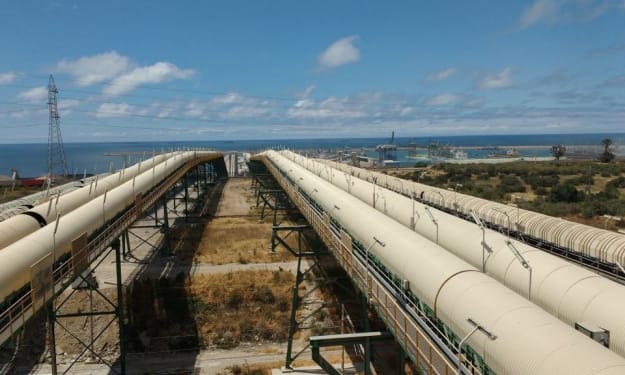
Saudi Arabia Conveyor Belt Market: Mining, Logistics Growth & Technology Advancements
According to IMARC Group's latest research publication, The Saudi Arabia conveyor belt market size was valued at USD 65.66 Million in 2025 and is projected to reach USD 81.31 Million by 2034, growing at a compound annual growth rate of 2.40% from 2026-2034.
By Abhay Rajput3 days ago in Futurism
Center Stage with Paul Stewart
*** I'm keen to republish the interviews I did for my series with Vocal creators. It's been a few years and I thought it might be nice to revisit these wonderful conversations. I'll be releasing them one at a time for a few weeks/months.
By Heather Hubler6 days ago in Interview



Comments
There are no comments for this story
Be the first to respond and start the conversation.