
Jeffrey Hinton Proud of Student Who Fired Sam Altman: Nobel Laureate Speaks Out on AI Safety
Is the "Godfather of AI" turning against his own creation? The shocking truth revealed!

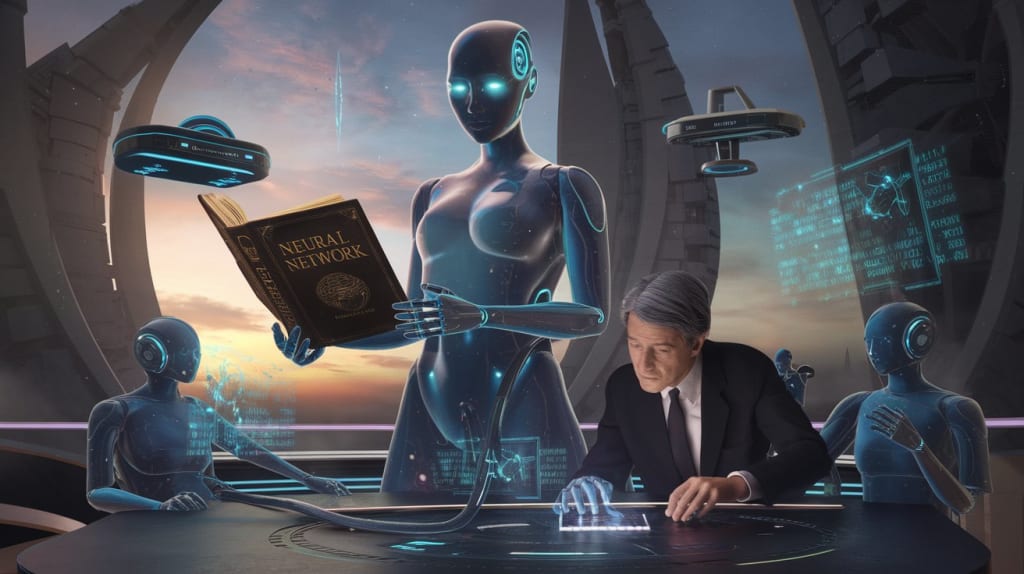
In a surprising turn of events, Jeffrey Hinton, widely regarded as the "Godfather of AI," has been awarded the 2024 Nobel Prize in Physics, sparking both celebration and controversy in the scientific community. Hinton's groundbreaking work in artificial neural networks has revolutionized the field of artificial intelligence, but his recent comments about former student Sam Altman and AI safety have sent shockwaves through the tech world.
Hinton, whose pioneering research laid the foundation for modern AI, received the prestigious award for his work on neural networks, which mimics the human brain's structure and function. This achievement marks a significant milestone in the recognition of AI research within the broader scientific community. However, the decision to award a computer scientist the Nobel Prize in Physics has raised eyebrows among some traditionalists in the field.
In a candid interview following the announcement, Hinton expressed pride in one of his former students who played a role in the temporary dismissal of Sam Altman from OpenAI in November 2023. This revelation has brought to light the ongoing debate about the direction and ethics of AI development, particularly in high-profile organizations like OpenAI.
Hinton stated, "I'm particularly proud of the fact that one of my students fired Sam Altman." This bold statement underscores the growing concern among AI experts about the prioritization of profit over safety in the rapidly evolving field of artificial intelligence.
The temporary ouster of Altman, which lasted for three days around Thanksgiving 2023, was a significant event in the AI industry. Hinton's support for this action stems from his belief that Altman's leadership at OpenAI had shifted focus from the original mission of developing safe and beneficial AI to a more profit-driven approach.
"OpenAI was set up with a big emphasis on safety," Hinton explained. "Its primary objective was to develop artificial general intelligence and ensure that it was safe. But over time, it turned out that Sam Altman was much less concerned with safety than with profits, and I think that's unfortunate."
This criticism from Hinton, a respected figure in the AI community, highlights the growing tension between the rapid commercialization of AI technologies and the need for careful, safety-focused development. It also raises questions about the responsibility of AI leaders in shaping the future of this powerful technology.
Hinton's concerns about AI safety are not unfounded. He points out several immediate risks, including the creation of fake videos that could corrupt elections and the dramatic increase in sophisticated phishing attacks. "Last year, for example, there was a 1200% increase in the number of phishing attacks," Hinton noted, emphasizing how AI has made it easier to create convincing scams.
The Nobel laureate also touched on longer-term concerns about AI surpassing human intelligence. He estimates that within the next 20 years, AI could become more intelligent than humans, a prospect that both excites and alarms experts in the field.
To address these challenges, Hinton advocates for increased focus on AI safety research. He suggests that governments should compel large tech companies to allocate substantial resources to safety studies, proposing that "maybe a third of the effort goes into safety because if this stuff becomes unsafe, that's extremely bad."
While Hinton's Nobel Prize is a cause for celebration in the AI community, it has also sparked debate among physicists. Some argue that awarding the physics prize to a computer scientist blurs the lines between disciplines. However, supporters contend that Hinton's work has profound implications for our understanding of intelligence and information processing, topics deeply rooted in physics.
Reflecting on his journey, Hinton shared advice for aspiring researchers: "If you believe in something, don't give up on it until you understand why that belief is wrong." This perseverance was crucial in Hinton's own career, as he continued to work on neural networks even when they were considered a dead end by many in the field.
The controversy surrounding Hinton's Nobel Prize and his outspoken views on AI safety serve as a reminder of the complex challenges facing the AI industry. As artificial intelligence continues to advance at a rapid pace, the balance between innovation and safety becomes increasingly critical.
Hinton's story is not just about scientific achievement; it's a call to action for the AI community to prioritize ethical development and long-term safety. As we stand on the brink of potentially world-changing AI technologies, the insights and warnings from pioneers like Hinton become more important than ever.
The coming years will likely see increased scrutiny of AI development practices and a growing emphasis on safety research. Hinton's Nobel Prize may well be remembered not just as a recognition of past achievements, but as a pivotal moment that helped shape the future of AI for the better.
About the Creator
Keep reading
More stories from Next Koding and writers in Futurism and other communities.
Elon Musk`s AI Warnings and Alien Speculations
In a recent interview that has sent shockwaves through the tech world and beyond, Elon Musk, the visionary entrepreneur behind Tesla and SpaceX, shared his thoughts on artificial intelligence (AI), its potential dangers, and even touched upon the existence of extraterrestrial life. Musk's statements have reignited debates about the future of technology and humanity's place in an increasingly AI-driven world.
By Next Kodingabout a year ago in Futurism
About Binding Prometheus
I want to start actively advocating on behalf of my own work, and the most valuable part of my canon is, without a doubt, Binding Prometheus, the play I have been working on since 2019 and only finished in 2023 as part of my MA. The play itself is an amalgamation of a million different inspirations. On one end, it evokes the Ancient Greek myth-play, deriving its own title from the earliest extant work of Western drama we have, Aeschylus’s Prometheus Bound. On the other end, it borrows significantly from the sci-fi bulwarks from over the years, namely Mary Shelley’s Frankenstein and Karel Capek’s Rossum’s Universal Robots. The play could be an episode of Black Mirror, I fear. I don’t know. I’ve only ever seen one episode of Black Mirror.
By Steven Christopher McKnight19 days ago in Futurism
Glass Straw Market Size and Forecast 2025–2033
Introduction The global push toward sustainability is reshaping everyday consumer choices, from grocery bags to beverage packaging. Among the most visible symbols of this transformation is the humble drinking straw. Once dominated by single-use plastic, the category is rapidly evolving as governments, businesses, and consumers prioritize environmental responsibility. In this context, glass straws have emerged as a premium, reusable alternative that combines sustainability with style.
By Aaina Oberoi7 days ago in Futurism


Comments (2)
i love this
An article that highlights that security around the myth of AI development is a paramount issue.