

Futurism is a movement that looks towards the future and imagines the possibilities of new technologies and advancements. One area of futurism that has seen significant progress in recent years is the Internet of Things (IoT).
The Internet of Things (IoT) is the network of physical devices, vehicles, home appliances, and other items embedded with electronics, software, sensors, and connectivity which enables these objects to connect and exchange data. These connected devices can be controlled and monitored remotely, and can also share data with other devices and systems.
IoT has the potential to revolutionize various industries and make our lives more convenient and efficient. For example, in the field of healthcare, IoT-enabled devices can help monitor patients remotely and provide real-time health data to doctors and caregivers. In the field of agriculture, IoT-enabled devices can help farmers optimize crop yields and reduce water usage. In the field of transportation, IoT-enabled devices can help improve traffic flow and reduce accidents.
One of the key drivers of IoT growth is the decreasing cost of sensors and other IoT components. As these costs continue to decrease, it is becoming increasingly affordable for companies and individuals to develop and deploy IoT-enabled devices. Additionally, the advent of 5G networks will enable faster data transfer, which will be a key enabler for IoT.
Another important aspect of IoT is the role of artificial intelligence (AI) and machine learning (ML). IoT devices generate a huge amount of data which can be analyzed using AI and ML to discover patterns and insights. This can help improve the performance and efficiency of IoT devices, and also enable new use cases.
The Internet of Things is a rapidly growing area of futurism that has the potential to revolutionize various industries and make our lives more convenient and efficient. With the decreasing cost of sensors and other IoT components, and the advent of 5G networks, the growth of IoT is expected to accelerate in the coming years. The integration of AI and ML with IoT will also bring new opportunities for innovation and discovery.
One instance of an advancement in IoT is the development of smart cities. A smart city is a city that uses IoT technology to improve the quality of life for its citizens, increase efficiency and sustainability, and reduce costs.
Smart cities use IoT-enabled devices such as sensors, cameras, and other connected devices to gather data about the city and its inhabitants. This data is then analyzed using artificial intelligence (AI) and machine learning (ML) to identify patterns and insights. This can help city officials make data-driven decisions to improve the city's infrastructure and services.
One example of a smart city is Songdo, South Korea. Songdo is a planned city that was built on reclaimed land near Incheon International Airport. The city is equipped with a wide range of IoT-enabled devices such as sensors, cameras, and other connected devices. These devices gather data on everything from traffic flow to air quality, which is then used to improve the city's infrastructure and services.
For example, Songdo's transportation system uses real-time traffic data to optimize traffic flow and reduce congestion. The city also has a waste management system that uses IoT-enabled sensors to optimize garbage collection routes and reduce waste.
In addition to improving the city's infrastructure and services, smart cities can also improve the quality of life for citizens. For example, Songdo has a public bike sharing system that uses IoT-enabled bikes and docks to make it easy for citizens to get around the city.
In conclusion, smart cities are an example of an advancement in IoT that has the potential to improve the quality of life for citizens, increase efficiency and sustainability, and reduce costs. The use of IoT-enabled devices, AI & ML in smart cities can provide valuable insights and help city officials make data-driven decisions to improve the city's infrastructure and services.
About the Creator
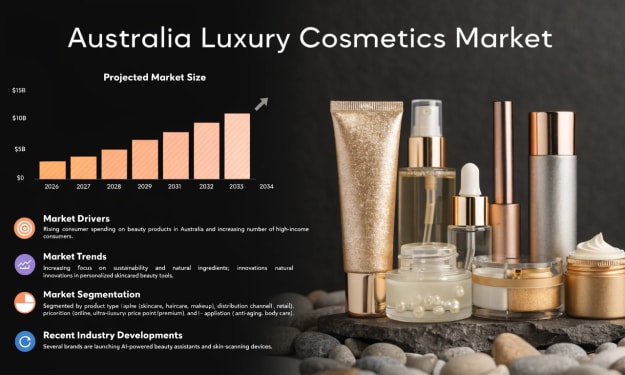
Australia Luxury Cosmetics Market: Premium Demand, Retail Expansion & Brand Innovation
According to IMARC Group, the Australia luxury cosmetics market reached USD 1.6 Billion in 2025 and is projected to grow to USD 2.3 Billion by 2034, exhibiting a compound annual growth rate (CAGR) of 3.92% during 2026–2034. The steady expansion of the market reflects rising disposable incomes, evolving beauty standards, and a growing preference for premium personal care products across Australia. Consumers are increasingly investing in high-end skincare, makeup, and fragrance products that promise quality, performance, and exclusivity. With digital influence reshaping purchasing decisions and sustainability becoming central to brand identity, the Australia luxury cosmetics market share continues to expand within the broader beauty and personal care industry.
By Shrestha Roy5 days ago in Futurism
Review of 'Man on the Run'
My wife and I saw Man on the Run, a nearly 2-hour documentary on Amazon Prime, about Wings, Paul McCartney's group that flew around the world from shortly after The Beatles broke up in early 1970 to shortly after John Lennon was murdered at the end of 1980, making a Beatles reunion forever impossible.
By Paul Levinson7 days ago in Beat



Comments
There are no comments for this story
Be the first to respond and start the conversation.