
Industry 4.0 Market: Smart Factories, Machine Connectivity & Innovation Trends
How smart manufacturing strategies, automation investments, and workforce upskilling are shaping long-term growth in the Industry 4.0 market

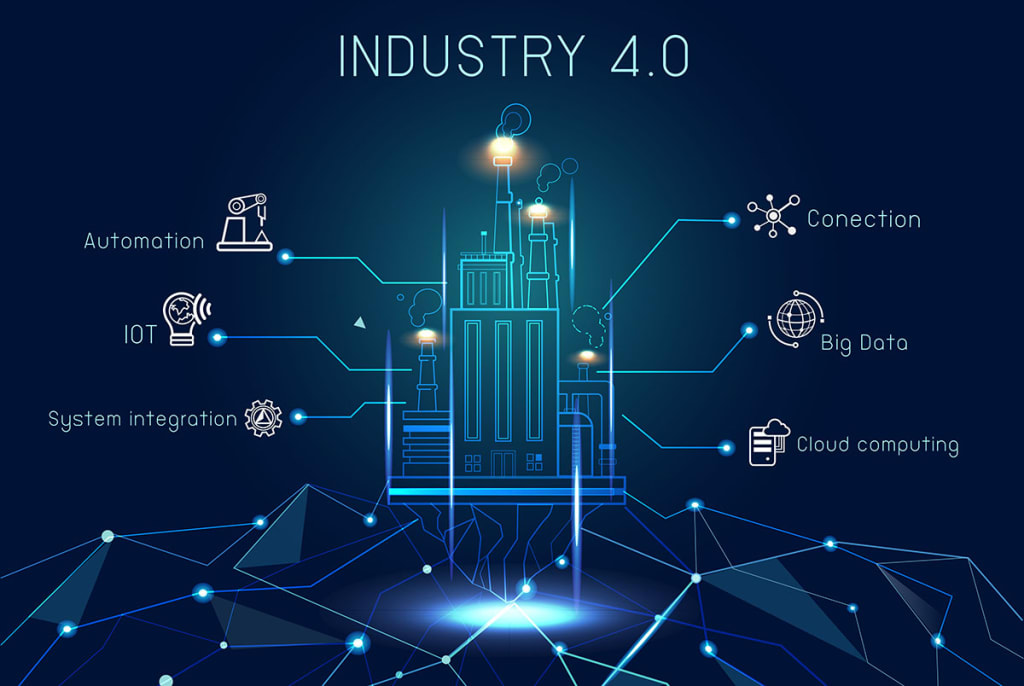
According to IMARC Group's latest research publication, global Industry 4.0 market size reached USD 188.5 Billion in 2025. Looking forward, IMARC Group expects the market to reach USD 599.2 Billion by 2034, exhibiting a growth rate (CAGR) of 13.71% during 2026-2034.
How AI is Reshaping the Future of Industry 4.0 Market
- Predictive Maintenance and Real-Time Analytics: AI-powered predictive systems analyze equipment data to detect potential failures before breakdowns occur, improving operational efficiency by 10-20% and reducing downtime by up to 15%. Manufacturers now use machine learning to optimize maintenance schedules and prevent costly equipment failures.
- Smart Manufacturing and Production Optimization: AI systems continuously analyze production line data to identify inefficiencies and optimize parameters like temperature, humidity, and ventilation. Machine learning algorithms enable self-learning systems that adapt to changing variables, ensuring production runs at peak efficiency while minimizing waste.
- Quality Control Through Computer Vision: Advanced computer vision systems powered by AI perform automated visual inspections at speeds impossible for humans. These systems detect defects, anomalies, and quality variations in real-time, ensuring consistent product quality across manufacturing facilities and reducing the risk of substandard products.
Access a Free Sample of the “Industry 4.0 Market” Research Study
Industry 4.0 Industry Overview:
Manufacturing sectors worldwide are rapidly embracing smart factory technologies as digital transformation reshapes industrial operations. Over 18.8 billion connected IoT devices are currently deployed globally, with projections reaching 25.44 billion by 2030. Enterprises allocated USD 2.5 trillion toward digital transformation in 2024, with automation spending alone hitting USD 232 billion. The number of connected devices in manufacturing surged from 237 million in 2015 to 923 million in 2020, and the Industrial IoT market is expected to reach 21.1 billion devices by 2025. Manufacturing executives overwhelmingly recognize smart factory solutions as competitive drivers, with 92% viewing these technologies as essential for future competitiveness. Germany's Industrie 4.0 initiative leads global efforts with nearly €100 million in government funding, while the U.S. Department of Energy recently announced USD 33 million for smart manufacturing technology advancement supporting the clean energy transition.
Industry 4.0 Market Trends & Drivers
The demand for automation and operational efficiency is transforming how manufacturers approach production. Real-time data analytics enable businesses to make informed decisions, optimize processes, and predict maintenance needs before equipment failures occur. Industrial IoT platforms facilitate seamless data collection from sensors throughout manufacturing plants, capturing variables like temperature, pressure, humidity, and machine performance. This data is transmitted to centralized systems for analysis, allowing operators to detect anomalies, adjust settings remotely, and troubleshoot issues without physical presence particularly valuable in hazardous environments. The U.S. manufacturing sector, representing approximately 11% of GDP, is making significant investments in digitalization to boost competitiveness and cut costs. Artificial intelligence adoption has become a distinct productivity factor, with research showing AI functioning as a separate production input since late 2017. Companies implementing AI-driven systems report improved forecast accuracy, enhanced labor productivity, and significantly reduced downtime through predictive analytics.
Government initiatives and strategic partnerships are accelerating Industry 4.0 adoption across regions. India launched the SAMARTH Udyog Bharat 4.0 initiative to create an ecosystem for Industry 4.0 technology adoption across manufacturing sectors by 2025. The Department of Telecommunications introduced the "Industry 4.0 Baseline Survey" in June 2024 to identify challenges facing micro, small, and medium-sized enterprises and enhance competitiveness amid 5G and 6G developments. China's "Made in China 2025" strategy, supervised by more than 150 scientists and 20 cabinet-level agencies, targets 70% local market share for technology suppliers and 50% reduction in product defect rates. Germany's Platform Industry 4.0, launched with over 350 stakeholders from 150+ companies and associations, promotes technology transfer especially to small and medium-sized businesses. Singapore's RIE2020 Plan committed S$19 billion to research and innovation, while Japan's 5th Science and Technology Basic Plan supports manufacturing advancement. These coordinated efforts provide funding, tax incentives, and collaboration opportunities that enable businesses to integrate advanced technologies.
The convergence of cyber-physical systems, cloud computing, and advanced analytics is creating interconnected manufacturing ecosystems where machines communicate and coordinate seamlessly. This evolution toward "smart manufacturing" involves predictive maintenance, just-in-time production, and mass customization capabilities that align with growing consumer demand for personalized products and shorter lead times. Manufacturers across automotive, aerospace, electronics, and consumer goods sectors are embracing these technologies to gain competitive advantages. Smart sensors and communication equipment serve as the physical backbone of Industry 4.0, operating as the sensory organs of connected factories that gather essential data for analytics and decision-making. The global smart factory market valued at USD 191.6 Billion in 2023 is expected to reach USD 436.4 Billion by 2032. Europe emphasizes sustainability and environmental responsibility through Industry 4.0 adoption, enabling resource-efficient production, waste reduction, and energy optimization that align with carbon emission reduction commitments. Recent initiatives include the European Commission's digital tool for exploring EU-funded carbon capture projects, showcasing how funding supports clean-tech innovation.
Leading Companies Operating in the Industry 4.0 Industry:
- Cisco Systems Inc.
- DENSO Corporation
- Fanuc Corporation
- Hewlett Packard Enterprise Company
- Intel Corporation
- International Business Machines Corporation
- Nvidia Corporation
- Robert Bosch GmbH
- SAP SE
- Schneider Electric SE
- Stratasys Ltd.
- Swisslog Holding AG (Kuka AG)
- Techman Robot Inc. (Quanta Storage Inc.)
Industry 4.0 Market Report Segmentation:
By Component:
- Hardware
- Software
- Services
Hardware leads the market with around 49.8% share in 2024, serving as the physical backbone of Industry 4.0 through devices like industrial robots and sensors that collect real-time data for decision-making.
By Technology Type:
- Industrial Robotics
- Industrial IoT
- AI and ML
- Blockchain
- Extended Reality
- Digital Twin
- 3D Printing
- Others
Industrial IoT dominates with a 27.5% market share in 2024, enabling industries to gather extensive data for optimization and decision-making, with the market predicted to grow significantly by 2032.
By End Use Industry:
- Manufacturing
- Automotive
- Oil and Gas
- Energy and Utilities
- Electronic and Foundry
- Food and Beverages
- Aerospace and Defense
- Others
Manufacturing holds a 31.4% market share in 2024, as manufacturers adopt Industry 4.0 to enhance efficiency, reduce costs, and improve supply chain management through interconnected smart factories.
Regional Insights:
- North America (United States, Canada)
- Asia Pacific (China, Japan, India, South Korea, Australia, Indonesia, Others)
- Europe (Germany, France, United Kingdom, Italy, Spain, Russia, Others)
- Latin America (Brazil, Mexico, Others)
- Middle East and Africa
Europe accounts for over 35.8% of the market in 2024, driven by early adoption of Industry 4.0 technologies and strong government support for digitalization and sustainability initiatives.
Recent News and Developments in Industry 4.0 Market
- December 2025: At SPS 2025, Germany-based Beckhoff Automation reported positive business momentum after a challenging 2024, projecting 7% growth for 2025 to reach €1.25 billion turnover. The company's recovery signals renewed confidence in industrial automation investments across European manufacturing sectors.
- December 2025: ABB completed its acquisition of Gamesa Electric's power electronics business from Siemens Gamesa, strengthening its position in renewable power conversion. The acquired portfolio includes wind converters, industrial battery energy storage systems, and utility-scale solar inverters with annual revenues of approximately €145 million.
- November 2024: Innodisk launched the E1.S edge server SSD tailored for next-generation edge computing and AI applications. With robust thermal management, compact design, and PCIe Gen 5 support, the new solution addresses heat dissipation challenges in high-performance industrial environments with capacities up to 8TB.
Note: If you require specific details, data, or insights that are not currently included in the scope of this report, we are happy to accommodate your request. As part of our customization service, we will gather and provide the additional information you need, tailored to your specific requirements. Please let us know your exact needs, and we will ensure the report is updated accordingly to meet your expectations.
About the Creator
Andrew Sullivan
Hello, I’m Andrew Sullivan. I have over 9+ years of experience as a market research specialist.
Keep reading
More stories from Andrew Sullivan and writers in Futurism and other communities.
Board Games Market: Digital Integration, Hybrid Play Models & Industry Transformation
According to IMARC Group's latest research publication, global board games market size reached USD 18.53 Billion in 2024. Looking forward, IMARC Group expects the market to reach USD 41.63 Billion by 2033, exhibiting a growth rate (CAGR) of 9.32% during 2025-2033.
By Andrew Sullivanabout 17 hours ago in Futurism
About Binding Prometheus
I want to start actively advocating on behalf of my own work, and the most valuable part of my canon is, without a doubt, Binding Prometheus, the play I have been working on since 2019 and only finished in 2023 as part of my MA. The play itself is an amalgamation of a million different inspirations. On one end, it evokes the Ancient Greek myth-play, deriving its own title from the earliest extant work of Western drama we have, Aeschylus’s Prometheus Bound. On the other end, it borrows significantly from the sci-fi bulwarks from over the years, namely Mary Shelley’s Frankenstein and Karel Capek’s Rossum’s Universal Robots. The play could be an episode of Black Mirror, I fear. I don’t know. I’ve only ever seen one episode of Black Mirror.
By Steven Christopher McKnight19 days ago in Futurism
Saudi Arabia PCB Components Market Expanding Electronics Manufacturing and Industrial Demand
According to IMARC Group's latest research publication, Saudi Arabia PCB components market size reached USD 289.7 Million in 2025. The market is projected to reach USD 720.8 Million by 2034, exhibiting a growth rate (CAGR) of 10.66% during 2026-2034.
By Suhaira Yusuf5 days ago in Futurism
Smart phones, Humans and Aliens.
WARNING. I will be tapping into one of your favorite creative tensions: The absurdity of humans worshipping their glowing rectangles as if they were tiny oracles. There’s something deliciously poetic about that contradiction, and it lends itself beautifully to an instructive proviso.
By Novel Allen4 days ago in Poets




Comments
There are no comments for this story
Be the first to respond and start the conversation.