
Indoor Farming Market: Rising Food Security Concerns, Innovation & Commercial Expansion
How controlled-environment agriculture, urbanization, and sustainability goals are driving demand and reshaping competitive strategies

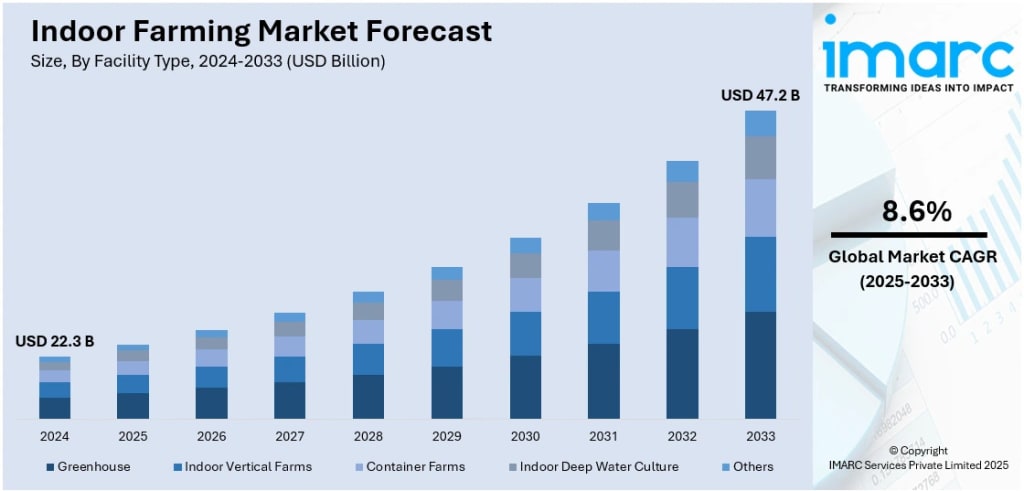
Driven by urbanization, limited arable land, climate uncertainty, and demand for year-round crop production, indoor farming benefits from technological advances, resource efficiency, and rising food security priorities. According to IMARC Group's latest research publication, global indoor farming market size reached USD 22.3 Billion in 2024. Looking forward, IMARC Group expects the market to reach USD 47.2 Billion by 2033, exhibiting a growth rate of 8.6% during 2025-2033.
How AI is Reshaping the Future of Indoor Farming Market
- Energy Optimization Through AI Control Systems: AI systems reduce indoor farming energy consumption by 25% by optimizing lighting and climate controls, cutting costs from 9.5 to 6.42 kilowatt hours per kilogram of lettuce produced.
- Precision Crop Monitoring and Disease Detection: Computer vision and machine learning detect nutrient deficiencies and pest issues in real-time, enabling early intervention and reducing crop losses across vertical farming operations.
- Automated Resource Management and Yield Forecasting: IoT sensors combined with AI algorithms continuously adjust water, nutrients, and environmental parameters while predicting harvest timing, improving yields by up to 30% in controlled environments.

Download the Free “Indoor Farming Market” Industry Report Sample
Indoor Farming Industry Overview:
North America dominates the indoor farming landscape with 36.9% market share, driven by sustainability priorities and technological leadership. The region benefits from advanced automation adoption, favorable regulatory frameworks like the 2024 California ruling allowing hydroponic organic certification, and strong consumer demand for locally-grown, pesticide-free produce. Energy-efficient LED systems and renewable energy integration are reducing operational costs, while strategic partnerships between vertical farms and major retailers (Walmart with Plenty, major grocers with 80 Acres Farms) secure reliable distribution channels and accelerate mainstream adoption across urban centers.
Indoor Farming Market Trends & Drivers
Climate resilience and food security concerns are accelerating indoor farming adoption globally. Extreme weather events, water scarcity, and declining arable land push governments toward controlled-environment agriculture solutions. Singapore targets 30% local food production by 2030 through vertical farming incentives, while Middle Eastern nations invest heavily in climate-controlled facilities. Indoor systems use 90% less water than traditional farming and enable year-round production regardless of external conditions. The 2025 USDA Regenerative Agriculture Pilot allocated $700 million for sustainable farming transitions, creating additional momentum for innovative growing methods including indoor agriculture across water-stressed regions.
Consolidation and operational efficiency define current market dynamics as the sector matures beyond early growth phases. After investment peaked at $2.8 billion in 2022, funding dropped 75% to $680 million in 2023, forcing industry consolidation. The 2025 merger between 80 Acres Farms and Soli Organic now serves over 17,000 retail locations, demonstrating economies of scale. Companies prioritize automation, LED efficiency, and renewable energy over rapid expansion. BrightFarms opened three new facilities making parent Cox Farms the largest U.S. greenhouse operator surpassing 700 acres, while strategic partnerships replaced standalone growth as 50 collaborative agreements were recorded in 2025 focused on product integration and shared technology development.
Premium crop diversification and high-value production expand beyond traditional leafy greens. Vertical farms increasingly cultivate strawberries, herbs, specialty vegetables, and even vanilla to improve unit economics and profitability. Plenty's $680 million GCC partnership launches vertical strawberry production targeting 2 million kg annually in Abu Dhabi, while greenhouse operators grow tomatoes, cucumbers, and peppers year-round. Oishii's $150 million funding round at $615 million valuation demonstrates investor confidence in premium berry production. Consumer willingness to pay 9.7% more for sustainably-produced goods supports premium pricing strategies, while retailers stock CEA-grown products across all 50 U.S. states through partnerships with Gotham Greens and Little Leaf Farms.
Leading Companies Operating in the Global Indoor Farming Market Industry:
- AeroFarms
- Autogrow
- BrightFarms
- Certhon
- Freight Farms, Inc
- Fujian Sananbio Technology Co., Ltd
- iFarm
- Logiqs B.V.
- Plenty Unlimited, Inc.
- Sky Greens Canada
- Urban Crop Solutions
- Vertical Growth
- Voeks Inc.
Indoor Farming Market Report Segmentation:
Analysis by Facility Type:
- Greenhouse
- Indoor Vertical Farms
- Container Farms
- Indoor Deep Water Culture
- Others
Greenhouses lead the market in 2024 with 47.0% share, offering controlled environments for year-round cultivation, energy efficiency, and sustainability.
By Crop Type:
- Fruits, Vegetables and Herbs
- Lettuce
- Spinach
- Kale
- Tomato
- Herbs
- Bell and Chilli Peppers
- Strawberry
- Cucumber
- Others
- Flowers and Ornamentals
- Annuals
- Perennials
- Ornamentals
- Others
Fruits, vegetables, and herbs dominate with 96.5% market share, benefiting from controlled conditions that ensure year-round availability of fresh produce.
By Component:
- Hardware
- Structure
- LED Lights
- HVAC
- Climate Control System
- Irrigation Systems
- Others
- Software
- Web-based
- Cloud-based
Hardware accounts for 89.2% of the market share, encompassing essential infrastructure like structures, LED lights, HVAC systems, and irrigation systems for optimal growing conditions.
Analysis by Growing System:
- Aeroponics
- Hydroponics
- Aquaponics
- Soil-based
- Hybrid
Soil-based systems hold 41.6% market share, favoring traditional methods that utilize natural soil, appealing to growers seeking organic and chemical-free produce.
Regional Insights:
- North America (United States, Canada)
- Asia Pacific (China, Japan, India, South Korea, Australia, Indonesia, Others)
- Europe (Germany, France, United Kingdom, Italy, Spain, Russia, Others)
- Latin America (Brazil, Mexico, Others)
- Middle East and Africa
North America captures 36.9% of the market share in 2024, driven by growth in indoor farming, particularly in the U.S. and Canada, focusing on sustainability and controlled environment agriculture.
Recent News and Developments in Indoor Farming Market
- August 2025: Intelligent Growth Solutions partnered with Aberdeen-based EPC contractor Modutec to support expansion into the UAE market, strengthening the company's presence in Middle Eastern controlled-environment agriculture projects and demonstrating continued international growth momentum.
- March 2025: 80 Acres Farms completed its merger with Soli Organic, creating a combined entity serving over 17,000 retail locations across the United States. This consolidation represents the largest M&A transaction in the vertical farming sector and positions the merged company as a leading indoor agriculture operator.
- December 2024: Plenty and Mawarid announced a $680 million partnership to build multiple indoor farms across the GCC region, starting with a vertical strawberry farm in Abu Dhabi designed to produce 2 million kilograms annually, addressing food security challenges in harsh climate conditions.
Note: If you require specific details, data, or insights that are not currently included in the scope of this report, we are happy to accommodate your request. As part of our customization service, we will gather and provide the additional information you need, tailored to your specific requirements. Please let us know your exact needs, and we will ensure the report is updated accordingly to meet your expectations.
About the Creator
Andrew Sullivan
Hello, I’m Andrew Sullivan. I have over 9+ years of experience as a market research specialist.
Keep reading
More stories from Andrew Sullivan and writers in Futurism and other communities.
Railway System Market: Smart Stations, Passenger Experience & Market Transformation
Driven by infrastructure modernization, government investments, urban transit expansion, rail electrification, digital signaling adoption, and sustainability goals, railway systems are increasingly prioritized for efficient, low-emission mass transportation. According to IMARC Group's latest research publication, global railway system market size reached USD 29.57 Billion in 2024. Looking forward, IMARC Group expects the market to reach USD 41.85 Billion by 2033, exhibiting a growth rate (CAGR) of 3.90% during 2025-2033.
By Andrew Sullivanabout 9 hours ago in Futurism
About Binding Prometheus
I want to start actively advocating on behalf of my own work, and the most valuable part of my canon is, without a doubt, Binding Prometheus, the play I have been working on since 2019 and only finished in 2023 as part of my MA. The play itself is an amalgamation of a million different inspirations. On one end, it evokes the Ancient Greek myth-play, deriving its own title from the earliest extant work of Western drama we have, Aeschylus’s Prometheus Bound. On the other end, it borrows significantly from the sci-fi bulwarks from over the years, namely Mary Shelley’s Frankenstein and Karel Capek’s Rossum’s Universal Robots. The play could be an episode of Black Mirror, I fear. I don’t know. I’ve only ever seen one episode of Black Mirror.
By Steven Christopher McKnight22 days ago in Futurism
Office Supplies Market: Hybrid Work Demand, Smart Stationery & Workplace Productivity Trends
According to IMARC Group's latest research publication, global office supplies market size reached USD 267.56 Billion in 2024. Looking forward, IMARC Group expects the market to reach USD 307.34 Billion by 2033, exhibiting a growth rate (CAGR) of 1.54% during 2025-2033.
By yash mishra3 days ago in Futurism
The Path to Salvation
The late autumn evening air filled the monk's lungs, but it wasn't the season that chilled his bones. The heavy-handed presence of evil he had sensed upon entering the woods surrounding this mountain village had not bothered to conceal itself from him.
By Made in DNAa day ago in Fiction


Comments
There are no comments for this story
Be the first to respond and start the conversation.