
In the future, humans are predicted to be shorter and have less body hair.
Here's the reasoning behind this projection.

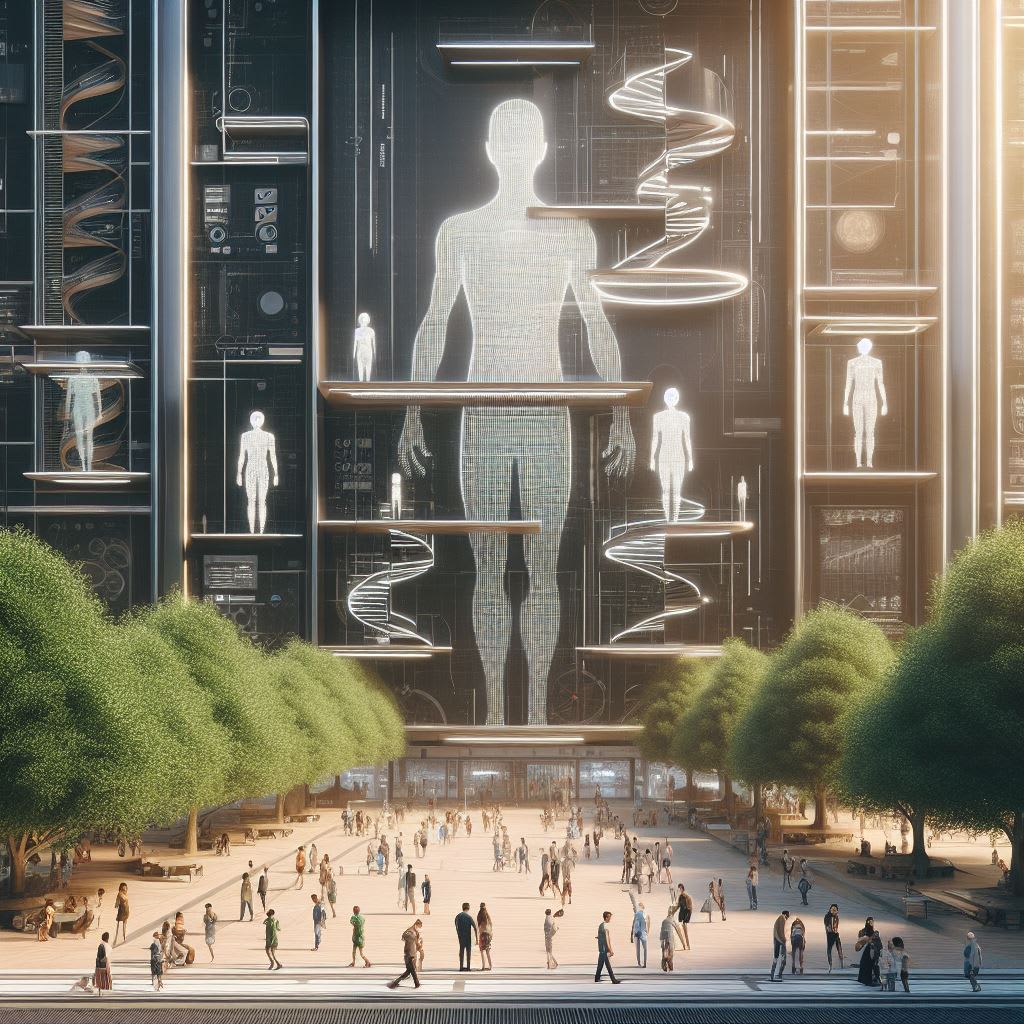
Every species in the world needs to adapt to its environment to survive. Humans are no exception. We haven't been around for a long time. The oldest human skeleton ever found is about 196,000 years old. But in this relatively short time, our species has evolved a lot. Some scientists believe that we have evolved continuously, and some of our genes seem to indicate that. For example, about 6,000 years ago, only infants could drink milk without getting sick. But then humans domesticated animals like cows and goats. This led to a change in people's bodies over the centuries. Today, about one-third of the world's population can drink milk as adults. This ability developed independently in different groups all over the world. Our jaws are also not as large as those of our extinct relatives. They became smaller because our processed food is very different from our ancestors' diet. Our teeth have also decreased in size, and some have even disappeared completely. Many people may never develop third molars, also known as wisdom teeth. For our ancestors, these teeth were crucial. Third molars usually develop when a person is 18 to 25 years old. By that time, most of our ancestors' teeth had worn down. So the third molars were likely replacements. But some slight changes in human anatomy may not be related to evolution. For example, people have generally become taller over the past few hundred years. The most likely reason for this is simply better nutrition and access to modern medical care. What changes await humanity in the future? No one can say for sure, but researchers have interesting theories. One possibility is that we could become shorter as we adapt to life on our overcrowded planet. Studies have shown that smaller people consume less energy and resources than taller people. In the time of hunter-gatherers, people didn't encounter many others in their daily lives. Now people have to adapt to life in densely populated cities. Perhaps, given enough time, our genes will respond to this change and reduce the average height of individuals. Another possibility is that more and more people will look alike. Modern humans travel a lot, and different types of people interact and have children. Our genes are becoming more and more mixed. In the future, this could make some physical traits even more unusual. The average-looking person could have darker skin and hair, and features like freckles or blue eyes could become rare. Some scientists believe that evolution won't play a significant role in the future. Unlike our ancestors, who lived thousands of years ago, we now have a very advanced culture based on cooperation and modern technology. Because of this, we may no longer need to literally fight to survive. Due to this, we might stop evolving as a species and remain essentially the same far into the future. But there is a chance we'll become more advanced and intelligent beings due to technological advancement. The way we solve problems could depend more on our intelligence than our physical abilities. So our brains could expand. It's possible that this is already happening. Some scientists' estimates show that the skulls of Americans are actually getting larger on average. The space for the brain has increased by about the size of a tennis ball. On the other hand, our brains could shrink. This direction of evolution has been around for much longer. Some people believe that the male human brain has been shrinking for the past 20,000 years. If it continues to shrink at the same rate for the next 20,000 years, it will become the same size as the brain of a Homo erectus who lived around 1.8 million years ago. Does this mean we're becoming less intelligent? A larger brain doesn't necessarily mean greater intelligence. We could be evolving to have smaller but more efficient brains. Another theory is that our bodies could learn to use calories from fast food. Items like pizza, fries, and doughnuts contain trans fats, which are difficult for our bodies to process. But what if future humans somehow adapt to this type of food? If we eat it for many years, the same process that occurred with milk could happen. In a few thousand years, people might develop genes that can break down trans fats and extract something beneficial from them, assuming they still enjoy eating hamburgers and French fries. Of course, there is also a chance that humans of the future could have less hair than we do today. Hair was important for our ancestors as it regulated their body temperature, keeping them warm in cold environments and cool in hot conditions. However, some scientists have pointed out that our hair is not as crucial to our survival as it used to be, thanks to modern heating systems and all-weather clothing. Perhaps, given enough time, we will become much less hairy. About 6% of people can rapidly vibrate and shake their eyeballs back and forth. It doesn't mean anything is wrong.
About the Creator
Hilaria K
Let's read and learn about ourselves and the globe around us!
Keep reading
More stories from writers in Futurism and other communities.
About Binding Prometheus
I want to start actively advocating on behalf of my own work, and the most valuable part of my canon is, without a doubt, Binding Prometheus, the play I have been working on since 2019 and only finished in 2023 as part of my MA. The play itself is an amalgamation of a million different inspirations. On one end, it evokes the Ancient Greek myth-play, deriving its own title from the earliest extant work of Western drama we have, Aeschylus’s Prometheus Bound. On the other end, it borrows significantly from the sci-fi bulwarks from over the years, namely Mary Shelley’s Frankenstein and Karel Capek’s Rossum’s Universal Robots. The play could be an episode of Black Mirror, I fear. I don’t know. I’ve only ever seen one episode of Black Mirror.
By Steven Christopher McKnight26 days ago in Futurism
Europe Home Appliance Market Trends & Summary (2025–2033)
Europe Home Appliance Market Outlook The Europe Home Appliance Market is entering a period of steady and technology-driven growth, fueled by changing consumer preferences, sustainability mandates, and rapid innovation across smart home solutions. According to Renub Research, the market is projected to expand from US$ 112.33 billion in 2024 to US$ 147.98 billion by 2033, registering a CAGR of 3.11% from 2025 to 2033.
By Renub Research2 days ago in Futurism
🅼🅸🅳🅽🅸🅶🅷🆃 🆂🅽🅰🅲🅺🆂
"It's 10 in Tuscon! We all know what that means... It's Time for Midnight Snacks with your man, Gerald Gee! Ready to spend the night together? Me too! I'm full of snacks and can't wait to regurgitate them all back into your hungry ears. Crack a brew! Pop some corn! Anything to get ready for one hell of a show where the talk maybe cheap but the words cut deep...
By Lamar Wiggins5 days ago in Fiction


Comments
There are no comments for this story
Be the first to respond and start the conversation.