
How to Build a Domain Layer That Works Across iOS, Android, and Backend?
A practical look at creating a single source of truth so product rules stay consistent no matter where the code runs.

The room felt heavier than it should have for a Tuesday morning. Coffee cups lined the table like timestamps, each one marking another hour spent circling the same issue. Whiteboards covered every wall, layered with half-erased diagrams that no longer matched the code anyone was shipping. I stood near the window, watching traffic move below, while three engineers sat in front of me, each confident in their own implementation and quietly uneasy about everyone else’s.
This was a product built during rapid growth, shaped by parallel teams and tight deadlines connected to mobile app development Orlando. iOS moved quickly. Android followed a different rhythm. Backend services evolved under constant pressure. Every team delivered. Every team fixed real problems. And yet the product no longer spoke with one voice.
They weren’t debating syntax.
They were debating meaning.
When the Same Rule Means Different Things
The Android engineer went first. He explained how eligibility worked on his side. A simple check, he said, shaped by device state and timing. The iOS engineer followed, describing a similar flow, but with slightly different conditions. Then the backend lead opened an endpoint definition that accepted requests neither mobile app fully aligned with.
No one was careless.
No one was wrong.
Still, users slipped through cracks that no one could reproduce consistently.
I asked a simple question.
“What does eligible mean?”
Silence followed. Not because they didn’t know, but because they each knew it differently.
That moment is where most cross-platform systems begin to fracture. When business rules live inside platforms instead of above them, meaning starts to drift. Each environment shapes the rule around its own constraints until the shared truth disappears.
When Platforms Start Owning Decisions
Mobile teams often carry logic because it feels natural. A screen needs to know whether a button is enabled. A flow needs to decide whether to proceed. Backend teams do the same, validating requests and enforcing constraints. Over time, the same rule appears in three places, written three times, adjusted three times, and tested three different ways.
At first, this duplication feels manageable.
Later, it becomes invisible risk.
The problem is not reuse.
The problem is authority.
When platforms own business rules, they begin interpreting them. Small differences creep in. Timing assumptions vary. Edge cases multiply. And the product slowly loses its internal consistency.
When Truth Needs Its Own Home
I erased part of the whiteboard and drew a single box in the center. No screens. No endpoints. Just a boundary.
“This is the domain,” I said. “This part should not care where it runs.”
They leaned forward, watching closely. I explained that a domain layer is not a library of helpers. It is a representation of the product’s rules. It defines what is allowed, what is not, and why. It does not render UI. It does not handle requests. It simply describes reality.
The backend lead nodded slowly.
“So this decides eligibility, not the API?”
“Yes,” I said. “And not the screen either.”
That distinction mattered. The domain does not belong to any platform. Platforms depend on it.
When Building Once Is Not the Goal
One engineer asked the question I expected.
“Are we trying to share the same code everywhere?”
I shook my head. “Not necessarily. We’re trying to share the same meaning.”
A domain layer does not need to be written once and copied everywhere. It needs to be defined once and respected everywhere. Sometimes that means shared code. Sometimes it means parallel implementations guided by the same model and rules.
What matters is that the logic behaves the same way regardless of where it runs.
When the Domain Becomes a Reference Point
We started by writing the rules in plain language. Not code. Sentences. Conditions. Outcomes. We described what the product believed to be true. What qualified as valid. What disqualified a request. What state transitions were allowed.
Only after that did we talk about implementation.
The iOS engineer saw immediately how much logic could leave the UI. The Android engineer realized how many checks no longer needed to live in view models. The backend lead recognized which validations could defer to a shared understanding instead of reinterpreting intent.
For the first time, they weren’t aligning code.
They were aligning reality.
When Platforms Learn to Ask Instead of Decide
As the domain took shape, something subtle changed in how the teams spoke. Screens stopped deciding whether actions were allowed. They asked the domain. APIs stopped interpreting requests. They delegated.
This shift reduced tension in unexpected ways. Engineers no longer debated edge cases in three places. The domain defined them once. When behavior needed to change, there was a single conversation, not three parallel ones.
One Android engineer smiled and said, “It feels like we stopped arguing with each other.”
That happens when truth stops moving.
When Testing Finally Makes Sense
Another benefit appeared quietly. Testing became clearer. Domain rules could be verified without booting an app or hitting a server. Scenarios could be explored without UI state or network timing.
Tests stopped proving that code ran.
They started proving that behavior matched intent.
The backend team noticed fewer inconsistent requests. Mobile teams noticed fewer surprises during integration. Users noticed fewer moments where the app behaved differently depending on platform.
No one celebrated. Things simply felt calmer.
When the Domain Protects the Product
Over time, the domain layer became the place new features began. Not in a screen. Not in an endpoint. In a conversation about rules. This slowed nothing down. It removed rework.
Product discussions became clearer. Engineers could explain why something was allowed or not without referencing platform-specific details. Decisions felt grounded.
One product manager said something I still remember.
“It feels like the product finally knows itself.”
That sentence captured the entire effort.
When Growth Stops Creating Drift
As the system evolved, new features arrived without bending existing behavior. The domain absorbed change by design. Platforms adapted without reinterpreting meaning. The backend enforced rules without guessing intent.
The product grew, but its core remained stable.
This is what a shared domain layer offers. Not speed. Not reuse. Stability of meaning.
Quiet Ending in the War Room
By the end of the week, the whiteboards looked different. Fewer arrows. Clearer boundaries. The coffee cups were still there, but the tension was gone.
I watched the engineers pack up, talking more easily now, no longer defending implementations. They were discussing behavior instead.
Building a domain layer that works across iOS, Android, and backend is not a technical trick. It is a decision to give truth a home that platforms cannot distort.
When business rules live above platforms, apps stop arguing with themselves.
And when they stop arguing, users feel the difference without ever knowing why.
About the Creator
Keep reading
More stories from Samantha Blake and writers in Futurism and other communities.
How to Test AI Features in CI Without Inconsistent Outputs?
The first time I watched an AI test fail for no apparent reason, I felt a cold rush of panic rise through my chest. Not the kind of panic that comes from something crashing, but the kind that arrives when everything looks correct and still behaves differently each time you run it. I was standing in a dim meeting room that late afternoon, the kind with glass walls that reflect more than they reveal, watching the same test pass, then fail, then pass again. Nothing in the logs screamed for attention. Nothing about the code had changed. Yet the model acted as if it were living in a world that shifted beneath it every few seconds.
By Samantha Blake3 months ago in Futurism
Australia Power Market: Renewable Integration, Grid Modernization & Demand Growth
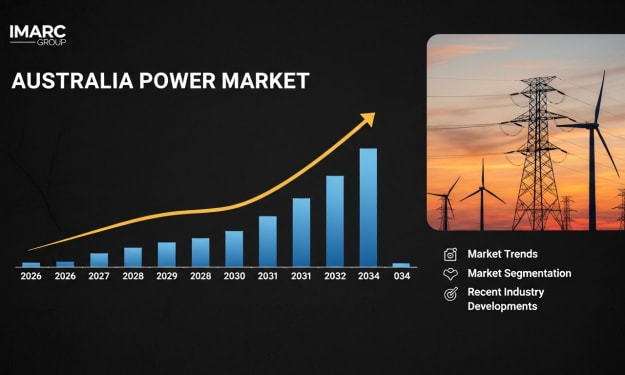
According to IMARC Group, the Australia power market reached 285.7 TWh in 2025 and is projected to expand to 377.0 TWh by 2034, exhibiting a compound annual growth rate (CAGR) of 3.04% during 2026–2034. This steady expansion reflects structural changes in electricity generation, transmission and consumption patterns across Australia. The power sector is undergoing a historic transformation as renewable energy capacity accelerates, coal-fired plants phase out and grid infrastructure modernizes. Rising electrification across transport, residential and industrial sectors is further reinforcing long-term electricity demand growth.
By Shrestha Roy5 days ago in Futurism
Medical Swabs Market Insights: Diagnostic Accuracy Focus, Product Innovations & Industry Outlook to 2033
Rising demand for accurate diagnostic testing, a growing geriatric population, and the increasing prevalence of infectious diseases and chronic conditions are driving the medical swabs market. These factors are further supported by advancements in swab materials like flocked and foam tips, the expansion of healthcare infrastructure, and the rising popularity of at-home and point-of-care testing. According to IMARC Group’s latest data, the global medical swabs market size reached USD 3.3 Billion in 2024. Looking forward, IMARC Group estimates the market to reach USD 4.7 Billion by 2033, exhibiting a CAGR of 3.82% from 2025-2033.
By Andrew Sullivan3 days ago in Futurism
I was in a Toxic Relationship, with my Workplace
“You got that?” My ex yelled. His hands were balled into fists at his side. At six foot three, he towered over me. A normal person would have been afraid, but I looked up a video of George Lopez repeatedly saying, “I got this,” and showed it to him. I had grown used to this treatment, so much so that I didn’t blink when he ripped the phone from my hand and threw it across the room.
By Jade M.2 days ago in Confessions



Comments
There are no comments for this story
Be the first to respond and start the conversation.