
How quark-gluon plasma is studied in the laboratory?
Plasma, new technologies

Recreating conditions similar to the early universe is extremely difficult. However, physicists have learned how to create tiny volumes of quark-gluon plasma using large particle accelerators, heavy ion colliders. The idea is to accelerate two heavy atomic nuclei to relativistic speeds and collide them head-on. At the same time, the energy of the collision is concentrated in a small volume – a microscopic "fire layer" of ultra-high temperature and density is formed, in which ordinary nuclear matter "melts" for a moment and quark-gluon plasma arises.
First experiments. The first search for quark-gluon plasma began in the 1980s and 90s at CERN at the SPS accelerator, where the nuclei of heavy elements were accelerated. In 2000, CERN announced the receipt of signs of a new state of matter – potentially quark-gluon plasma. The next big step was the launch of the Relativistic Heavy Ion Collider in 2000 (RHIC, Brookhaven National Laboratory, USA). At RHIC, collisions of gold nuclei at energies of hundreds of GeV per nucleon made it possible to create a more "pure" quark-gluon plasma and investigate it in detail. The first results shocked scientists: The new matter behaved like a liquid, not a gas! The clashes gave rise to the so-called «Perfect Quark Liquid Soup». In particular, in the RHIC experiments, the phenomenon Jet attenuation: When two nuclei collide, a pair of reactive jets of particles flying in opposite directions is often formed. But in 2003, the STAR detector at RHIC found that one of the two jets could disappear, "extinguishing" in a dense plasma environment. This meant that the formed quark-gluon plasma is so thick that it is able to absorb and scatter particles of enormous energy. Such results became convincing evidence: in these collisions, a new state of matter is indeed born. Estimated, plasma temperature on RHIC reached 4×10¹² K (about 4 trillion °C) – the hottest temperature in the known universe at that time! This record even made it into the Guinness Book of Records.
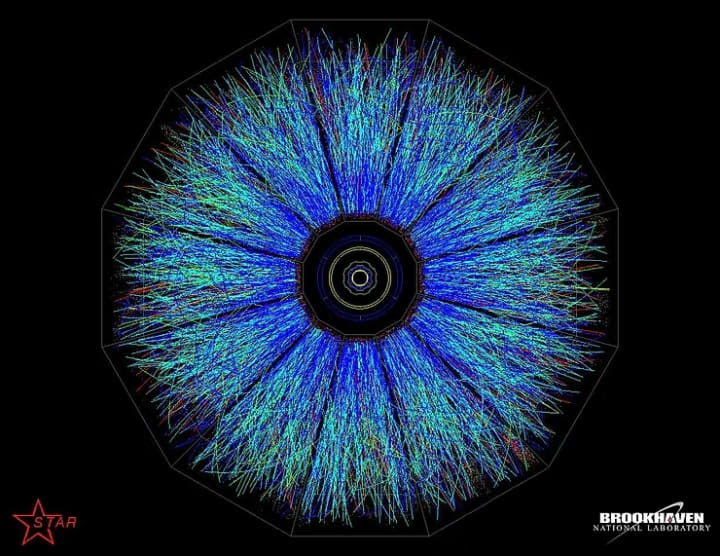
One of the first full-energy collisions of gold ions recorded by the STAR detector at RHIC (Brookhaven, USA). The colour tracks display the paths of thousands of particles formed by the collision as they fly through the detector. According to the asymmetry of the tracks, scientists noticed the phenomenon of "jet attenuation" - one of the two oppositely directed jets of particles disappears, losing energy in the quark-gluon plasma.
Large Hadron Collider (HAC). A new era of research was opened by the launch of the Higher Attestation Commission at CERN. Although most of the time the LHC runs on protons (bringing, for example, the discovery of the Higgs boson), about once a year it switches to the collision mode of heavy ions - lead nuclei. Heavy-ion collisions at the LHC make it possible to obtain an even hotter and more durable quark-gluon plasma due to significantly higher energy than on RHIC. The very first launches of heavy ions in 2010 led to new records: according to estimates, the plasma temperature reached ~5×10¹² K (over 5 trillion degrees) – it is already ~300,000 times hotter than the core of the Sun. The HAC not only broke the temperature record, but also gave the plasma a larger volume and lifetime (tens of yoctoseconds), which made it possible to more accurately measure its characteristics.
Several detectors that study quark-gluon plasma are working at the Higher Attestation Commission. An experiment was created specifically for this ALICE (A Large Ion Collider Experiment) - it is optimised for the registration of thousands of particles flying out of the collision zone of heavy nuclei. Plasma is also examined by universal detectors ATLAS and CMS during special series of ion collisions. In 2015, HAC detectors confirmed the phenomenon of jet attenuation at even higher energies by measuring in detail how much energy fast particles lose as they fly through quark-gluon plasma. This made it possible to penetrate deeper into the structure of the "quark soup". In addition, due to the huge number of particles born at the LHC, researchers were able to detect new effects – for example, the dependence of particle flows on their mass and type, the appearance of strange particles, correlated fluctuations, etc. Especially impressive was the already mentioned discovery of X-particles - they were discovered by the team at the CMS detector, having analysed more than 13 billion ion collisions. This is the first time exotic tetraquarks have been recorded in plasma, which opens the way to the study of their structure.
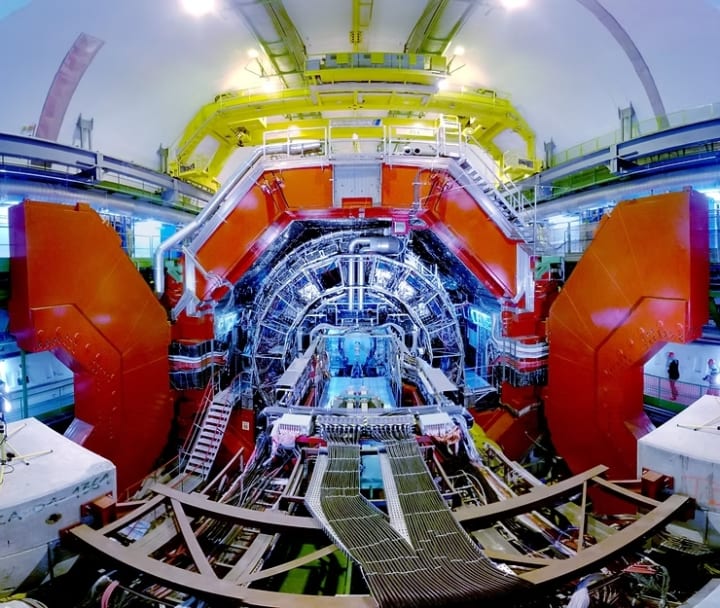
The ALICE experiment at CERN conducting research on quark-gluon plasma.
How to "see" invisible plasma? It is worth noting that the detectors do not directly register the quark-gluon plasma itself - it passes into other particles too quickly. Instead, scientists study Experimental signatures, that plasma leaves behind. These include: spectra and correlations of formed particles, the phenomenon of jet attenuation (mentioned above), distributions of particles from heavy quarks (b-, c-quarks), emission of photons and leptons from plasma, etc. For example, by measuring the energies and angles of thousands of particles, physicists can restore the viscosity and temperature of plasmas. One of the important parameters is the so-called flow parameter – Elliptical flow: The particles do not scatter evenly in all directions, but a little predominantly in the plane of collision. This indicates that the plasma behaves like a spreading liquid - a kind of "liquid explosion". Another key observation was the inhibition of the formation of J/ψ -mesons (particles from charm quarks) in hard-to-ion collisions: hot plasma "dissolves" bound quarks, preventing them from forming J/ψ. This effect was predicted theoretically and confirmed experimentally, becoming another proof of the occurrence of CGP. Thus, although we cannot look inside the plasma directly, Its presence and properties are manifested through its effect on decay products – just as the properties of a missing material can be studied from the fragments left of it.
Currently, research on quark-gluon plasma continues in several scientific centres. In addition to CERN and BNL, new installations are planned - for example, an experiment CBM at the FAIR accelerator in Germany and the project NICA at the Joint Institute for Nuclear Research. They will make it possible to study plasma under other conditions - at higher baryonic density, lower energies, complementing the picture of the QCD phase diagram. Quark-gluon plasma remains one of the hottest areas of modern high-energy physics – literally and figuratively.
About the Creator
Olaf Podolski
Married, have two children and beautiful wife. I've been working at Autoplovykla for three years, the best carwash in Lithuania. I love my wife, reading, German car brands and Polish icecream. Think that poetry makes people better.
Keep reading
More stories from Olaf Podolski and writers in Futurism and other communities.
Medicinal herbs of the Carpathians
According to popular beliefs, the Carpathians are considered a healing "place of power" and there is no mysticism in this. Air with a unique composition and medicinal Carpathian herbs can work real miracles. Since ancient times, the Hutsuls have used them to treat various diseases. Today, herbal medicine in the Carpathians is experiencing its revival, attracting more and more attention from both locals and tourists.
By Olaf Podolskiabout 20 hours ago in Earth
About Binding Prometheus
I want to start actively advocating on behalf of my own work, and the most valuable part of my canon is, without a doubt, Binding Prometheus, the play I have been working on since 2019 and only finished in 2023 as part of my MA. The play itself is an amalgamation of a million different inspirations. On one end, it evokes the Ancient Greek myth-play, deriving its own title from the earliest extant work of Western drama we have, Aeschylus’s Prometheus Bound. On the other end, it borrows significantly from the sci-fi bulwarks from over the years, namely Mary Shelley’s Frankenstein and Karel Capek’s Rossum’s Universal Robots. The play could be an episode of Black Mirror, I fear. I don’t know. I’ve only ever seen one episode of Black Mirror.
By Steven Christopher McKnight20 days ago in Futurism
Medical Ceramics Market: Rising Implant Procedures, Material Innovation & Market Expansion
According to IMARC Group's latest research publication, the global medical ceramics market size reached USD 11.8 Billion in 2024. Looking forward, IMARC Group expects the market to reach USD 17.4 Billion by 2033, exhibiting a growth rate (CAGR) of 4.34% during 2025-2033.
By Andrew Sullivan5 days ago in Futurism



Comments
There are no comments for this story
Be the first to respond and start the conversation.