
How Poor State Management Breaks Apps Over Time?
Watching an app slowly forget what it’s supposed to remember.

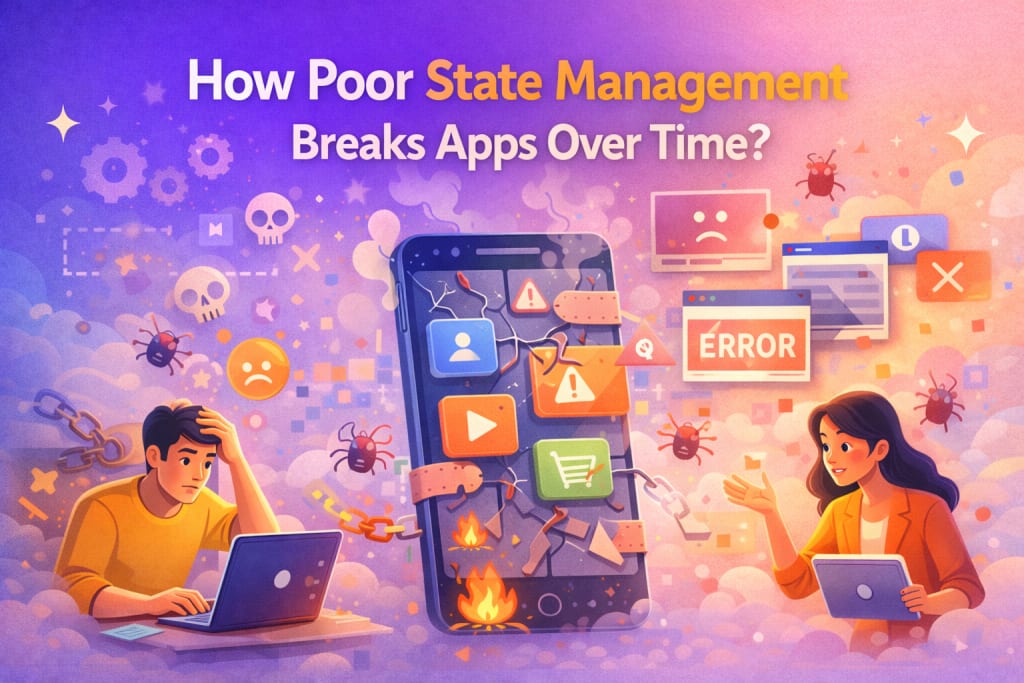
The first clue wasn’t on the screen. It was in my own reaction. I caught myself tapping the same button twice, not out of impatience, but uncertainty. I wasn’t sure the app had understood me the first time. That small doubt lingered longer than the action itself.
I stopped and thought about that moment. An app shouldn’t make you second-guess yourself. When it does, something deeper than UI is already drifting.
State Is the App’s Inner Voice
Every app is constantly talking to itself. What am I showing right now. What changed. What should stay the same.
That internal conversation is state. When it’s clear, the app feels confident. When it’s muddled, the app hesitates, contradicts itself, or quietly corrects its own behavior in front of the user.
I’ve learned that users don’t notice state directly. They notice doubt.
Early Success Masks the Problem
Poor state management rarely causes immediate failure. In early versions, everything feels fine because there isn’t much to remember.
Few screens. Short sessions. Minimal background activity. State resets often without effort.
I’ve seen teams celebrate early stability without realizing they were building on sand. The cracks don’t show until time and usage pile on.
Growth Turns Memory Into Burden
As apps grow, state grows with them. More data. More user preferences. More moments to resume from.
What once felt like simple memory becomes a burden if it isn’t structured carefully. Old assumptions stick around. Temporary values overstay their welcome.
The app starts carrying history it no longer understands.
When the App Tells Conflicting Stories
One of the clearest signs of broken state is contradiction. A badge says one thing. A screen says another. A refresh changes nothing, then changes everything.
I’ve watched users pause in these moments, unsure which version of reality to trust. That pause erodes confidence quietly.
The app isn’t broken. It’s confused.
Time Is the Enemy of Poor State
Some bugs only appear after hours of use. Others show up days later. A few surface only after updates.
These aren’t mysterious failures. They’re state aging badly. Values that were never meant to persist begin influencing decisions long after their context disappeared.
State that isn’t designed for time eventually betrays itself.
Navigation Exposes Weak Memory Fast
Moving through an app should feel like walking through a familiar place. You expect rooms to be where you left them.
Poor state management turns navigation into guesswork. Screens reset unexpectedly. Others cling to outdated information.
I’ve seen apps reload everything because they don’t trust their own state. I’ve seen others trust it too much and refuse to update.
Both feel wrong to users.
Background Events Complicate the Story
Real apps don’t pause politely when they’re not visible. Data syncs. Notifications arrive. Systems interrupt.
State changes while the user is gone. When they return, the app has to reconcile past and present.
Poor state management struggles here. It snaps from one version of reality to another without explanation. Users feel disoriented, even if nothing technically failed.
The Slow Creep of Defensive Code
As state issues accumulate, teams respond defensively. Extra checks. Fallbacks. Just-in-case updates.
This code isn’t sloppy. It’s protective. Still, it adds noise. Every change triggers more work than intended.
The app becomes reactive instead of intentional. Performance slips. Clarity fades.
Why Fixing State Later Feels Risky
State problems don’t live in one place. They weave through the app.
Fixing them later means touching areas people avoid. Knowledge concentrates in a few heads. Fear replaces confidence.
I’ve seen teams choose not to improve features simply because state felt too fragile to disturb.
That’s how poor state management breaks progress before it breaks functionality.
Long-Term Users Feel It First
New users arrive clean. Long-term users carry baggage.
Saved settings. Interrupted flows. Partial actions. Those histories stress state management in ways testing rarely does.
When loyal users complain that something feels off, it’s often state failing to reconcile who they are with who the app thinks they are.
Testing Doesn’t Age Like Users Do
Test environments reset constantly. Production does not.
Real apps live through updates, migrations, partial failures, and inconsistent usage. State accumulates scars.
Poor state management hides comfortably in clean test cycles. It reveals itself only through lived time.
Teams Sense the Problem Internally
Before users complain, developers feel it. Bugs seem random. Reproducing issues feels impossible.
Someone says don’t touch that area. Another says it’s always been weird.
That internal unease usually traces back to state no one fully owns.
Centralizing State Isn’t a Shortcut
Moving state into one place can help, but it doesn’t solve confusion by itself.
What matters is clarity. What is the source of truth. Who can change it. When does it expire.
Without those answers, centralization just creates a louder mess.
State Shapes Product Confidence
Product decisions depend on predictability. Can we trust the app to behave consistently if we add this.
Poor state management makes teams conservative. Roadmaps shrink. Features simplify to avoid risk.
The app doesn’t stop working. It stops growing.
Scale Makes the Cost Obvious
Working with teams involved in mobile app development Orlando projects, I’ve seen how state problems surface as audiences widen.
More devices. More interruptions. More long-lived sessions. What stayed hidden suddenly becomes unavoidable.
Scale doesn’t create state issues. It removes the cover.
Learning to Let State Go
One of the most powerful changes I’ve seen is letting go of state that doesn’t need to live forever.
Not everything needs to persist. Not everything needs to be remembered.
Apps feel lighter when memory is intentional rather than habitual.
Ending With Certainty Instead of Doubt
I reopened that app weeks later after state boundaries were clarified. Same features. Same flows.
This time, I didn’t tap twice. I didn’t hesitate. The app responded like it knew where it was and what it was doing.
That confidence is fragile. It’s built quietly and lost slowly. Poor state management breaks apps over time not through crashes, but through doubt. When state is treated with care, apps don’t just behave correctly. They feel trustworthy, even after years of use.
About the Creator
Ash Smith
Ash Smith writes about tech, emerging technologies, AI, and work life. He creates clear, trustworthy stories for clients in Seattle, Indianapolis, Portland, San Diego, Tampa, Austin, Los Angeles, and Charlotte.
Commercial Aircraft Windshields and Windows Market Outlook: Aviation Safety Enhancements and Growth Opportunities
According to IMARC Group's latest research publication, The global commercial aircraft windshields and windows market size reached USD 765.0 Million in 2024. Looking forward, IMARC Group expects the market to reach USD 975.1 Million by 2033, exhibiting a growth rate (CAGR) of 2.6% during 2025-2033.
By James Whitman5 days ago in Futurism
Pates Market Outlook: Gourmet Food Demand and Premiumization Growth Opportunities
According to IMARC Group's latest research publication, The global pates market size was valued at USD 1.25 Billion in 2024. The market is projected to reach USD 1.42 Billion by 2033, exhibiting a CAGR of 1.40% from 2025-2033.
By James Whitman6 days ago in Futurism



Comments
There are no comments for this story
Be the first to respond and start the conversation.