
How Many Containers Fit on a Cargo Ship?
Discover how many containers fit on a cargo ship and the role of shipping containers in global trade. Learn more with SuperBox!


Cargo ships are essential for global trade, transporting goods across the world’s oceans. But have you ever thought about how many cargo containers can fit on a ship? The answer depends on the size of the ship, the type of containers, and how well the shipping operations are run. In this blog, we’ll explore how many containers a ship can carry, with a focus on the biggest container ships, their TEU capacity, and how they play a key role in moving goods and supporting international trade.
Understanding Cargo Ships
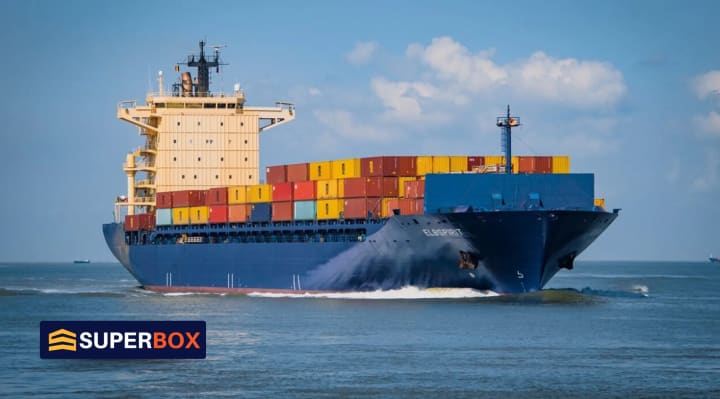
Cargo ships are large boats built to carry goods over long distances. The most common type is the container ship, which is designed to hold standardized shipping containers. These containers are a massive part of modern logistics and international trade because they make it easier to load, unload, and move goods between different transportation methods. Container ships come in many sizes, with the largest ones able to carry thousands of containers on a single trip.
A cargo ship's size determines how much cargo it can carry. Smaller ships may only hold a few hundred containers, while the biggest ships in the world can carry over 24,000 containers at once. The capacity of these ships is measured in TEUs (Twenty-foot Equivalent Units), a standard used in the shipping industry. To understand how many containers a ship can carry, it’s important to know its TEU capacity, which we’ll dive into next.
What is TEU Capacity?
TEU, or Twenty-foot Equivalent Unit, is a way to measure a cargo ship’s total capacity by counting how many standard 20-foot containers it can hold. Since most containers are 20 feet long, TEU makes it easy to understand the ship's carrying capacity. For example, a ship with a TEU capacity of 10,000 can carry 10,000 containers that are each 20 feet long.
Some containers are 40 feet long, which is equal to two TEUs. This allows for different sizes of cargo to be transported while keeping things simple for global shipping. Knowing a ship's total capacity is important for shipping companies because it helps them determine the carrying capacity and the costs of operating the ship.
Largest Container Ships and Their Capacity
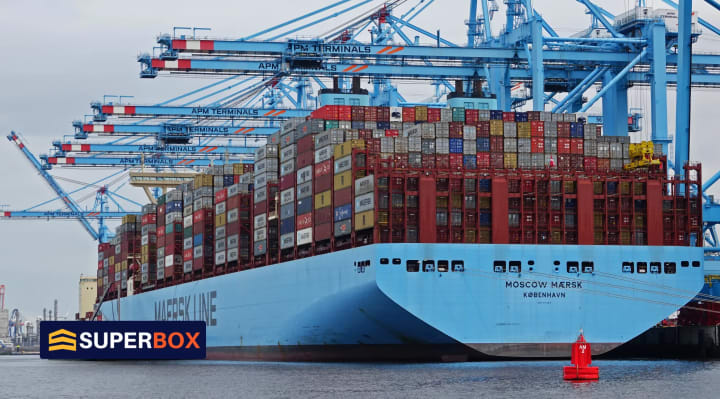
The largest container ships in the world are amazing examples of engineering, with huge TEU capacities. The biggest ones can carry up to 24,346 containers, making them some of the most efficient ships for international trade. These ships are built for maximum cargo capacity, allowing shipping companies to transport more goods while making fewer trips.
A major player in the shipping industry is the Maersk Line, which operates several large ships that can carry over 20,000 TEUs. These ships are about 400 meters (1,312 feet) long, almost the length of four football fields placed end to end. Their massive cargo capacity is impressive, and they play a key role in meeting the huge demand for global trade.
The amount of cargo these ships can carry helps shipping companies move goods more cheaply, reducing the cost of products around the world. By transporting large amounts of cargo, these ships keep supply chains running smoothly and support the global economy.

Ultra Large Container Ships (ULCS)
Ultra-large container ships (ULCS) are the latest advancements in cargo shipping. These ships are built to carry as many containers as possible, with capacities far greater than older container ships. Some ULCS can carry over 18,000 TEUs, and a few even reach up to 24,000 TEUs or more.
One of the most famous ULCS ships is the MSC Irina. With a capacity of 24,346 containers, it's one of the largest container ships in the world. These ships are over 1,300 feet long and 200 feet wide, with massive hulls that span across the ocean. Their huge size and efficiency make them crucial for modern shipping companies, allowing them to carry a lot of cargo over long distances.
The growth of ULCS vessels has changed the shipping industry by making it more cost-effective. With these larger ships, companies can ship goods more efficiently, which lowers the cost of transporting products around the world.

Shipping Operations and the Amount of Cargo
Shipping operations are complicated and involve careful planning, scheduling, and loading of cargo onto ships. The size of the ship is a huge factor in how much cargo it can carry, with larger ships able to hold more goods. However, things like weight limits, types of containers, and whether the containers are open-top or standard can all affect how much a ship can carry.
When loading containers, they are carefully placed into the ship's holds to make the best use of space while keeping the ship balanced. The loading and unloading process is usually done in ports using special cranes that can quickly move containers on and off the ship. Efficient shipping operations are important for getting products to the market on time and keeping international trade running smoothly.

Impact on International Trade
Cargo ships, especially those with large TEU capacities, are essential for international trade. They allow shipping companies to move goods around the world more cheaply, which helps lower product prices and makes goods more available. The ability to carry a lot of cargo helps companies like Maersk Line operate efficiently and offer affordable shipping to businesses everywhere.
The size and capacity of cargo ships have a massive impact on the global economy. As container ships get bigger and more efficient, they lower shipping costs, which helps grow international trade. This makes it easier for businesses to import and export goods, creating jobs, supporting economies, and making products more accessible to people everywhere.
Conclusion
In conclusion, how many containers a cargo ship can carry is an important part of shipping operations and international trade. Ships with large TEU capacities, like the MSC Irina Maersk Line vessels, can carry thousands of containers, helping shipping companies move large amounts of goods efficiently.
As the shipping industry keeps growing, understanding the sizes of ships, their TEU capacities, and their role in transporting goods is key to understanding how the global economy works. Whether it’s a ship carrying just a few hundred containers or a giant vessel holding over 24,000, these ships play a crucial role in connecting the world through trade.
Discover the Power of Cargo Shipping with SuperBox!
Ever wondered how many containers fit on a cargo ship? The answer depends on the ship's size, with the largest ships carrying up to 24,000 containers! At SuperBox, we provide high-quality shipping containers that help global trade move smoothly. Whether you need a container for shipping, storage, or transport, we’ve got you covered.
Ready to get started? Contact us today at 1-866-696-9269 and let SuperBox handle all your container needs!
About the Creator
SuperBox Shipping Containers
SuperBox offers a wide range of standard and high cube shipping containers for sale, modular containers, and custom-built solutions. Call us now for a free quote!
Keep reading
More stories from SuperBox Shipping Containers and writers in Futurism and other communities.
Shipping Container Off Grid Homes: A New Way to Live
In today’s world, many are looking for a simpler, more sustainable lifestyle. One popular way to achieve this is by building a shipping container off-grid home. This type of living arrangement offers the opportunity to live independently, with a focus on sustainability and cost-effectiveness. Shipping container off-grid homes is becoming an appealing option for those looking to minimize their environmental impact and reduce living costs.
By SuperBox Shipping Containers12 months ago in Futurism
Australia Medicated Skincare Market: Consumer Health Focus, Product Innovation & Clinical Demand
According to IMARC Group, the Australia medicated skincare market reached USD 1,011.7 Million in 2025 and is projected to grow to USD 2,080.6 Million by 2034, exhibiting a compound annual growth rate (CAGR) of 8.34% during 2026–2034. The expansion reflects a structural shift in consumer behavior across Australia, where skincare is increasingly viewed through a medical and preventative health lens rather than purely cosmetic. Rising awareness of dermatological conditions such as acne, eczema and psoriasis, coupled with a preference for clinically tested formulations, is accelerating demand for specialized and scientifically validated skincare solutions.
By Kevin Cooper4 days ago in Futurism
Industry 4.0 Market Analysis: Industrial Automation, Data-Driven Operations & Industry Forecast to 2034
Rising demand for automation, real-time data integration, and the surge in smart factory initiatives are driving the Industry 4.0 evolution. Supported by government digitalization schemes and massive investments in Industrial IoT (IIoT) and AI, the sector is transforming traditional manufacturing into highly efficient, self-optimizing ecosystems. According to IMARC Group’s latest data, the global industry 4.0 market size reached USD 188.5 Billion in 2025. Looking forward, IMARC Group estimates the market to reach USD 599.2 Billion by 2034, exhibiting a CAGR of 13.71% from 2026-2034.
By Andrew Sullivan8 days ago in Futurism
I was in a Toxic Relationship, with my Workplace
“You got that?” My ex yelled. His hands were balled into fists at his side. At six foot three, he towered over me. A normal person would have been afraid, but I looked up a video of George Lopez repeatedly saying, “I got this,” and showed it to him. I had grown used to this treatment, so much so that I didn’t blink when he ripped the phone from my hand and threw it across the room.
By Jade M.5 days ago in Confessions




Comments
There are no comments for this story
Be the first to respond and start the conversation.