
How Enterprises Are Using Generative AI Beyond Chatbots
Generative AI is reshaping how work gets done across industries.
The hype started with chatbots. But enterprises aren't stopping there.
They're using GenAI to write code, summarize documents, automate support, generate insights from data, and accelerate internal workflows. This shift isn't happening in silos or labs. It's happening in production, across departments, tools, and use cases.
The question is no longer "What can GenAI do?" It's "Where does it save time, reduce friction, and create leverage today?"
This article looks at how companies are operationalizing generative AI—not in theory, but in practice.
Content Generation at Scale
Companies are using GenAI to generate large volumes of business content—fast.
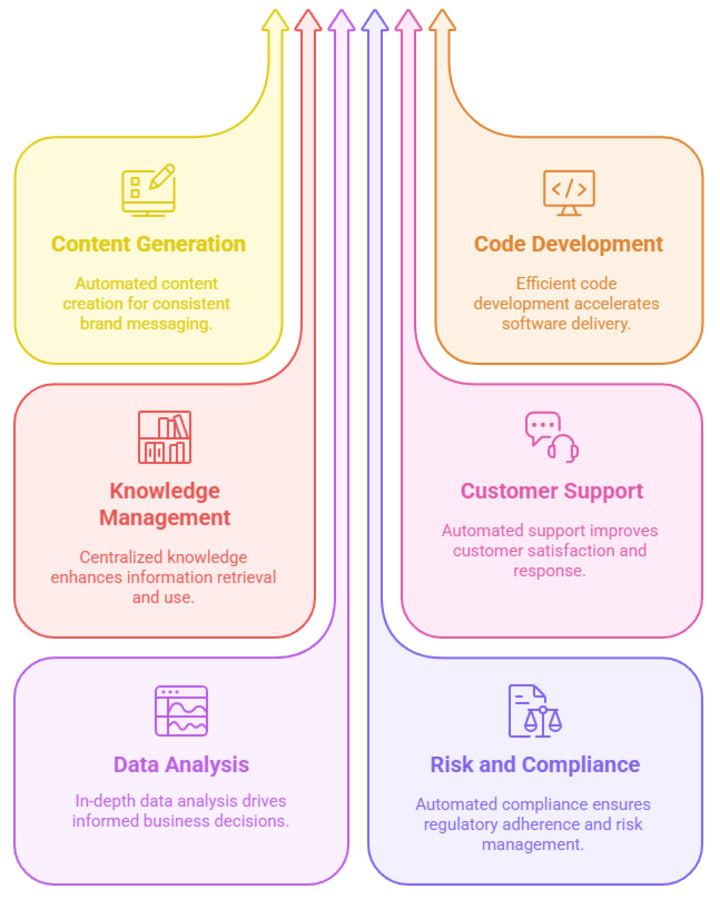
Marketing teams generate email campaigns, ad copy, blog posts, and product descriptions. Product teams write user guides, changelogs, and FAQs. Operations and HR teams draft policies, summaries, and internal announcements.
This isn't experimental. Teams are doing it daily.
A centralized GenAI platform connects models to enterprise data. This works by pulling information from approved sources and prompting large language models (LLMs) with relevant context. That ensures generated output stays accurate and aligned with internal standards.
These tools can route drafts for review, track edits, and auto-publish to CMS systems or send content directly to Slack or email. This cuts manual content generation by hours per week, per team.
Instead of starting from scratch, employees start with AI-generated drafts and focus on editing.
Code Generation and Software Development
Developers use GenAI to write, debug, and refactor code.
Engineers ask GenAI to write a function based on a ticket description. QA teams generate unit tests automatically. DevOps teams build scripts to manage infrastructure faster.
Instead of switching between browser tabs, documentation, and terminals, developers stay inside their IDEs. Context-aware assistants can connect to internal codebases, providing inline suggestions.
AI copilots can recognize internal naming conventions, dependencies, and documentation styles. This reduces friction and helps new hires ramp up faster.
When connected to CI/CD pipelines, GenAI tools can even suggest fixes to failed builds or misconfigured environments.
Time saved isn't the only gain. GenAI reduces context-switching, cuts repetitive work, and accelerates delivery.
Knowledge Management and Search
Employees lose time hunting for information.
GenAI changes that by powering semantic search and summarization across internal systems.
Instead of guessing keywords, employees type a natural question: "What is our current return policy in Europe?" or "Where is the latest pricing sheet for enterprise clients?"
GenAI systems index company content from wikis, PDFs, emails, Slack threads, and documents. They return relevant answers with citations and direct links.
This helps every department—sales, finance, HR, engineering—work faster and make fewer mistakes.
Some platforms deploy retrieval-augmented generation (RAG) pipelines that continuously refresh internal indexes. This means answers stay current without retraining the model.
The result is less time spent searching and more time acting on information.
Customer Support Automation
Support teams are using GenAI to go far beyond chatbots.
AI summarizes support tickets so agents get the full context fast. It detects tone, urgency, and intent. It flags risks like churn or legal complaints.
GenAI copilots assist live agents by surfacing past case resolutions, pulling product documentation, or drafting replies in seconds.
These tools integrate into CRMs and help desks like Salesforce or Zendesk. Agents don’t switch tabs. The AI works inside the ticketing system.
This reduces first-response time and increases resolution rates.
In some cases, GenAI automates follow-ups or escalations. But most often, it's about making human agents faster, better, and less burdened by routine tasks.
Enterprise Data Analysis
GenAI helps translate complex data into clear narratives.
Instead of reading dashboards and graphs, leaders get written summaries: "Sales increased 12% month-over-month due to renewals in EMEA."
Finance, marketing, and ops teams use GenAI to pull insights from spreadsheets, BI tools, and raw data exports.
Assistants can query databases in natural language: "Show me accounts with high usage and no recent support tickets."
GenAI also reviews unstructured data—meeting notes, call transcripts, product reviews—to identify patterns and trends.
This is not a replacement for analysts. It’s a productivity multiplier.
It helps analysts scale insights, explain findings, and answer follow-up questions quickly.
Risk, Compliance, and Legal
GenAI is helping legal and compliance teams work faster with fewer blind spots.
Legal teams use it to review contracts, identify missing clauses, and highlight risky language. Compliance officers track regulation changes and map them to internal policies.
GenAI can draft contract redlines, summarize case law, or generate custom disclosures based on deal terms.
Platforms allow these teams to control source content, enforce templates, and log changes for auditability.
This is especially valuable in heavily regulated industries: healthcare, finance, insurance, energy.
It doesn’t replace lawyers. It gives them a head start and more visibility.
Deployment at Scale
Scaling GenAI across the enterprise requires orchestration, not just access.
Platforms manage workflows, source approvals, security controls, and integrations. They ensure teams don’t build one-off hacks that can't scale or comply with policy.
GenAI is often embedded in intranets, Slack, Microsoft Teams, or custom tools. This meets employees where they work.
Fine-tuning isn’t always required. Instead, RAG pipelines give models the context they need. That keeps outputs grounded in enterprise reality.
Access controls, user roles, and audit logs matter. So does clear usage guidance. GenAI in production needs structure.
This is where platforms—not just models—come into play.
Real-World Enterprise Use Cases
Organizations are already using GenAI at scale across industries—and not in isolated experiments, but in operational workflows that deliver measurable results.
- A global bank partnered with a technology provider to integrate GenAI into its compliance workflows. By summarizing complex regulatory texts and compliance documentation, the bank reduced audit review times by 40%. (source)
- A Fortune 100 insurance firm connected GenAI to its CRM platform to automatically generate client-facing summaries and correspondence. This not only reduced turnaround time for service requests but also increased consistency in communication across agents and branches. (source)
- A global logistics provider embedded AI assistants in its warehouse and logistics systems. These assistants generate incident summaries, track operational issues, and feed reports to supervisors in real time. As a result, operations teams cut reporting time and reduced the delay in issue resolution. (source)
- A top consulting firm deployed GenAI tools to support business development. It auto-generates proposal drafts by pulling from historical bids, standard templates, and industry data, reducing proposal prep time by 50% while increasing win rates through more targeted responses. (source)
- A manufacturing company applies GenAI to monitor IoT sensor data. The AI flags abnormal patterns, generates plain-language maintenance summaries, and alerts field teams with next steps. This improved uptime and enabled predictive maintenance workflows. (source)
These aren’t proofs of concept. These are tools already woven into daily operations.
The common thread: high-volume, repetitive, knowledge-heavy tasks where accuracy, speed, and consistency are critical—and GenAI makes the process better, not just faster.
Closing Questions
Where in your organization are people writing similar content over and over?
Which teams are losing time to redundant research or manual summaries?
Where are mistakes happening because people don’t have the right context?
What would happen if you removed 50% of the time spent on routine writing and searching?
Generative AI is not a side project anymore.
It’s a force multiplier—when deployed with purpose, controls, and real use cases.
About the Creator
Keep reading
More stories from AI Enthusiast and writers in Futurism and other communities.
Agentic AI: 10 Common Challenges and Development Strategies
Agentic AI is a game-changing technology capable of making independent decisions to achieve its goals. It promises to transform industries like healthcare, finance, and logistics by enabling smarter, more efficient systems.
By AI Enthusiastabout a year ago in Futurism
Irrigation Controllers Market: Precision Farming Demand, Automated Scheduling & Market Forecast
According to IMARC Group's latest research publication, global irrigation controllers market size reached USD 1.9 Billion in 2024. Looking forward, IMARC Group expects the market to reach USD 5.7 Billion by 2033, exhibiting a growth rate (CAGR) of 13.07% during 2025-2033.
By sujeet. imarcgroup4 days ago in Futurism
Why Chestnut Market Are Emerging as the Future of Plant-Based Protein Snacks?
1) A Quiet Comeback in the Plant-Based Aisle As consumers rethink what “healthy snacking” means, a humble forest crop is returning to center stage. Chestnuts - long associated with winter roasting and traditional cuisines—are being rediscovered as a smart, plant-based ingredient that fits modern expectations: minimally processed, nutrient dense, and environmentally responsible. In a world crowded with protein bars, isolates, and ultra-formulated bites, chestnut market offer something refreshingly simple: whole-food nourishment with culinary flexibility.
By Sonpal Singhabout 2 hours ago in Futurism




Comments
There are no comments for this story
Be the first to respond and start the conversation.