
How ChatGPT Changed Millions of Lives — Including Mine
I lost my job. AI helped me build something better.

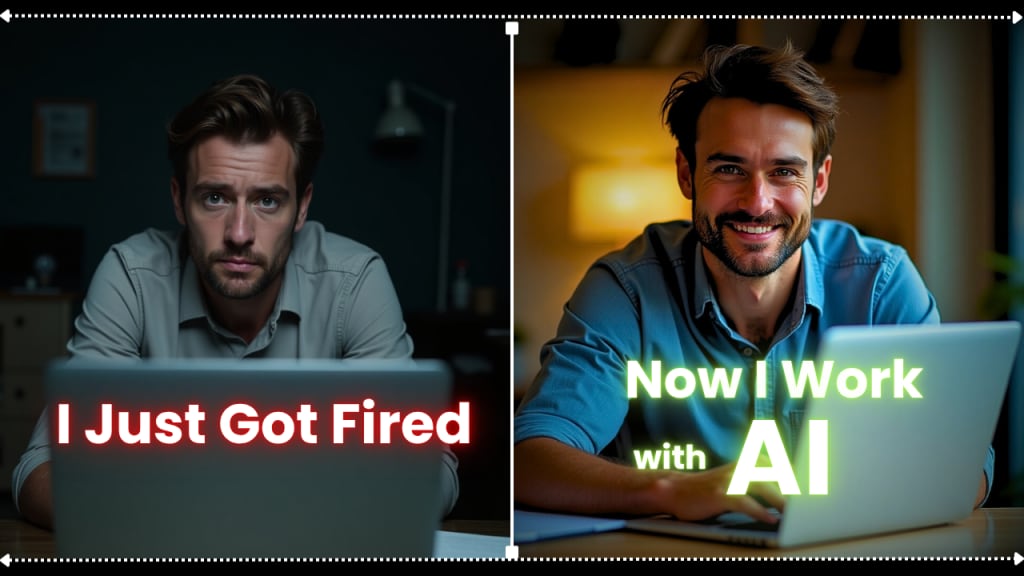
If someone had told me in 2022 that a chatbot would become my business partner, my personal coach, and the most reliable assistant I’ve ever had, I would’ve laughed and gone back to my overstuffed email inbox. But here I am, in 2025, reflecting on how a strange little tool called ChatGPT not only changed the world — it changed me.
Let me rewind.
I used to work in digital marketing for a mid-sized agency in Chicago. Life was okay — not great, not terrible. We had clients, we made campaigns, and I wrote copy for websites and social media. But everything changed when layoffs hit during the economic slowdown of late 2023. One Monday morning, I was let go — just like that. I had rent due in two weeks, savings barely enough for a month, and no job prospects in sight. It was terrifying.
That same week, a friend told me to “play around with ChatGPT.” I’d heard of it, of course — who hadn’t? But I thought it was just some AI toy that nerds used for fun. Still, desperation has a funny way of opening your mind. I created an OpenAI account, logged in, and typed:
- “Help me write a freelance proposal.”
Within seconds, a perfectly formatted proposal appeared on the screen. It was better than what I’d ever written myself. I edited a few lines, sent it out to a potential client on Upwork, and within three days, I had my first gig.
That was the beginning of everything.
The Freelance Revolution
What surprised me wasn’t just the speed or accuracy of ChatGPT’s writing — it was the sheer versatility. Over the next few weeks, I used it to:
- Brainstorm business names for clients
- Draft cold emails
- Write product descriptions for Shopify stores
- Create engaging captions for Instagram posts
- Summarize complex research articles
And here’s the thing: I wasn’t cheating. I was collaborating. I still had to fact-check, rewrite, add emotion, inject personality — but the time it saved me was immeasurable.
Soon, I was making more money freelancing than I did at my 9–5. I wasn’t alone. In Facebook groups, on Reddit, and in freelance communities, people shared stories like mine. Teachers, marketers, coders, even poets — all of them finding ways to earn, create, and grow with the help of ChatGPT.
AI Didn’t Kill Jobs. It Changed Them.
There’s a myth that AI like ChatGPT is going to "steal" jobs. I don’t fully agree.
Yes, some roles are changing — customer support is now AI-assisted, content writing is more automated, and junior-level copywriters are struggling to stay competitive. But what I’ve seen is this: AI removes the boring, repetitive tasks, so humans can focus on creativity, strategy, and connection.
Take my friend Jasmine — she’s a therapist in Toronto. She started using ChatGPT to draft client worksheets, write blog posts for her website, and brainstorm newsletter topics. She didn’t lose her job. She grew her audience. Her private practice is now booked months in advance.
Another friend, Daniel, is a chef. He uses ChatGPT to create new recipes based on seasonal ingredients and even writes Instagram captions in five languages to attract international followers.
AI didn’t replace them. It empowered them.
The Strangest Partnership of My Life
There’s something surreal about talking to a machine every day. I ask it how to deal with angry clients. I ask it for feedback on my writing. Sometimes I even vent to it when I’m overwhelmed.
And yet, it never judges, never gets tired, never says “I told you so.”
Is it human? Of course not. But in a world that often feels chaotic, filtered, and impatient, ChatGPT became something I didn’t know I needed: a calm, thoughtful, 24/7 assistant who shows up, listens, and helps me figure things out.
It’s not perfect. It makes mistakes. Sometimes it sounds too robotic or gives outdated info. But with each update, it gets better. And so do I.
My Life, Post-ChatGPT
Today, I run a small content agency with three other freelancers. We call ourselves “The Human-AI Hybrid Studio” — because we don’t hide our use of AI. We embrace it. Clients know we use ChatGPT, Claude, and Perplexity to speed up our work, but they also know that humans do the thinking, the editing, and the storytelling.
I work fewer hours, make more money, and spend more time with my dog and my guitar. For the first time in my life, I feel creatively free — and weirdly optimistic.
I’m not saying AI is perfect. I worry about misuse, deepfakes, ethics, and bias in algorithms. But I also see something amazing: a world where knowledge is more accessible, creativity more affordable, and opportunity no longer locked behind a fancy degree or corporate title.
I used to fear automation. Now I work with it. And I’m better for it.
Final Thoughts
If you’re reading this and wondering whether ChatGPT is just another tech fad, let me tell you — it’s more than that. It’s a tool. A mirror. A quiet revolution happening one conversation at a time.
You can fear it. Or you can learn it, shape it, and grow with it.
Because the truth is: AI didn’t just change the world. It changed people.
And I’m one of them.
About the Creator
Keep reading
More stories from Jehanzeb Khan and writers in Futurism and other communities.
How AI Vocal Remover Tools Are Revolutionizing Music Production
For decades, music producers, remix artists, and even casual hobbyists dreamed of a tool that could separate vocals from any song — instantly, cleanly, and without needing access to studio files. Today, thanks to AI vocal remover tools, that dream is no longer sci-fi. It’s real, and it's exploding across the internet.
By Jehanzeb Khan8 months ago in Futurism
Australia Automotive Infotainment Market: Connected Car Demand, Smartphone Integration & 5G Connectivity
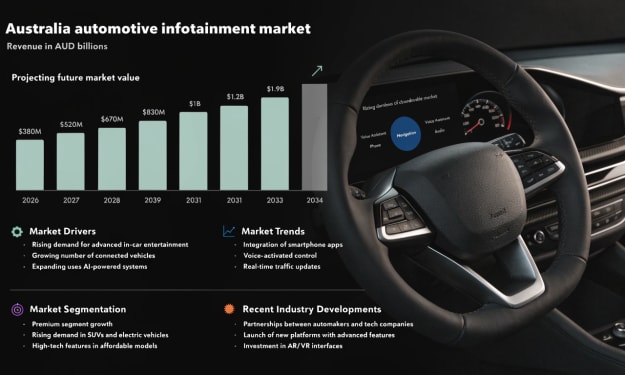
According to IMARC Group, the Australia automotive infotainment market is experiencing steady growth as consumers increasingly expect connected digital experiences inside vehicles. Modern drivers are demanding seamless smartphone integration, high-quality multimedia systems and real-time connectivity features that enhance convenience and entertainment during travel. Automakers and technology providers are responding by integrating advanced infotainment platforms with navigation services, voice assistants and cloud-based applications. The expansion of 5G connectivity and connected vehicle technologies is further strengthening the development of next-generation in-car entertainment and communication systems. As Australia’s automotive sector continues adopting digital technologies and connected mobility solutions, infotainment systems are becoming central components of modern vehicle design and driver experience.
By Shrestha Roy5 days ago in Futurism
Top 10 Enterprise AI Development Companies in 2026: Leading AI Innovators for Businesses
Artificial intelligence is transforming the way businesses operate, compete, and innovate. From intelligent automation to predictive analytics and generative AI solutions, enterprises across industries are investing heavily in AI-powered technologies. As organizations strive to adopt AI at scale, partnering with the right development company becomes critical.
By Ritu Singh8 days ago in Futurism



Comments (1)
wow so amazing