
Hawthorn
An offering to the Fair Folk need be precious as gold For when time becomes due, they repay it tenfold.

I was sixteen years old when I found an injured barn owl in the forest.
He had been pierced through the wing by an iron-headed arrow — too singular a weapon for the men and women of the village. They would never risk offending the Fair Folk in such a way. That, and it was dangerous to venture so deep into the forest at night. I wouldn’t have dared under usual circumstances, but Father’s chest pain had returned, which meant we were in desperate need of more hawthorn leaves.
The owl’s blood was black in the moonlight, sticking his feathers together and turning them stiff. His breathing was too rapid.
For one moment, I considered leaving him. My foot was aching, and had grown more painful with each step through the undergrowth. It would be hard to keep the owl steady, to not hurt him further with my limp.
I would regret leaving him, though. I knew I would.
If compassion hadn’t forced my hand, the sudden silence of the forest would have. One did not take from the forest as I had and neglect to give back, not without consequences. The healing of this creature would be my payment for the hawthorn leaves.
The owl didn’t react as I eased him off the ground. He was lighter than I thought he’d be, and I arranged him in the crook of my arm, covering him with my shawl when it started to rain. He stayed still and silent in my hold, unnaturally so. I sent a quiet plea to the Fair Folk that he would last the way back.
He was still alive when I entered the stone cottage my Father and I shared, and I set to work, breaking the arrow and pulling it from him in one swift motion. He screeched, flapping his good wing.
“Clodagh?” Father called from the adjacent room. His voice was hoarse.
“I’ll be in soon,” I called back, before trying to sooth the owl.
I cleaned the wound, clipping the feathers around it and applying a poultice in the hopes it would be as effective for the animal constitution as it was for the human. My hands were gentle, coaxing, and he calmed again, watching me with black eyes that were too intelligent for a simple barn owl.
Father, when I showed him, thought so too.
“Eldritch blight,” he spat. “Nothing but a curse on our heads.”
The petulant name calling hit a nerve — Clubfoot Clodagh, Clomping Clodagh, Crippled Clodagh — and I refused to speak to him until he apologized. He did so, eventually, but the damage was done. I kept the owl out of Father’s sight after that.
Days went by, blurring together, and I named the owl Hawthorn. It seemed appropriate, as the plant had led to our meeting.
“Do you like it?” I asked, as we made our way back from the river one morning. He was perched on my forearm, head darting around curiously. His wound was free from infection, and although I’d taken him outside previously, this was the furthest we’d strayed from the cottage. I tried to keep from jostling him as I carried the brimming water pail. He chirped loudly at my question, and I laughed for what felt like the first time in years.
I was in such high spirits that when the taunts came, they cut deeper than usual. Three boys, all on the cusp of manhood, staggered over to us. A pungent smell came with them, and I wrinkled my nose. Cheap alcohol.
“Excuse me,” I said, when they formed a wall in front of me.
The tallest and meanest looking one pointed at me — Donal, I remembered, was his name. His mother bought poultices from me occasionally. He waggled his finger. “You’re, uh, far from home, Clomping Clodagh.”
On the contrary, I could see smoke rising from our chimney in the distance.
They picked fun at me, laughing about the evil being my mother must have been, for me to turn out how I had. I’d long since learned retaliating made things worse, but one of them tried to pull Hawthorn’s tailfeathers, and reason left me. I threw the pail of water over them, threatening to send my ‘evil being’ of a mother their way if they so much as looked at me again. Hawthorn’s ear-splitting screech punctuated the end of my threat, and the three ran back to the village with their tails tucked between their legs.
The incident warmed me to the barn owl immensely.
One week passed and then another, until a month had gone by, then a season. Autumn was kinder to us than summer had been, the days milder, the rain more frequent; the year’s harvest would be plentiful.
Hawthorn continued to heal, slowly but surely. Soon enough, he could open his wings without pain, and would glide out the window at night to hunt, never quite staying, never quite leaving.
He was a proud, unusual creature, more stoic companion than wild animal. We would take walks, him digging his talons gently into my shoulder, leaning into my neck when the wind would blow. He would catch field mice and leave them on my windowsill, and while I would try to dispose of them discreetly — they were gifts, made precious by their importance to him — he would always know. The third time it happened, he returned from his hunt with sprigs of caraway, angelica seeds, marshmallow root; ingredients for my infusions and tinctures. If I hadn’t already known there was something uncanny in him, that would have convinced me. We were friends in all the ways that mattered.
Which is why it hurt so much when he disappeared.
The weather was closer to winter than autumn the night he left, and it scared me. He hated the rain, hated it, yet had flown into the raging storm with a mere chirp my direction as warning.
I spent days wandering through the forest, even risked the Fair Folk’s wrath and entered at night, hoping he would find me. I called for him, relentless in my search, only ceasing when Father’s health spiraled yet again. I worried one of the villagers had found Hawthorn, and that he was being served for dinner at the inn. I worried he was lost. I worried there was no reason, and he had simply decided to leave.
And you should be glad of it, I tried to convince myself one night as I spoon-fed Father potato soup, next to the hearth. You did what you were meant to. You looked after him, and now he’s left as you always knew he would.
The grief consumed me, but life went on.
In and out, the same inescapable mundanity. The same life on the periphery. The same cruelty.
Or perhaps not exactly the same.
Spring had begun to bloom when Donal found me once more in the forest, and proceeded to throw pebbles at me.
“Better sport than hunting,” he’d said, laughing.
My pride and body may have returned home equally bruised, but I did not question it when two days later, he fell at the river and split his head open on a stone. Neither did I see the pattern when Maeve, the chieftain’s youngest daughter, broke out in festering blisters mere hours after her coming-of-age ceremony, where she’d mocked me for being undesirable. The villagers blamed the ill luck of their children on the Fair Folk, which was unsurprising. The Fair Folk were, after all, capricious and a slave to their own whims. These mortal children, who had been nothing but vile in my experience, were natural targets for their amusement.
Three summers passed, in which the villagers kept their distance, and I looked after Father. Each year seemed to drag longer than the next, until one balmy night, as the stars hung low, Father passed away. I knelt by the body until morning, crying, pleading for him to return. My grief was not entirely filial; I had put off my own coming-of-age ceremony for years, brandishing the excuse my father was enough to look after me, and I him. His being gone meant I would have to choose whether to leave the village or wed. Insults notwithstanding, there were men in the village who would fancy the novelty of a girl with a clubfoot. The novelty of one who could not run away.
As it turned out, the choice was made for me.
A gaggle of women forced their way into our — my – cottage the day after Father’s funeral, bathing me in actual warm water, and braiding bluebells through my hair. They dressed me in a green gown, with long sleeves and silver embroidery on the collar. It was easily the finest garment I’d ever worn, and I resented that it was for something I wanted no part of.
The women knew what the reality of a coming-of-age ceremony meant for me, and so they were gracious, quiet. A greying woman attempted a smile, but her eyes were too tight.
“Have they chosen a husband?” I asked.
Her silence, I took as my eulogy.
The ceremony was garish, great garlands of flowers hanging from each house. The villagers had fashioned a chair for me from twisted tree branches. I would have found it beautiful if it wasn’t such blatant mockery.
I didn’t dance with the other girls. I didn’t sing. The sun went down and still I sat there, feeling like a marionette whose strings had been cut. I could see the forest in the distance and I wished more than anything that I could escape there, be hidden amongst the trees.
As if my wish had been heard, a towering figure, draped in shadows, emerged from the tree line. Behind him, followed beings of exquisite beauty, their skin glowing every shade from pearl to gold to ebony.
The towering figure stepped into the moonlight, and I knew him instantly.
I straightened, not quite believing my eyes. The villagers scattered, fleeing the festivities to take shelter inside their houses. It did not faze the Fair Folk, nor their Lord — for that was surely what he was. I was frozen at their approach, my heart about to break free of my chest.
The Lord of the Fair Folk wore a crown of hawthorn. Grey hair spilt over his shoulders to tangle in his feathered cloak, and although his visage was youthful, he was impossible to age.
He had probably lived millennia. Three years ago, he had lived with me.
He stopped before me and offered his hand. In the center of his palm was a scar, indented as if by a puncture wound. A mark left by an iron arrowhead.
Why didn’t you come sooner? I almost asked. Why did you leave me at all?
Instead, I placed my hand in his, felt the slide of his skin caress familiarity over me. And I suddenly understood — it wasn’t I who had been waiting for him, but he for me. The coming-of-age ceremony had released me from my girlhood status. I was my own person now, free from the charge of any other. Although I had grown into a woman long ago, this was the final step needed for the Fair Folk to also acknowledge me as such.
In his other hand was a bouquet, and I smiled at the flora within. Chamomile, meadowsweet and hollyhock. He’d gifted me all of them before.
Saving him had been an offering to the forest, to the Fair Folk. These flowers were his offering to me.
I was sixteen years old when I found that injured barn owl in the forest.
I was almost twenty when, in his true form, he came back for me.
About the Creator
Battery Charger Market: Smart Charging Systems, IoT Integration & Industry Growth Ahead
According to IMARC Group's latest research publication, The global battery charger market size reached USD 28.1 Billion in 2025. Looking forward, IMARC Group expects the market to reach USD 40.0 Billion by 2034, exhibiting a growth rate (CAGR) of 3.90% during 2026-2034.
By sujeet. imarcgroup2 days ago in Futurism
GCC Handicrafts Market Analysis: Key Drivers, Market Dynamics & Future Prospects
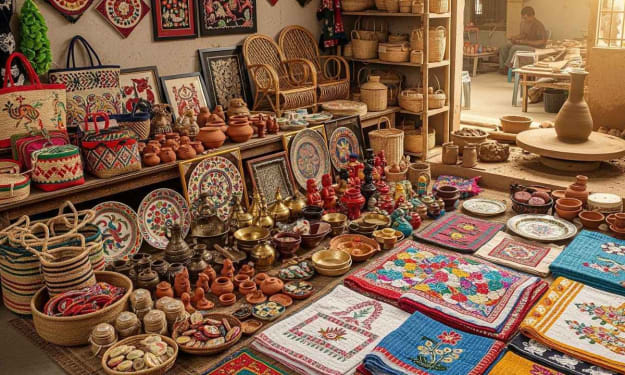
According to IMARC Group's latest research publication, "GCC Handicrafts Market: Industry Trends, Share, Size, Growth, Opportunity and Forecast 2026-2034", The GCC handicrafts market size reached USD 19.2 Billion in 2025. Looking forward, IMARC Group expects the market to reach USD 50.3 Billion by 2034, exhibiting a growth rate (CAGR) of 11.31% during 2026-2034.
By Abhay Rajput2 days ago in Futurism


Comments
There are no comments for this story
Be the first to respond and start the conversation.