
Global Smoke Detector Market: Technology Advancements and Industry Outlook
How wireless technologies, smart city development, and evolving safety codes are redefining market opportunities


According to IMARC Group's latest research publication, global smoke detector market size reached USD 2.26 Billion in 2024. Looking forward, IMARC Group expects the market to reach USD 4.07 Billion by 2033, exhibiting a growth rate (CAGR) of 7.64% during 2025-2033.
How AI is Reshaping the Future of Smoke Detector Market
- Predictive Analytics for False Alarm Reduction: Machine learning analyzes environmental patterns to distinguish real threats from cooking smoke or steam, cutting false alarms by up to 43%. Advanced algorithms adapt detection thresholds based on location-specific conditions, ensuring reliable fire identification.
- Smart Integration with IoT Ecosystems: AI-powered detectors seamlessly connect with smart home platforms via Wi-Fi and Thread networking, enabling real-time mobile alerts. Systems automatically trigger emergency protocols, activating ventilation, unlocking exits, and alerting authorities when fires are detected.
- Computer Vision for Early Fire Detection: Video analytics paired with AI surveillance continuously scan for visual smoke and fire signatures before traditional sensors activate. These systems identify fire origin points and track spread patterns, providing security personnel actionable intelligence for faster response.
- Self-Diagnostic and Predictive Maintenance: AI-enabled detectors perform automated system health checks every 48 hours, reporting battery status and sensor functionality through mobile dashboards. Predictive algorithms forecast component failures, scheduling maintenance before breakdowns occur and ensuring continuous protection.
- Multi-Sensor Fusion Technology: AI combines data from photoelectric, ionization, thermal, and carbon monoxide sensors to create comprehensive threat profiles. Intelligent algorithms weigh multiple inputs simultaneously, detecting both fast-flaming and slow-smoldering fires with exceptional accuracy while minimizing nuisance alarms.
Smoke Detector Industry Overview:
The global construction industry's expansion drives smoke detector adoption, with the United States building facilities worth over USD 2.1 trillion annually and China's construction sector reaching CNY 31.6 trillion (USD 4.4 trillion) in 2023. Stringent regulations like NFPA 72 in the U.S. and the International Building Code mandate smoke alarm installations in residential and commercial structures, creating consistent demand. The NFPA reported approximately 1.39 million fire incidents in the United States during 2023, resulting in 3,670 civilian deaths and 13,350 injuries, underscoring the critical need for reliable fire detection systems. Smart home technology integration is reshaping the market, with connected detectors sending real-time alerts via mobile apps and featuring remote monitoring capabilities that enable faster emergency responses.
Get Instant Access to a Free “Smoke Detector Market” Report Sample
Smoke Detector Market Trends & Drivers
Stricter building codes and fire safety regulations worldwide are the primary catalyst for market expansion, with governments mandating smoke detector installation in residential and commercial buildings. In the United States, non-compliance with local building codes can result in fines ranging from USD 500 to USD 10,000 per violation, compelling property owners to prioritize installation. The National Fire Protection Association has strengthened requirements, now mandating smoke detectors in bedrooms, hallways, and at least one location on each building level. With approximately 80% of the U.S. population urbanized and 75% of new buildings legally required to install smoke detectors according to the International Code Council, regulatory pressure ensures sustained demand across residential and commercial sectors.
Rapid urbanization and infrastructure development create expanding opportunities for smoke detector manufacturers, particularly in high-rise apartments, commercial spaces, and public buildings vulnerable to fire incidents. The migration to urban areas necessitates more housing and commercial spaces, indirectly boosting demand for fire safety equipment. Chemical plants, oil refineries, manufacturing units, and data centers face strict installation requirements due to high-risk operations, with industrial buildings representing a substantial market segment. Energy and power plants, telecom facilities, transportation centers including airports and stations all require comprehensive smoke detection systems. The growing awareness of workplace safety and employee protection has prompted businesses to invest in advanced fire detection as part of their safety protocols.
Smart home adoption and IoT-enabled fire safety solutions are revolutionizing the market, with consumers increasingly choosing connected smoke detectors featuring real-time alerts and remote monitoring. Amazon's January 2025 partnership with Kidde to launch Ring-integrated smoke and carbon monoxide detectors priced at USD 55-75, featuring Wi-Fi connectivity and optional USD 5/month monitoring service, exemplifies this trend. Installing home security systems can reduce insurance premiums by up to 15%, translating to average annual savings of approximately USD 26 according to Kangaroo Home Security, further incentivizing adoption. Modern detectors integrate seamlessly with Apple HomeKit, Amazon Alexa, and Google Home, creating comprehensive safety ecosystems. The July 2024 adoption of new NIST standards requiring detectors to identify both fast-burning and smoldering fires without triggering from cooking activities has driven innovation in sensor technology.
Leading Companies Operating in the Smoke Detector Industry:
- ABB Group
- Hochiki Corporation
- Honeywell International
- Johnson Controls International PLC
- Robert Bosch GmbH
- Schneider Electric
- SECOM CO., LTD
- Siemens AG
- United Technologies Corporation
- Ceasefire Industries Pvt. Ltd.
Smoke Detector Market Report Segmentation:
By Product Type:
- Photoelectric Smoke Detector
- Dual Sensor Smoke Detector
- Ionization Smoke Detector
Photoelectric smoke detectors lead the market due to their effectiveness in detecting smoldering fires, lower false alarms, and compliance with strict safety regulations.
By Power Source:
- Hardwired with Battery Backup
- Hardwired without Battery Backup
- Battery Powered
Battery-powered detectors dominate for their ease of installation, no wiring requirements, and improved battery life, making them ideal for both new and retrofit applications.
By End-Use Sector:
- Oil, Gas & Mining
- Residential
- Commercial
- Transportation & Logistics
- Manufacturing
- Telecommunication
- Others
The commercial sector holds the largest share, driven by mandatory fire safety systems, infrastructure growth, and businesses prioritizing employee and asset protection.
Regional Insights:
- North America (United States, Canada)
- Asia Pacific (China, Japan, India, South Korea, Australia, Indonesia, Others)
- Europe (Germany, France, United Kingdom, Italy, Spain, Russia, Others)
- Latin America (Brazil, Mexico, Others)
- Middle East and Africa
North America leads due to high adoption rates, strict NFPA regulations, rising CO awareness, commercial expansion, and strong smart home integration.
Recent News and Developments in Smoke Detector Market
- January 2025: Amazon announced at CES a partnership with Kidde to launch smoke and carbon monoxide detectors integrated with Ring technology. Priced between USD 55 and USD 75, the devices connect to Wi-Fi, provide push notifications for alerts, and include an optional USD 5/month monitoring service. Both the detectors and service will launch on April 2, 2025.
- November 2024: Aqara announced two new smart home safety devices: the Smoke Detector for European markets and the Valve Controller T1 for global release. The Smoke Detector offers smartphone notifications, Zigbee support, and a 10-year battery life. Both devices are Matter-compatible and integrate with Apple HomeKit, Amazon Alexa, and Google Home.
- October 2024: Siterwell launched the A8612B Combo Smoke & Carbon Monoxide Detector in the U.S., featuring 15-second faster smoke detection than UL217 9th Edition standards. Equipped with advanced dual-lightwave technology, it minimizes false alarms from cooking smoke while providing intelligent CO monitoring. The detector also offers a 10-year battery life and bilingual voice alerts.
- October 2024: Honeywell launched the Notifier Inspire fire alarm system, featuring EN-approved self-testing smoke detectors. These detectors automatically test optical and thermal sensors, enhancing safety while reducing maintenance challenges in hard-to-reach areas. The system integrates with Honeywell's CLSS cloud platform for real-time monitoring and streamlined maintenance.
- October 2024: Siemens Smart Infrastructure announced its acquisition of Danfoss Fire Safety, a subsidiary of the Danfoss Group specializing in fire suppression technology. This strategic move enhances Siemens' fire suppression portfolio, particularly with high-pressure water mist technology, and strengthens its offering of sustainable fire safety solutions.
Note: If you require specific details, data, or insights that are not currently included in the scope of this report, we are happy to accommodate your request. As part of our customization service, we will gather and provide the additional information you need, tailored to your specific requirements. Please let us know your exact needs, and we will ensure the report is updated accordingly to meet your expectations.
About the Creator
Andrew Sullivan
Hello, I’m Andrew Sullivan. I have over 9+ years of experience as a market research specialist.
Keep reading
More stories from Andrew Sullivan and writers in Futurism and other communities.
Bakery Ingredients Market: Supply Chain Dynamics and Raw Material Trends
According to IMARC Group's latest research publication, global bakery ingredients market size reached USD 17.3 Billion in 2024. Looking forward, IMARC Group expects the market to reach USD 26.0 Billion by 2033, exhibiting a growth rate (CAGR) of 4.4% during 2025-2033.
By Andrew Sullivan5 days ago in Futurism
About Binding Prometheus
I want to start actively advocating on behalf of my own work, and the most valuable part of my canon is, without a doubt, Binding Prometheus, the play I have been working on since 2019 and only finished in 2023 as part of my MA. The play itself is an amalgamation of a million different inspirations. On one end, it evokes the Ancient Greek myth-play, deriving its own title from the earliest extant work of Western drama we have, Aeschylus’s Prometheus Bound. On the other end, it borrows significantly from the sci-fi bulwarks from over the years, namely Mary Shelley’s Frankenstein and Karel Capek’s Rossum’s Universal Robots. The play could be an episode of Black Mirror, I fear. I don’t know. I’ve only ever seen one episode of Black Mirror.
By Steven Christopher McKnight10 days ago in Futurism
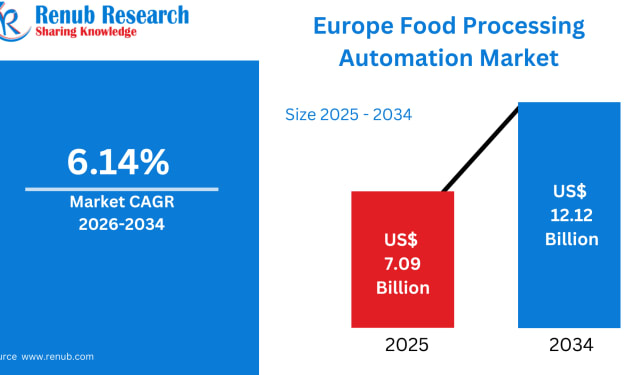
Europe Food Processing Automation Market Size & Forecast 2026–2034
Europe Food Processing Automation Market at a Glance The Europe food processing automation market is entering a decisive decade of transformation. According to Renub Research, the market is expected to expand from US$ 7.09 billion in 2025 to US$ 12.12 billion by 2034, registering a compound annual growth rate (CAGR) of 6.14% from 2026 to 2034.
By Renub Research2 days ago in Futurism
Fair Exchange, No Robberies
Dark Memoirs - Index There are at least two kinds of people in the world: those who write this half-arsed kind of intro to a story that looks to separate the rare and the norm, and those who realise it's an overused framing device and don't.
By Paul Stewart6 days ago in Chapters



Comments
There are no comments for this story
Be the first to respond and start the conversation.