
Global Champagne Market Size, Growth Trends & Forecast 2025–2033
Luxury Bubbles Continue to Rise as Celebration Culture Expands Worldwide

Global Champagne Market Overview
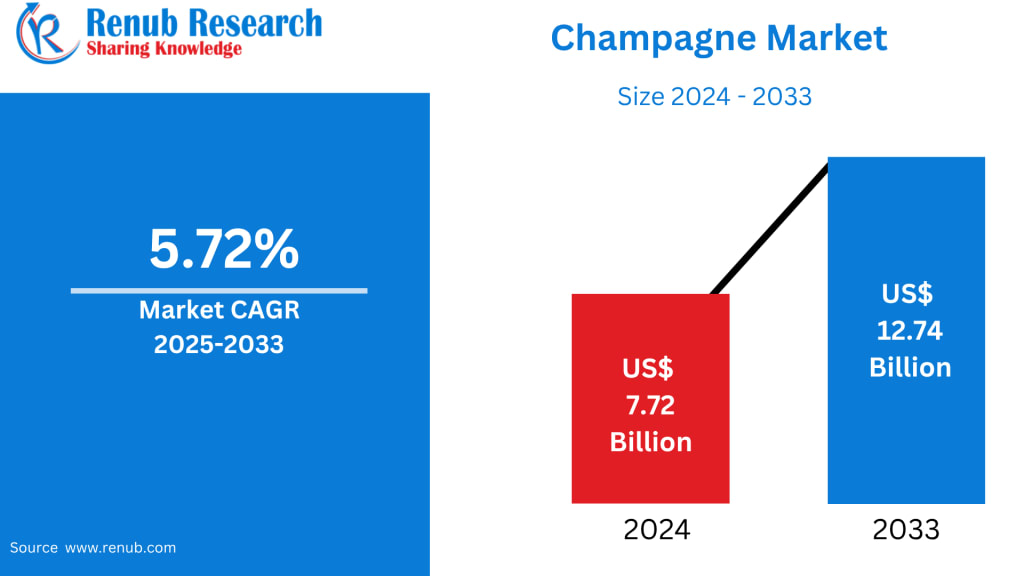
The Global Champagne Market was valued at USD 7.72 billion in 2024 and is forecast to reach USD 12.74 billion by 2033, growing at a CAGR of 5.72% during the forecast period. This growth is supported by rising luxury spending, expanding premium gift culture, and increasing consumption of celebratory beverages in both mature and emerging economies.
Champagne has long symbolized celebration, success, and prestige, but its global appeal has evolved beyond traditional European and North American markets. Today, demand is rising sharply in Asia-Pacific, the Middle East, and Latin America, where changing lifestyles and growing disposable incomes are creating new consumer bases for premium beverages.
Despite facing supply constraints and competition from alternative sparkling wines, champagne continues to maintain its elite positioning due to strict origin regulations, powerful branding, and deep cultural association with luxury moments.
What Makes Champagne Unique
Champagne is a sparkling wine produced exclusively in the Champagne region of France, using specific grape varieties—Chardonnay, Pinot Noir, and Pinot Meunier—and following the traditional méthode champenoise production process. These strict rules, protected by Appellation d'Origine Contrôlée (AOC) status, ensure consistent quality, authenticity, and global recognition.
The combination of craftsmanship, heritage, and controlled production makes champagne one of the most respected alcoholic beverages in the world. Its refined taste, elegant effervescence, and ceremonial role have secured its place in weddings, corporate events, festivals, and high-end dining experiences worldwide.
Key Growth Drivers of the Global Champagne Market
1. Rising Luxury Consumption and Gift Culture
One of the strongest drivers of champagne demand is the expansion of luxury consumption, particularly in emerging markets. Champagne is widely perceived as a status symbol, making it a preferred choice for gifting during weddings, corporate milestones, festive seasons, and personal celebrations.
As middle-class and upper-middle-class populations expand in countries such as China, India, UAE, and Southeast Asia, champagne is increasingly used to mark success and social standing. Corporate gifting, premium hospitality, and celebratory dining continue to reinforce champagne’s role in modern luxury culture.
2. Growth of Premium, Vintage, and Prestige Cuvée Offerings
Champagne producers are increasingly focusing on premiumization, introducing vintage blends, prestige cuvées, and limited-edition bottles to attract collectors and wine connoisseurs. These products command higher margins and elevate brand value.
For example, in June 2024, Laurent-Perrier launched Heritage, a multi-vintage blend positioned between its non-vintage and high-end products. Such innovations attract younger consumers seeking exclusivity and new experiences while retaining traditional luxury buyers.
Wine tourism, tasting events, and social media storytelling have further strengthened the global appeal of premium champagne segments.
3. Globalization and Digital Accessibility
Improved logistics, expanding e-commerce infrastructure, and digital marketing have made champagne more accessible than ever. Consumers can now browse, compare, and order premium bottles from online platforms such as Vivino, Wine.com, and regional wine retailers.
Digital wine tastings, influencer collaborations, and brand storytelling campaigns have significantly boosted awareness in non-traditional markets. In 2022, Laurent-Perrier partnered with Selfridges to offer customized packaging for its Cuvée Rosé, combining luxury retail with personalization—an approach increasingly favored by modern consumers.
Challenges Facing the Champagne Market
1. Strict Production Regulations and Supply Limitations
While AOC regulations protect champagne’s identity, they also limit production capacity. Producers cannot expand vineyards or significantly increase yields, even during periods of rising demand. This often leads to higher prices and supply shortages, especially for vintage and prestige bottles.
Climate change is also impacting grape quality and harvest consistency, creating additional pressure on producers to maintain standards while managing unpredictable weather patterns.
2. Growing Competition from Alternative Sparkling Wines
Champagne faces intense competition from Prosecco (Italy), Cava (Spain), and sparkling wines from the U.S., Australia, and England. These alternatives offer similar celebratory appeal at lower prices, making them attractive to younger and value-conscious consumers.
To maintain relevance, champagne brands must continue emphasizing heritage, terroir, craftsmanship, and authenticity—the elements that justify their premium pricing.
Market Segmentation Analysis
By Product Type
Prestige Cuvée: Ultra-premium bottles such as Dom Pérignon and Cristal dominate the luxury gifting and collector segment.
Blanc de Noirs: Made exclusively from dark grapes, offering richer, bolder flavor profiles.
Blanc de Blancs: Produced entirely from Chardonnay, known for elegance and freshness.
Rosé Champagne: Popular among younger consumers and lifestyle-driven buyers.
Others: Includes experimental blends and limited releases.
By Price Range
Economy: Entry-level non-vintage champagnes for casual celebrations and restaurants.
Mid-Range: Balanced offerings combining quality and affordability.
Luxury: Premium and limited-edition bottles positioned for high-end gifting and events.
By Distribution Channel
Supermarkets & Hypermarkets: Drive volume sales and everyday accessibility.
Specialty Stores: Focus on expert guidance, tastings, and premium selections.
Online Stores: Fastest-growing channel due to convenience and global reach.
Regional Market Insights
United States Champagne Market
The U.S. remains one of the largest importers of champagne globally, driven by strong premium beverage culture and celebratory spending. Champagne consumption is expanding beyond traditional occasions into brunch culture, gifting, and subscription wine clubs.
According to the U.S. Alcohol and Tobacco Tax and Trade Bureau, imports of sparkling wine—including champagne—reached 26.6 million cases in 2022, highlighting growing consumer interest in high-quality sparkling beverages.
Germany Champagne Market
Germany is Europe’s largest sparkling wine consumer and an increasingly important champagne market. While price sensitivity exists, demand for vintage and prestige cuvées is growing among affluent wine enthusiasts. Sustainability and organic production are emerging as key purchase drivers.
China Champagne Market
China is one of the fastest-growing champagne markets, fueled by rising disposable incomes and Western lifestyle adoption. Champagne is widely used for gifting, business dinners, and upscale events, especially in tier-one cities such as Shanghai, Beijing, and Shenzhen.
According to China’s National Bureau of Statistics, the foreign wine market is expected to exceed USD 10 billion by 2025, positioning champagne as a premium beneficiary of this growth.
Saudi Arabia Champagne Market
Although alcohol sales are restricted, non-alcoholic “halal champagne” alternatives are gaining traction in Saudi Arabia. As Vision 2030 drives tourism, hospitality, and luxury dining development, alcohol-free sparkling beverages are increasingly used for weddings, events, and upscale experiences.
Key Players in the Global Champagne Market
The competitive landscape is defined by heritage brands, global distribution strength, and innovation in premium offerings. Major players include:
LVMH Moët Hennessy
Laurent-Perrier Group
Société Jacques Bollinger SA
Champagne Taittinger
Champagne AYALA
Diageo plc
F. Korbel & Bros.
Cook’s Champagne Cellars
Andre Champagne Cellars
La Marca USA
Each company has been analyzed across overview, leadership, recent developments, SWOT, and revenue performance, reflecting their strategic positions in the global market.
Future Outlook: Champagne’s Enduring Global Appeal
The champagne market is entering a phase of sustainable premium growth, where heritage, authenticity, and digital engagement define brand success. While production remains constrained, demand is expanding into new demographics and regions, ensuring long-term value growth.
Luxury gifting, experiential consumption, and premium celebrations will continue to drive market expansion, particularly in Asia-Pacific and the Middle East. As consumers seek meaningful experiences and elevated moments, champagne remains the ultimate symbol of celebration—timeless, refined, and globally admired.
Final Thoughts
From historic cellars in France to high-rise celebrations in Asia, champagne continues to evolve while preserving its identity. With rising global wealth, digital accessibility, and premiumization trends, the Global Champagne Market is set for steady growth through 2033, offering opportunities for producers, distributors, and luxury retailers alike.
About the Creator
Marthan Sir
Educator with 30+ years of teaching experience | Passionate about sharing knowledge, life lessons & insights | Writing to inspire, inform, and empower readers.
Keep reading
More stories from Marthan Sir and writers in Futurism and other communities.
Global Coffee Market Size and Forecast 2025–2033: Brewing Growth in a Changing World
Introduction: Coffee’s Expanding Global Footprint Coffee is no longer just a morning beverage—it is a global cultural, economic, and lifestyle phenomenon. From the bustling cafés of Europe to the rapidly expanding coffee culture in Asia-Pacific, coffee has become deeply woven into everyday life. According to Renub Research, the global coffee market is expected to grow from US$ 121.69 billion in 2024 to US$ 186.55 billion by 2033, expanding at a CAGR of 4.86% from 2025 to 2033.
By Marthan Sir3 days ago in Futurism
About Binding Prometheus
I want to start actively advocating on behalf of my own work, and the most valuable part of my canon is, without a doubt, Binding Prometheus, the play I have been working on since 2019 and only finished in 2023 as part of my MA. The play itself is an amalgamation of a million different inspirations. On one end, it evokes the Ancient Greek myth-play, deriving its own title from the earliest extant work of Western drama we have, Aeschylus’s Prometheus Bound. On the other end, it borrows significantly from the sci-fi bulwarks from over the years, namely Mary Shelley’s Frankenstein and Karel Capek’s Rossum’s Universal Robots. The play could be an episode of Black Mirror, I fear. I don’t know. I’ve only ever seen one episode of Black Mirror.
By Steven Christopher McKnight23 days ago in Futurism
Biosensors Market: Electrochemical Sensors, High Sensitivity Detection & Analytical Accuracy
According to IMARC Group's latest research publication, global biosensors market size reached USD 30.9 Billion in 2024. Looking forward, IMARC Group expects the market to reach USD 57.0 Billion by 2033, exhibiting a growth rate (CAGR) of 6.97% during 2025-2033.
By sujeet. imarcgroup4 days ago in Futurism


Comments
There are no comments for this story
Be the first to respond and start the conversation.