
Fitbits Are Stupid
We shouldn't have this much data about ourselves.

That's the danger with getting fit. Sooner or later, you want data.
My desire started off quite simply. I was running regular 5k runs, and I wanted a way to time myself, track my distance (for when I started running more) and possibly see if my heart was doing anything it shouldn't. Nothing was wrong with my heart, you understand, but I like to check.
My phone wasn't going to cut it. I run with it in a tight waist belt, which is great for keeping it firmly in place and out of the way, less great for starting and stopping timers. I could have gone with some sort of acceleratometer app, I suppose, but I also sensed the opportunity to buy a new gadget, so fuck that.
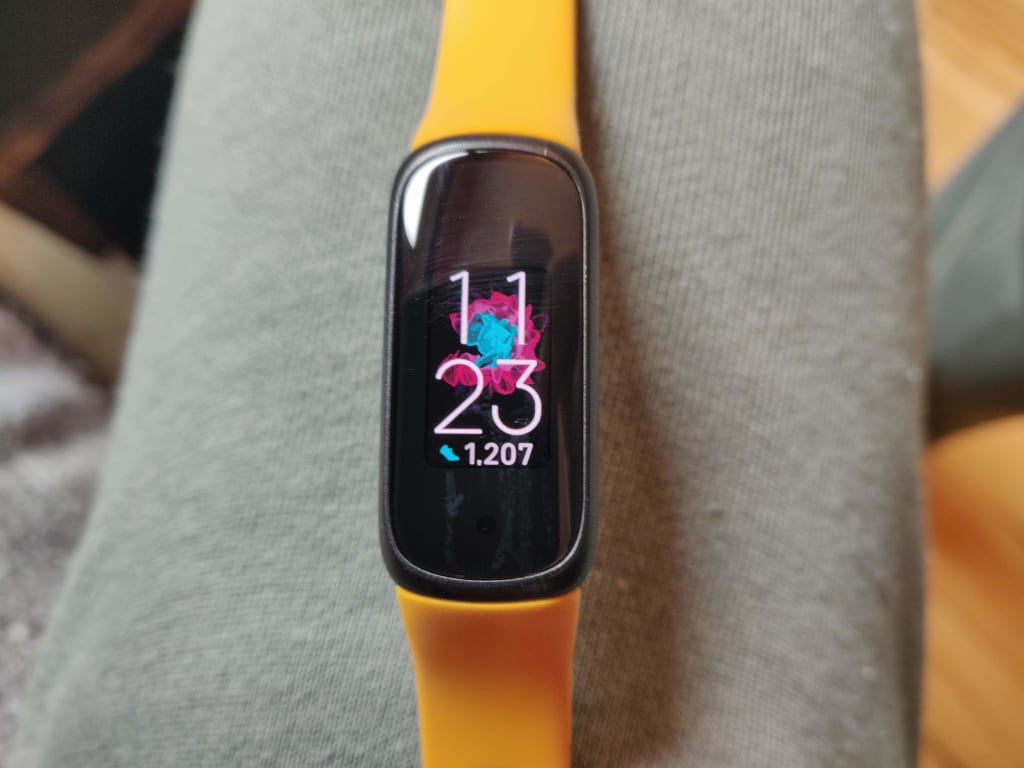
I'm not going to bore you with a breakdown of the world of fitness trackers. You either have one already, or you don't care. I went with a Fitbit Inspire 3, a chunky-ass watch thing with a neon orange band that my wife despises.
I discovered very quickly that this thing could do so much more than track heart rate and distance. It gave me access to a frankly absurd level of data on my body and my health in general.

Did I wish to know what my sleep animal was? Any interest in your Heart Rate Variation, Sir? Perhaps a Daily Readiness Score to give you an indication of how much physical activity will hurt that day? Antioxidant Power Mutations? A step counter? Calories burned? Overall Elevated Recombinant Levels? Active Zone Minutes? Stress Management?
(I made two of those up, by the way. And I don't know what my sleep animal is yet—apparently you have to wear it for a few nights. I'm holding out for marmoset, although I will take meerkat.)

After some time with the Inspire 3, I have a few observations. Most of which are a bit worrying.
Firstly: data can do funny things to your mind. I have several friends who have diligently tracked their sleep and fitness for years, and I have sometimes gravely warned them not to get too obsessed with the numbers. "Your sleep score won't help!" I would intone. "You can't do anything about last night's sleep! You'll just be more anxious for tonight! Only look at the averages, you poor fools."
And then I got my first morning's sleep data. My Heart Rate Variability was shockingly low. I wasn't spending nearly enough time in deep sleep. Never mind the fact that I'd slept soundly for nearly eight hours and felt spry: THIS WAS A CATASTROPHE.
I had to quite firmly tell myself to stop, because I could see where this was going, and it involved hyperventilating in the corner. Fortunately, the app makes it easy to either hide or minimise this data, and I've resolved not to check it until I've been assigned my sleep marmoset.
This leads neatly into my second observation: my Fitbit is a bit dim.
Example: the Daily Readiness Score. That was something I didn't make up. It's a number out of a hundred, and it tells you how ready you are for physical activity. After a few days' calibration, I got my first score, which was...one. Out of a hundred.
Thanks, Fitbit, you fucking prick.
Since then, I've never gotten more than forty-four, even on days where I felt just fine and quite capable of a challenging workout.

Then there's the heart rate monitor. It is—how shall I put this?—easily confused.
I initially wore the Fitbit on my left wrist, because that's where my watch goes when I wear it. But I have a full sleeve tattoo, and something in the ink confuses the monitor and stops it working, which seems like a rather silly design flaw in 2022, when you get strange looks if you don't have tattoos.
Fine. Right wrist it is. The monitor worked fine there, but its results were sometimes a little haphazard. The Fitbit makes a big deal of how it can automatically sense the start of a workout or a run, based on heart rate. But when I start a gym session, it takes me quite some time for my heart rate to elevate high enough to trigger this—I don't know why.
It's certainly not because my workouts are easy; I did a reasonably challenging one yesterday, with heavy squats and deadlifts and lat pulldowns, all at a decent clip.
(I know it was challenging because today I could barely walk. At least, not without making a noise like a wounded sleep animal.)
I was two thirds through before my Fitbit buzzed, congratulating me for starting my workout...which it then registered as a walk.
I truly don't know if I can trust the data my orange-strapped machine is giving me, and so I've resolved to disregard almost all of it. Unless, of course, it tells me my cardiovascular health is tip-top, or my resting heart rate is that of an endurance athlete, or if my sleep animal is a grizzly bear. Then, of course, it's all accurate.
I will allow that fitness trackers, when used for basic things, work pretty well—tracking time and distance on runs is child's play, and I can assume a fair degree of accuracy there. I'm also certain that were I to spend hundreds of dollars more on a sleeker and better-built model, my data would be more accurate.
But that's the thing. If you discount timing my runs, I'm not trying to solve a problem. I feel fine. Any data my Fitbit gives me will just fuel my anxiety, and frankly, I have more important things to worry about. Like what a marmoset actually is...
About the Creator
Jackson Ford
Author (he/him). I write The Frost Files. Sometimes Rob Boffard. Always unfuckwittable. Major potty mouth. A SH*TLOAD OF CRAZY POWERS out now!
Keep reading
More stories from Jackson Ford and writers in Futurism and other communities.
The ReReadables: The Art of Fielding
Welcome to The ReReadables! It's a brand new, occasional series where I'll talk about books I keep coming back to. Anyone who reads has books that they have read multiple times, but they keep coming back to, like visiting an old friend. I certainly have these. And each time I read them, I find something new to enjoy.
By Jackson Ford3 years ago in Journal
Australia Regenerative Medicine Market: Clinical Demand, Research Innovation & Therapeutic Advancements
According to IMARC Group, the Australia regenerative medicine market reached USD 636.5 Million in 2025 and is projected to surge to USD 2,875.4 Million by 2034, exhibiting a remarkable compound annual growth rate (CAGR) of 18.24% during 2026–2034. This rapid expansion highlights Australia’s growing prominence in advanced biomedical innovation across Australia. Regenerative medicine—encompassing stem cell therapy, tissue engineering, gene therapy and biologics—focuses on repairing, replacing or regenerating damaged cells and tissues. As chronic diseases and age-related conditions rise, demand for transformative therapeutic solutions is reshaping the country’s healthcare and life sciences landscape.
By Shrestha Roy7 days ago in Futurism
Australia Digital Payment Market: Consumer Adoption, Fintech Innovation & Regulatory Frameworks
According to IMARC Group, the Australia digital payment market was valued at USD 142.7 Billion in 2025 and is projected to reach USD 728.1 Billion by 2034, exhibiting a robust compound annual growth rate (CAGR) of 19.86% during 2026–2034. Notably, Victoria & Tasmania dominate the market, accounting for a significant 38.3% share in 2025, reflecting strong regional digital infrastructure and consumer adoption trends. The rapid transition toward cashless transactions across Australia underscores a fundamental transformation in financial behavior, driven by smartphone penetration, mobile wallet usage, expanding e-commerce activity and increasing demand for peer-to-peer (P2P) and buy now, pay later (BNPL) services.
By Kevin Cooper5 days ago in Futurism
Trickle Them Down, But Not Out
The thing about smart people is that they should know better, but alas, intelligence is not the same as wisdom. Not only do the mistakes of experts too short on vision—when they are not corrected—have the potential to do great and far-reaching damage, but they also undermine public confidence in the very notion of expertise. This is particularly so when expertise is wielded in defence of the rich and powerful as a cudgel against those laid low. As an academic, this lack of faith in “so-called experts” is painful to see as it plays out in the spread of dis-/misinformation, conspiracy theories, and anti-intellectualism writ large. But it is also an understandable impulse given the catastrophic failure of an economic ideology pushed by certain economic experts. Supply-side economics has shaped a broken system for the last half-century and has arguably done more to undermine the fabric of the American Dream than any policy framework of the past century.
By Cory Wright-Maley7 days ago in Humans


Comments (2)
Agreed. Fucking hate those things. "Any data my Fitbit gives me will just fuel my anxiety, and frankly, I have more important things to worry about. Like what a marmoset actually is..." haha, awesome
Lol this title makes me happy