
Fire Sprinklers Market Size and Forecast 2025–2033
How Smart Fire Protection Systems Are Reshaping Global Building Safety

Global Fire Sprinklers Market Outlook
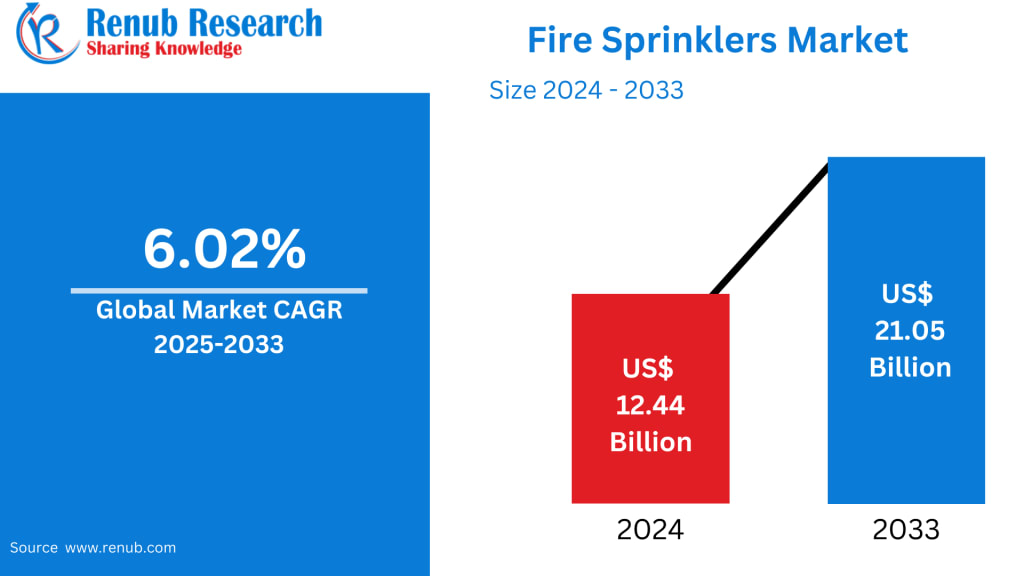
The global fire sprinklers market is entering a strong growth phase as governments, insurers, and property developers increasingly prioritize fire safety. According to Renub Research, the fire sprinklers market is expected to reach US$ 21.05 billion by 2033, rising from US$ 12.44 billion in 2024, at a CAGR of 6.02% between 2025 and 2033.
This expansion is being driven by a combination of strict fire safety regulations, rapid urbanization, infrastructure modernization, and growing awareness of life and property protection. Additionally, technological advancements such as smart sprinklers, automated detection systems, and IoT-based monitoring are transforming traditional fire suppression into intelligent safety ecosystems.
From residential high-rises to industrial plants and commercial complexes, fire sprinklers are no longer optional additions — they are becoming mandatory safety infrastructure across the globe.
Global Fire Sprinklers Industry Overview
The fire sprinklers industry plays a critical role in modern fire protection strategies. With the rise in high-density urban living and large-scale commercial developments, the potential risk and impact of fire incidents have increased significantly. Governments and regulatory authorities worldwide are responding by tightening building codes and enforcing mandatory installation of fire suppression systems.
Fire sprinkler systems act as the first line of defense against fire outbreaks. Unlike manual fire-fighting measures, these systems automatically detect and suppress fires at the source, significantly reducing damage and saving lives. Modern systems are increasingly integrated with building management systems (BMS), allowing real-time monitoring, faster response, and lower maintenance costs.
The growing emphasis on loss prevention rather than damage control is further accelerating market demand. Businesses, insurers, and governments now recognize that early fire suppression reduces insurance claims, minimizes downtime, and protects human lives — making fire sprinklers a long-term economic and safety investment.
Key Drivers Fueling Fire Sprinklers Market Growth
1. Rapid Urbanization and Infrastructure Development
Urbanization remains one of the most powerful growth drivers for the fire sprinklers market. According to United Nations projections, 68% of the world’s population will live in cities by 2050, up from just over 50% today. This massive shift is fueling unprecedented construction of residential towers, shopping complexes, offices, hospitals, factories, and public infrastructure.
High-rise buildings and dense urban areas significantly increase fire risk due to limited evacuation routes and higher occupancy. To address this, authorities are mandating the installation of sprinkler systems in both new and renovated buildings. In many emerging economies, fire safety standards are being upgraded to match international norms, creating strong long-term demand for sprinkler installations.
2. Expanding Influence of the Insurance Industry
The insurance sector plays a major role in the adoption of fire sprinkler systems. Insurers increasingly offer lower premiums and better coverage for buildings equipped with automatic fire suppression systems. In high-risk industries and commercial spaces, sprinkler installation is often required as a condition for insurance approval.
Insurance companies also collaborate with regulators to shape fire safety codes, reinforcing the importance of sprinklers as a preventive measure. This alignment between insurance incentives and regulation is accelerating adoption across residential, commercial, and industrial properties worldwide.
3. Strict Fire Safety Regulations Worldwide
Governments across regions are strengthening fire safety regulations in response to rising fire incidents and public safety concerns. In developed markets, compliance with fire sprinkler standards is mandatory in most new construction projects. For example, NFPA 13 standards in the United States define strict guidelines for sprinkler system design and installation.
Non-compliance can lead to heavy fines, legal consequences, and insurance denial — making sprinkler systems a non-negotiable requirement for developers. Similar regulations are being adopted across Europe, Asia-Pacific, and the Middle East, driving sustained market expansion.
4. Technological Advancements in Fire Sprinkler Systems
Innovation is reshaping the fire sprinklers industry. Modern systems now include smart sensors, automated controls, remote monitoring, and predictive maintenance capabilities. IoT-enabled sprinklers can detect fire hazards faster, reduce false alarms, and provide real-time system status to building managers.
Advanced materials and improved system designs are also reducing water usage and installation complexity, making sprinkler systems more attractive for retrofitting older buildings.
Challenges Facing the Fire Sprinklers Market
High Installation and Maintenance Costs
Despite their life-saving benefits, fire sprinkler systems involve high upfront costs, particularly for small businesses and residential properties. Installation requires specialized design, skilled labor, piping, and integration with existing infrastructure — which can be expensive, especially in older buildings.
Additionally, ongoing maintenance is mandatory to ensure system reliability. Regular inspections, testing, and part replacements add to long-term costs, slowing adoption in price-sensitive regions.
Regulatory Variability Across Regions
Fire safety regulations vary significantly between countries and even within regions. This creates complexity for manufacturers and service providers, who must adapt designs and certifications for each market. Frequent updates to local codes also require ongoing training and documentation, increasing operational costs and slowing international expansion.
Regional Outlook: Fire Sprinklers Market by Geography
United States Fire Sprinklers Market
The U.S. represents one of the most mature and technologically advanced fire sprinkler markets. Strict fire codes, strong insurance influence, and a well-established construction industry drive widespread adoption across all sectors.
As of 2025, there are 19,845 companies in the U.S. engaged in fire protection system installation and services. Growth is further supported by investments in infrastructure modernization and the retrofitting of older buildings to meet updated safety standards.
Smart sprinkler systems are increasingly deployed in hospitals, airports, data centers, and commercial facilities, reinforcing the U.S. market’s leadership in innovation.
United Kingdom Fire Sprinklers Market
The UK fire sprinkler market is expanding steadily, driven by tighter regulations following high-profile fire incidents and renewed focus on building safety. New laws now require automatic fire suppression systems in high-rise residential buildings, significantly boosting demand.
Retrofitting older structures and the adoption of eco-friendly sprinkler systems are also contributing to market growth. Despite challenges such as skilled labor shortages, the long-term outlook remains positive as safety compliance becomes a top priority.
India Fire Sprinklers Market
India’s fire sprinkler market is experiencing rapid growth due to urban expansion, high-rise construction, and stricter enforcement of fire safety laws. Sprinkler systems are now mandatory in malls, IT parks, residential towers, and industrial facilities.
Fire incidents caused by electrical faults have risen sharply — 21% of fire accidents in 2022 were due to electrical issues, up from just 3% in 1996 — prompting authorities to strengthen safety standards. Government initiatives and insurance incentives are accelerating adoption, while smart sprinkler technology is gaining traction in large commercial projects.
United Arab Emirates Fire Sprinklers Market
The UAE’s fire sprinkler market is expanding rapidly alongside its ambitious infrastructure development. High-rise buildings, luxury residential projects, and mega commercial complexes require advanced fire suppression systems under strict local regulations.
The country is also embracing IoT-enabled and smart fire safety solutions, particularly in smart city developments. Despite higher installation costs, continued investment in safety infrastructure and strong regulatory enforcement are driving sustained market growth.
Recent Developments in the Fire Sprinklers Industry
April 2025: The British Automatic Fire Sprinkler Association (BAFSA) launched a new online certified training program, enhancing professional skills in system design and installation.
April 2025: AGF Manufacturing introduced the PURGENVENT™ Model 7940 BLE, a next-generation automated air vent system compliant with NFPA 13 and BABAA standards, improving system reliability and air management.
These innovations highlight the industry’s ongoing commitment to performance, compliance, and reliability.
Fire Sprinklers Market Segmentation
By Component
Product
Service
By Product Type
Wet Pipe
Dry Pipe
Deluge Systems
Pre-Action Systems
Others
By Technology
Active Fire Protection
Passive Fire Protection
By Application
Commercial
Residential
Industrial
By Region
North America: United States, Canada
Europe: UK, Germany, France, Italy, Spain, Netherlands, Belgium, Turkey
Asia-Pacific: China, Japan, India, Australia, South Korea, Southeast Asia
Latin America: Brazil, Mexico, Argentina
Middle East & Africa: UAE, Saudi Arabia, South Africa
Competitive Landscape
The global fire sprinkler market is moderately consolidated, with major players focusing on innovation, acquisitions, and strategic partnerships. Key companies include:
Honeywell International
Johnson Controls
Minimax GmbH & Co. KG
API Group Inc.
United Technologies Corporation
Robert Bosch GmbH
Hochiki Corporation
VT MAK
These companies are investing heavily in smart technologies, regional expansion, and regulatory-compliant product development to maintain competitive advantage.
Final Thoughts
The global fire sprinklers market is moving beyond traditional safety solutions toward intelligent, automated, and integrated fire protection systems. As urbanization accelerates and safety regulations tighten, fire sprinklers will become standard infrastructure rather than optional installations.
With strong support from governments, insurers, and technology providers, the market’s growth trajectory toward US$ 21.05 billion by 2033 appears robust and sustainable. For stakeholders across construction, insurance, real estate, and public infrastructure, fire sprinkler systems are no longer just a safety measure — they are a critical investment in resilience, compliance, and human protection.
About the Creator
Ben Tom
Ben Tom is a seasoned content writer with 12+ years of experience creating SEO-friendly blogs, web copy, and marketing content that boosts visibility, engages audiences, and drives results.
About Binding Prometheus
I want to start actively advocating on behalf of my own work, and the most valuable part of my canon is, without a doubt, Binding Prometheus, the play I have been working on since 2019 and only finished in 2023 as part of my MA. The play itself is an amalgamation of a million different inspirations. On one end, it evokes the Ancient Greek myth-play, deriving its own title from the earliest extant work of Western drama we have, Aeschylus’s Prometheus Bound. On the other end, it borrows significantly from the sci-fi bulwarks from over the years, namely Mary Shelley’s Frankenstein and Karel Capek’s Rossum’s Universal Robots. The play could be an episode of Black Mirror, I fear. I don’t know. I’ve only ever seen one episode of Black Mirror.
By Steven Christopher McKnight22 days ago in Futurism
The CEO of Everything
They say "jack of all trades, master of none," but they forgot to mention the part where the jack of all trades is also the camera woman, the makeup artist, and the person currently yelling at a tangled Wii microphone cable in a her own bathroom while recording herself singing and trying to make it look realistic and professional. (As professional as you can make it with nothing but a cell phone camera and a mic that doesn't work)
By Sara Wilson5 days ago in Humans




Comments
There are no comments for this story
Be the first to respond and start the conversation.