
It’d be hard to explain to you the sort of desperate straits I was in when I found this book. But I shall try, for I am storyteller at heart, and cannot help but fulfill this last, foolish desire of mine.
...
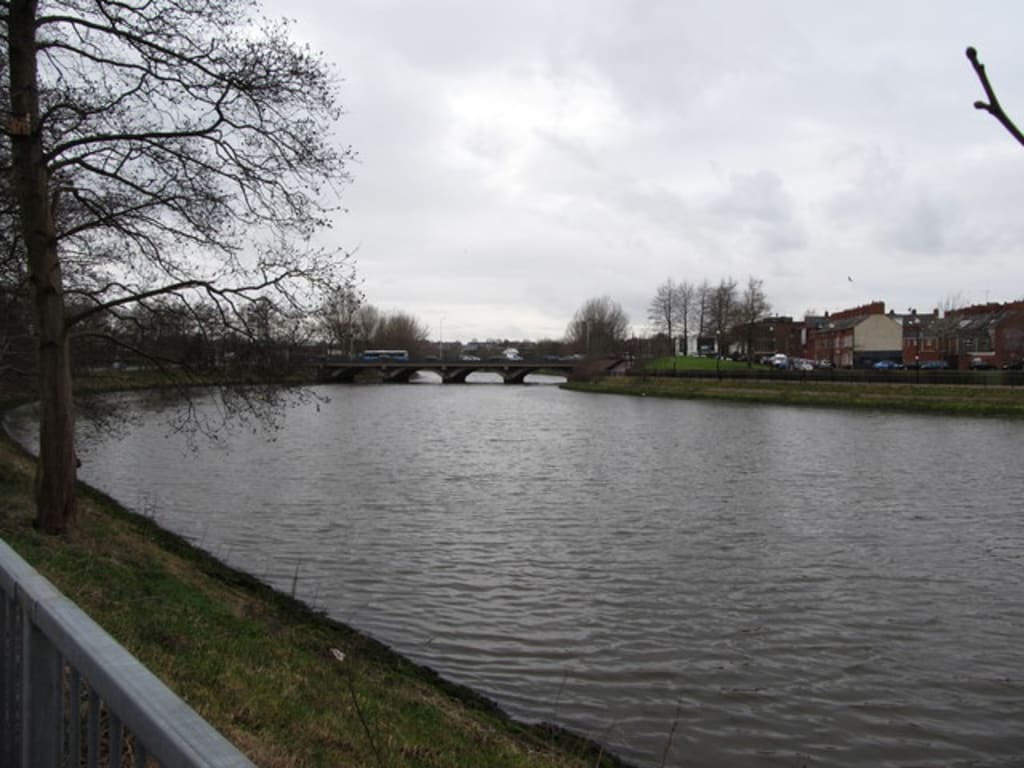
I grew up in small village outside Belfast. It was the sort of shanty town that should have been retired long ago, but stayed afloat for the sheer irony of it all.
My house was single story and had two rooms connected by an empty doorframe. A kitchen with a small wooden table for dining, and a bedroom. I slept on a wool blanket on the floor, while my mother nursed her aching bones in our only bed.
My mother was born just early enough for wealth to plump her cheeks and soften her fingers before The Famine hit. The Famine ripped apart every security she had ever known, and she watched her own house rot from the inside out. From what I know, what I can read from echoing dead things, the Famine was purgatory on Earth. The ground itself seemed to shrivel up and reject you. Families took on the face of Ugolino and devoured each other whole. And each horrific episode carried with it the sense of watching, judging eyes.
After the famine carved away her plump cheeks, my mother lived in eternal Catholic guilt, convinced that drinking and sodomy had poisoned the water and leeched the dirt dry. I, however, always had a more agnostic view of the matter. There was nothing in the rolling tides and the crowded slums of Ireland that couldn’t be seen in the rest of the world, and I knew well enough that they hadn’t gone hungry.
I never met my father. My mother said he drowned. My cousin said he left after it was certain that pregnancy had swelled my mother’s bosom to their sunken peak. My priest said, that in its final act of depravity, The Famine’s winds swept him away into a pile of dust.
My mother, the skeleton woman. My father, the crumbling man.
Given my heritage, it would be hard to believe I’m human. But I know that my blood runs red through my veins; I’ve seen it spilled and bartered over like a cut of fatty ham.
I was never able to provide for my mother as I should. Any land sowed by my hand turn over to dust. Leather, metal, and all fine crafts faced a similar fate. I lacked the schooling to be a scholar, and the obedience to be a factory worker. Money, thus, came inconsistently and in small amounts.
...
I spent most my days wandering the streets of Belfast. It was a good way to spend a day, and as good a job search as any browse through the paper.
It was on one of those days, when I was making my way back home, that I spotted it.
Maybe I was drawn to look at it by a flash of light. A speck of dust in my eye. Boredom. But I saw it, nonetheless.
A fine black notebook sat undisturbed on the ground. Cautiously, I waited a few moments. If I got caught filching the thing by its owner, I’d surely be labeled a pickpocket. After a few tense moments, I grabbed it.
The cover was smooth to the touch, and, upon opening, I saw that it housed a rich collection of aged yellow pages. Strangely, however, the pages were empty. Every single one.
‘It must have been dropped by a shopkeeper or some craftsmen,’ I thought, “It’s brand new.”
It’d fetch a decent price on the market, though it’d take some time to scrounge up someone of secure enough means to write at their own leisure. Before I could make off with it, my morals made me check the inside of the front cover for a name.
To my surprise, the inside cover was marked, but not by any name. A line of golden stitches formed a horseshoe-shape, and, dumbly, I realized it was a pocket. Somebody had stitched a pocket onto the notebook.
Quickly, I shoved my fingers inside to look for goods.
Paper. More paper. But it wasn’t the same texture as the notebook’s pages; its edges were sharper, the width thicker. It had to be something important.
I pulled it out, and the pocket made a small, sad sound as the paper scraped against its fabric. I would have missed that sound had I not been used to communicating with my mother. It was the same sound that left her lips as she swallowed her first bite of dinner, as she left prayer, and as she shifted to the soundless world of dreams.
Maybe that should have been my sign.
The paper I detected was revealed by the dusking sun to be a pair of tickets. A trip to New York on a luxury liner. No names were printed on them, but a date was: 10-4-12. It was stamped, the imprint clerical and inked black.
It was a gift from the heavens, a coincidence of no particular meaning, a meaty thigh sliced off a fat roast, a shooting star materialized. It was everything and nothing at all.
...
It was hard to arrange passage across the channel, even harder to convince my mother to accompany me, but we were arrived at the port, nonetheless.
I had to guide my mother through the crowd, which seemed to ebb and flow at the same speed as the tides in front of them. My mother was delicate, and she claimed that sea salt agitated her bones, so breaks in our pace were frequent. Still, we continued and broke through the crowd just before official boarding began.
I saw the bow of her, then, big and black and cresting over the frothing sea. She really was a thing of beauty, the latest marvel of an ever-evolving art form.
My mother followed me, her head wrapped in a sheer enough fabric that it could pass for silk in the right light. She looked like a proper Mamo, and, maybe, over there, I could make her one. Shack up with the right lady, break bread over a new dining table, line my family to sit upright like a flock of peeping chickens in the pews of a stain-glassed church.
It was that dream, so round and soft and joyful, that allowed me to leave all I had ever known for a new land.
At 10:45 am, I shook the hand of Captain Smith and expressed my sincerest pleasure to be accompanying him on the maiden voyage of the Titanic.
...
My mother, God be with her, is boarding the lifeboats. I sit here, unable or unwilling to move. There is no longer any difference between the two for me. I think I know the face of my father now.
As I write, I have one last tidbit of knowledge to impart on you.
When drowning, the feeling of frigidness overpowers the taste of salt.
The Diary of [NAME REDACTED]
Sold on March 2cnd, 2021, at New York Auction House, for $20,000.
Preservation: Perfect
About the Creator
Keep reading
More stories from writers in Futurism and other communities.
About Binding Prometheus
I want to start actively advocating on behalf of my own work, and the most valuable part of my canon is, without a doubt, Binding Prometheus, the play I have been working on since 2019 and only finished in 2023 as part of my MA. The play itself is an amalgamation of a million different inspirations. On one end, it evokes the Ancient Greek myth-play, deriving its own title from the earliest extant work of Western drama we have, Aeschylus’s Prometheus Bound. On the other end, it borrows significantly from the sci-fi bulwarks from over the years, namely Mary Shelley’s Frankenstein and Karel Capek’s Rossum’s Universal Robots. The play could be an episode of Black Mirror, I fear. I don’t know. I’ve only ever seen one episode of Black Mirror.
By Steven Christopher McKnight27 days ago in Futurism
Europe Telehealth & Telemedicine Market on Track to Exceed US$42 Billion by 2030
The Europe telehealth and telemedicine market is transitioning from rapid adoption to structural integration within national healthcare systems and enterprise health strategies. Valued at US$22.01 billion in 2024 and US$24.76 billion in 2025, the market is projected to reach US$42.04 billion by 2030, expanding at a resilient CAGR of 11.2% from 2025 to 2030.
By Jennifer Reynolds6 days ago in Futurism
🅼🅸🅳🅽🅸🅶🅷🆃 🆂🅽🅰🅲🅺🆂
"It's 10 in Tuscon! We all know what that means... It's Time for Midnight Snacks with your man, Gerald Gee! Ready to spend the night together? Me too! I'm full of snacks and can't wait to regurgitate them all back into your hungry ears. Crack a brew! Pop some corn! Anything to get ready for one hell of a show where the talk maybe cheap but the words cut deep...
By Lamar Wiggins5 days ago in Fiction


Comments
There are no comments for this story
Be the first to respond and start the conversation.