
Fear and Loathing in the Final Frontier
The short empty life of Spock II


As I sit here in the early hours of the morning, staring out into the abyss of the final frontier, my mind wanders to the unsettling notion of Innocent Spock II being forced to bear the soul of Spock I. It is a concept that strikes fear into the heart of any rational being, and yet it is happening right now, As I sit here, the blackness of space stretching out before me, my mind drifts to the troubling notion of Innocent Spock II being forced to carry the soul of Spock I. The very thought of such a violation of consciousness is enough to make one shudder with unease. It seems like something that belongs in the darkest recesses of science fiction, the kind of grotesque experiment carried out by mad scientists. Yet, it is happening in our universe, right now, forcing us to question the very nature of existence.
One cannot help but wonder if this is a symptom of a larger problem. Is this what happens when we push the boundaries of what is possible with technology, attempting to play God? Do we risk crossing lines that should never be crossed? It is a question that has plagued humanity since the dawn of time, the tension between the desire for knowledge and the fear of what that knowledge might bring.
As I ponder these ideas, my mind travels to the deeper implications of this act. In a universe where souls and consciousness are still shrouded in mystery, what does it mean to manipulate them in such a way? What does it say about our understanding of the universe and our place in it?
Perhaps the true ethical misgiving is not with the act itself, but with the very idea of attempting to play God. Perhaps we should be content with the mysteries of the universe and not seek to control them. After all, as H.P. Lovecraft once wrote, "The most merciful thing in the world, I think, is the inability of the human mind to correlate all its contents." Maybe there are things beyond our comprehension that we should leave alone.
But then, another thought occurs to me. What if the manipulation of consciousness is not the problem, but rather the fact that it is being done without consent? What if it is the violation of Spock I's agency that is the true crime?

It is a question that leads to even deeper philosophical inquiries. If we accept that consciousness can be manipulated, does that mean it can also be owned? And if so, who has the right to own it? The implications of these questions are staggering, and they force us to confront the limitations of our understanding of consciousness and the universe as a whole.
In the end, the fate of Innocent Spock II and Spock I's souls may seem like a small matter in the grand scheme of things. But it serves as a potent reminder of the dangers of playing God with our technology. The final frontier is a place of great danger and excitement, but it is also a place of unknown perils. If we hope to survive and thrive, we must proceed with the utmost caution.
The complexities of this issue cannot be ignored. It forces us to question not only our relationship with technology but also our relationship with the universe. It raises difficult ethical and philosophical questions that have yet to be fully answered. Perhaps this is the ultimate challenge of the final frontier, not the discovery of new worlds or the exploration of new territories, but the exploration of the very limits of our understanding.
As I sit here, gazing out into the endless void, I am struck by the enormity of it all. The vastness of space and the mysteries it holds are both beautiful and terrifying. It reminds me that there is still so much we do not know, so much we have yet to discover. And perhaps, just perhaps, the greatest discovery of all will be the discovery of our own limitations.
About the Creator
Brendan McGlynn
3-2-1, liftoff! Major Rick felt the g-force as his rocket lost control. Ricky tossed his plastic toy in the air and caught it just in time.
Keep reading
More stories from Brendan McGlynn and writers in Futurism and other communities.
It's Comforting to Know UFO's can Crash
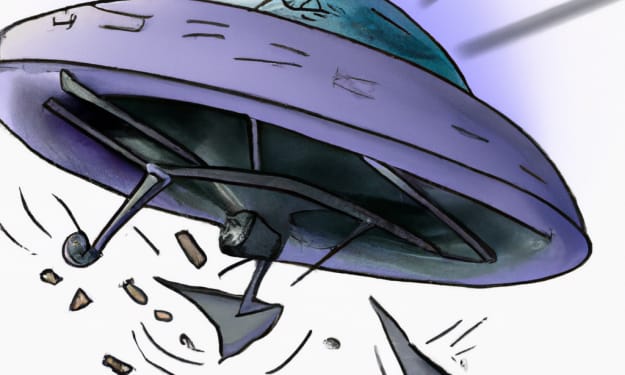
Let's talk about UFO crashes, folks. The idea that even extraterrestrial beings with advanced technologies can make mistakes and crach* their flying saucers gives us hope. It means that they're not infallible, and neither are we.
By Brendan McGlynn3 years ago in Futurism
About Binding Prometheus
I want to start actively advocating on behalf of my own work, and the most valuable part of my canon is, without a doubt, Binding Prometheus, the play I have been working on since 2019 and only finished in 2023 as part of my MA. The play itself is an amalgamation of a million different inspirations. On one end, it evokes the Ancient Greek myth-play, deriving its own title from the earliest extant work of Western drama we have, Aeschylus’s Prometheus Bound. On the other end, it borrows significantly from the sci-fi bulwarks from over the years, namely Mary Shelley’s Frankenstein and Karel Capek’s Rossum’s Universal Robots. The play could be an episode of Black Mirror, I fear. I don’t know. I’ve only ever seen one episode of Black Mirror.
By Steven Christopher McKnight12 days ago in Futurism
Chocolate Market: Craft Chocolate Trends, Flavor Diversification & Outlook
According to IMARC Group's latest research publication, The global chocolate market size was valued at USD 167.0 Billion in 2025. Looking forward, IMARC Group estimates the market to reach USD 219.9 Billion by 2034, exhibiting a CAGR of 2.8% during 2026-2034
By James Whitman5 days ago in Futurism


Comments
There are no comments for this story
Be the first to respond and start the conversation.