
Exploring the Power of Machine Learning in Generative AI
In this blog, we'll delve into the power of machine learning in Generative AI, exploring how it works, its applications
In recent years, artificial intelligence (AI) has advanced at an exponential rate, ushering in a new era of possibilities for businesses, governments, and society at large. Within this evolving landscape, one subset of AI is making waves due to its remarkable capabilities—Generative AI. Unlike traditional AI, which relies on predefined rules and human-fed data to produce outcomes, Generative AI uses machine learning algorithms to create new, original content. This technology has the potential to revolutionize various industries by transforming how content is created, problems are solved, and interactions are personalized.
In this blog, we'll delve into the power of machine learning in Generative AI, exploring how it works, its applications, and how it compares to Generative AI vs Traditional AI models.
What is Generative AI?
Generative AI refers to AI systems capable of generating new, meaningful content based on existing data. Whether it's text, images, audio, or even complex designs, Generative AI models can produce outputs that mimic human-like creativity. Unlike predictive AI, which analyzes data to make forecasts or decisions, Generative AI learns from data to generate something new—ranging from artwork and written content to synthetic data and deepfake videos.
The key component that powers Generative AI is machine learning, a subset of AI that allows computers to learn from data without explicit programming. By using neural networks and deep learning models, machine learning algorithms enable Generative AI systems to self-improve and create high-quality content autonomously.
The Role of Machine Learning in Generative AI
Machine learning is at the core of Generative AI’s functionality. It enables AI models to learn patterns, representations, and rules from vast datasets, and then use that understanding to generate new outputs. Several machine learning techniques contribute to the power of Generative AI, including:
1. Neural Networks
Generative AI often relies on neural networks, specifically Generative Adversarial Networks (GANs) and Variational Autoencoders (VAEs). Neural networks mimic the human brain’s interconnected neuron structures, enabling AI to learn complex relationships and patterns in data.
GANs involve two neural networks—the generator and the discriminator. The generator creates new data based on a given dataset, while the discriminator evaluates the authenticity of that data. This tug-of-war process results in a highly refined, realistic output.
VAEs use deep learning techniques to compress data into a simplified version and then reconstruct it in a way that maintains its essential characteristics. VAEs excel in producing high-quality images, text, and other content.
2. Reinforcement Learning
Generative AI models can also employ reinforcement learning, where agents learn to perform tasks by interacting with their environment and receiving rewards for successful actions. Over time, these agents develop more sophisticated strategies for generating content, refining their abilities through trial and error.
3. Natural Language Processing (NLP)
One of the most powerful applications of Generative AI is in Natural Language Processing (NLP). Through machine learning, AI models can generate human-like text by analyzing syntax, grammar, semantics, and even emotional context. Models like GPT (Generative Pretrained Transformer) have been groundbreaking in NLP, producing high-quality articles, stories, and even coding scripts.
Key Applications of Generative AI
The rise of Generative AI, fueled by machine learning, has transformed several industries by automating tasks that once required human ingenuity. Below are some of the most impactful applications of Generative AI:
1. Content Creation
Generative AI is revolutionizing content creation by enabling the generation of articles, blogs, social media posts, and video scripts. For instance, AI models can now write coherent and contextually relevant articles with minimal human intervention. This technology is particularly useful for media companies, marketing agencies, and eCommerce platforms looking to scale their content production efforts.
2. Art and Design
In the creative industries, Generative AI is used to produce original artwork, logos, product designs, and even entire marketing campaigns. AI-generated art has gained attention from artists and collectors alike, with some pieces selling for millions of dollars in auctions. Designers can also use AI to automate repetitive tasks, freeing up time for more innovative projects.
3. Personalization in Marketing
With machine learning's ability to analyze and predict customer behavior, Generative AI can create personalized marketing campaigns at scale. For instance, AI can generate customized emails, product recommendations, and advertisements tailored to individual users based on their past interactions. This level of personalization enhances customer engagement and drives conversion rates.
4. Video Game Development
Generative AI is also being utilized in video game development to create realistic environments, non-playable characters (NPCs), and interactive storylines. By generating endless variations of textures, sounds, and character designs, Generative AI enables developers to build immersive worlds more efficiently.
5. Synthetic Data Generation
In sectors where data privacy is paramount, such as healthcare and finance, Generative AI can create synthetic data that mimics real-world datasets. This synthetic data can be used to train machine learning models without risking sensitive information, offering a solution for companies bound by strict privacy regulations.
6. Drug Discovery and Healthcare
Generative AI is revolutionizing healthcare by aiding in drug discovery and medical research. Machine learning models can analyze vast amounts of biological data to predict how different compounds will interact with diseases. Generative AI can also be used to create new molecular structures, speeding up the drug development process.
Generative AI vs Traditional AI: What Sets Them Apart?
While both Generative AI and Traditional AI have their merits, they differ fundamentally in how they operate and the kinds of problems they solve.
Traditional AI is primarily designed to recognize patterns, make predictions, and solve predefined problems. It relies on structured datasets and applies statistical analysis to generate outcomes, typically focused on decision-making and optimization.
Generative AI, on the other hand, goes beyond problem-solving by creating entirely new data or content. It doesn’t just respond to inputs with fixed outputs; instead, it learns to generate outputs that are novel yet coherent with the input data. This capacity for creation makes Generative AI far more versatile in fields like content generation, design, and creative industries.
The key difference lies in their scope—Traditional AI focuses on analyzing existing data and automating repetitive tasks, while Generative AI leverages machine learning to create new data or creative solutions.
Challenges and Limitations of Generative AI
Despite its many benefits, Generative AI is not without challenges. Here are a few obstacles that organizations may face:
1. Ethical Concerns
The ability to generate lifelike content raises concerns about deepfakes, misinformation, and copyright violations. It’s crucial to establish guidelines to prevent unethical use of AI-generated content.
2. Computational Resources
Training Generative AI models requires substantial computational power and resources, making it a costly investment for smaller organizations.
3. Quality Control
While Generative AI is capable of producing high-quality content, it’s not always perfect. Human oversight is still necessary to ensure that AI-generated outputs meet quality standards and align with the brand or project’s objectives.
Conclusion
Machine learning is the driving force behind the immense potential of Generative AI, enabling it to transform industries ranging from content creation to healthcare. By leveraging advanced algorithms, neural networks, and deep learning techniques, Generative AI goes beyond traditional AI’s predictive abilities to create new, valuable content. As the technology continues to evolve, its applications will only expand further, providing businesses with innovative solutions for a wide range of challenges. In the fast-paced world of AI-driven innovation, Trantor is helping businesses adopt and implement cutting-edge AI technologies to stay ahead of the curve. Whether it's Generative AI vs Traditional AI, the power of machine learning is undeniable in driving this digital transformation. The future of AI will see an increasing convergence of creativity and data-driven solutions, making Generative AI a crucial component of tomorrow’s technological landscape.
About the Creator
Keep reading
More stories from Sam Wilson and writers in Futurism and other communities.
How the Circuit Breaker Pattern Prevents Failures in Microservices
In today’s fast-paced digital environment, organizations are moving towards microservices architecture for developing scalable and resilient applications. Microservices, by their nature, distribute functionalities across a series of smaller, independently deployable services, which allows for improved scalability, flexibility, and faster development cycles. However, as beneficial as microservices are, they also bring new challenges related to service reliability and fault tolerance. This is where microservices design patterns like the Circuit Breaker Pattern come into play.
By Sam Wilsonabout a year ago in Futurism
Vinyl Record Market Trends: Music Collectibles, Analog Revival & Forecast to 2034
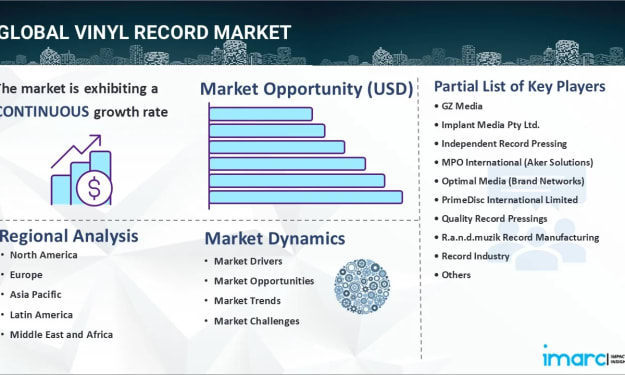
Vinyl is no longer a relic of the past — it's one of the most exciting growth stories in the global music industry. Fueled by nostalgia, the enduring appeal of analog sound, and a passionate collector community, the global vinyl record market is on a firm upward trajectory. According to IMARC Group's latest research, the global vinyl record market size reached USD 2.1 Billion in 2025. Looking ahead, IMARC Group expects the market to reach USD 3.6 Billion by 2034, exhibiting a CAGR of 6.50% during 2026-2034. Asia Pacific currently dominates the global market, driven by growing middle-class spending, flourishing indie music scenes, and strong collector culture across the region.
By Suhaira Yusuf3 days ago in Futurism
I Let ChatGPT Build My Startup Prototype
How handing my idea to an AI in one weekend forced me to question what “building” a startup actually means A weekend experiment with "I let ChatGPT build my startup prototype" turned into an identity crisis about what a founder is for in the age of AI.
By abualyaanart3 days ago in Futurism
Guard Your Battery
Why are some people so attractive just by standing there? It’s not because they are "likable," but because they don’t need everyone to like them. I realized later that truly charismatic people allow themselves to be criticized, but they never criticize themselves. They never try to please the world; instead, the world stops to watch them.
By Emily Chan - Life and love sharing5 days ago in Poets



Comments
There are no comments for this story
Be the first to respond and start the conversation.