
Event-Driven Microservices: Building Scalable and Resilient Systems
How to Use Events to Build Systems That Grow Easily and Bounce Back from Failure

In today's fast-paced world, IT systems are producing, gathering, and processing more data than before. Thus, they are dealing with more complex processes as well as integrations that are bringing challenges to the entire enterprise software development team. With the ever-growing technologies and associated frameworks, it is expected that IT systems will be developed in a faster and more cost-effective manner while being highly scalable and resilient.
Well, to achieve this, proficient developers are implementing various architectural styles, algorithms, and programming paradigms which include DevOps, microservices, event driven architecture, and much more. Furthermore, new frameworks and tools are developed to assist the developers in working on these expectations without any hassle.
Now, developers can combine microservices and event-driven architecture to develop IT systems that are not only easily accessible but are highly scalable, resilient, concurrent, and fault tolerant. The process is known as event-driven microservices.
To Know in detail about event-driven microservices, it is important to understand the event-driven architecture.
Event-driven Architecture:
Well, event-driven programming is not an uncommon technique, and it predates the IT system itself. Developers can benefit from the event-driven architecture in serverless architecture and microservices. It helps in developing systems that are loosely connected, dependable, and scalable. The pattern is manageable and extensible. Event driven architecture patterns help in the system development with more availability. For instance, if one component fails to function in this model, the other one continues to work independently. While a typical monolithic system fails to function, it affects the entire model.
In other words, event-driven architecture is dependent on asynchronous non-blocking communication. It happens between the consumers and event producers that produce the resource consumption along with waiting for the response to return. Event driven architecture can also be used with OpenShift and Quarkus.
Introduction to Event-Driven Microservices
In the past few years, event-driven computing and microservices have gained immense popularity. Now, the design patterns of microservices are event-driven and reactive. Thus, they are easy to maintain and update. It is easier to access event-driven microservices in order to develop software applications that are simpler to maintain and highly adaptable over time. Event-driven microservices are also considered when there is a need for the development of responsive applications.
Depending on this, developers can have plenty of microservices that can interact with each other asynchronously. It is expected the applications to be independently maintained and the microservices that can generate the events that can be used by other services. This is where the role of event-driven microservices and event driven architecture patterns come into play.
Patterns Utilized in the Event-Driven Microservices
The patterns utilized in the event-driven microservices architecture are listed below-
- Event stream
- Polyglot Persistence
- Event Sourcing
- CQRS (Command Query Responsibility Separation)
Event Stream: Event streaming architecture shows the events stream through messaging techniques which include, Confluent and Apache Kafka. Consumers of this platform can use events from the streams.
Polyglot Persistence: It is a strategy which is used for data storage in heterogeneous databases. Data can also be safe in diverse formats in the event.
Event Sourcing: It is the commonly used architectural technique that is used to convert monolith architecture into microservices. The state of the application is determined by the set of events that exist in the Event Sourcing pattern.
CQRS (Command Query Responsibility Separation): CQRS (Command Query Responsibility Separation) is another paradigm used to separate the read-and-write model. Furthermore, the insert/update function can easily be handled by this pattern. It helps to improve the scalability, performance, and security of the application.
The Final Thought
In this blog, we have had an insight into event-driven architecture and microservices, how to build the microservices, and the pattern utilized in event-driven microservices through strategic approaches. A well-defined microservices architecture in an enterprise software development can expose the APIs as well as interfaces to produce and consume events for seamless integration with event-driven architecture.
About the Creator
Vipul Gupta
Vipul is passionate about all things digital marketing and development and enjoys staying up-to-date with the latest trends and techniques.
Keep reading
More stories from Vipul Gupta and writers in Futurism and other communities.
What are Enterprise Architecture Design Patterns?
Enterprise architecture design patterns are increasingly becoming necessary to today's fast-paced businesses. As the nature of enterprise architecture is multi-disciplinary and diverse, it is required that the design patterns be created in different domains, and disciplines and with meticulous attention to detail.
By Vipul Gupta11 months ago in Journal
Australia Caustic Soda Market: Industrial Demand Growth, Local Production Expansion & Sustainability Trends
According to IMARC Group, the Australia caustic soda market reached 1,687.3 Thousand Tons in 2025 and is projected to grow to 1,900.4 Thousand Tons by 2034, exhibiting a compound annual growth rate (CAGR) of 1.29% during 2026–2034. The moderate but steady growth reflects stable industrial demand and the essential role of caustic soda across multiple sectors in Australia. Expanding alumina refining operations, rising infrastructure development, and increased focus on supply chain resilience are supporting domestic production capacity. At the same time, sustainability-driven manufacturing upgrades and energy efficiency initiatives are shaping the long-term trajectory of the Australia caustic soda market share.
By Kevin Cooper4 days ago in Futurism
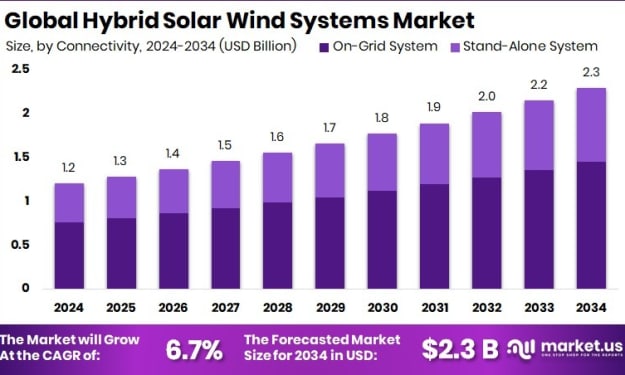
Hybrid Solar Wind Systems Market to Reach USD 2.3 Billion by 2034
The Global Hybrid Solar Wind Systems Market, valued at USD 1.2 billion in 2024, is projected to reach USD 2.3 billion by 2034, growing at a CAGR of 6.7% from 2025 to 2034. The Asia Pacific region led the market in 2024, holding a 43.8% share worth approximately USD 0.5 billion.
By Hayden Kulasa day ago in Futurism



Comments