
Upon the dawn that Orpheus, son of Apollo, perished, it was said that the sun hid his face and the heavens wept. The trees stirred, cloaked with the tears of a grieving father, who shrouded his subdued glory in mist. Rumour flew, borne upon the whispers that rustled through the woody realm, and all those who understood sylvan speech fell into mourning.
Even the fir trees lost many of their needles that year. But there was none more sorrowful than the tree nymph Eurydice, who sat for many days in despair beneath the great willow on the forest’s edge, clutching the golden lyre that once had emitted sweet songs plucked by her lover’s nimble fingers. Death fluttered silently around her as the willow gently dropped the last of its leaves. They stroked her cheek and wiped her tears before they settled onto the earth to rest.
‘Peace, sister,’ they whispered in her ear. ‘Lo! Dawn and her rosy fingers rise beyond once more.’
Indeed, the birth of a new day shattered forth from beyond the snow capped mountains, and for a moment all those awake fell silent to behold its quiet splendour.
Eurydice wiped her ferny eyes with her long shadowy hair. At that moment, an old and withering voice sounded above her, its source hidden by the willow’s gnarly branches.
‘Weep not, my child,’ thrummed the voice, ‘for your spirit rules the soul of the woodland realm. When you smile, the forest and all its inhabitants shout for joy; but when you weep, we are overcome with sorrow.’
‘Who are you, gentle creature? I know not your voice,’ Eurydice called out, and her voice rang out clear and bright as bells upon the morning air.
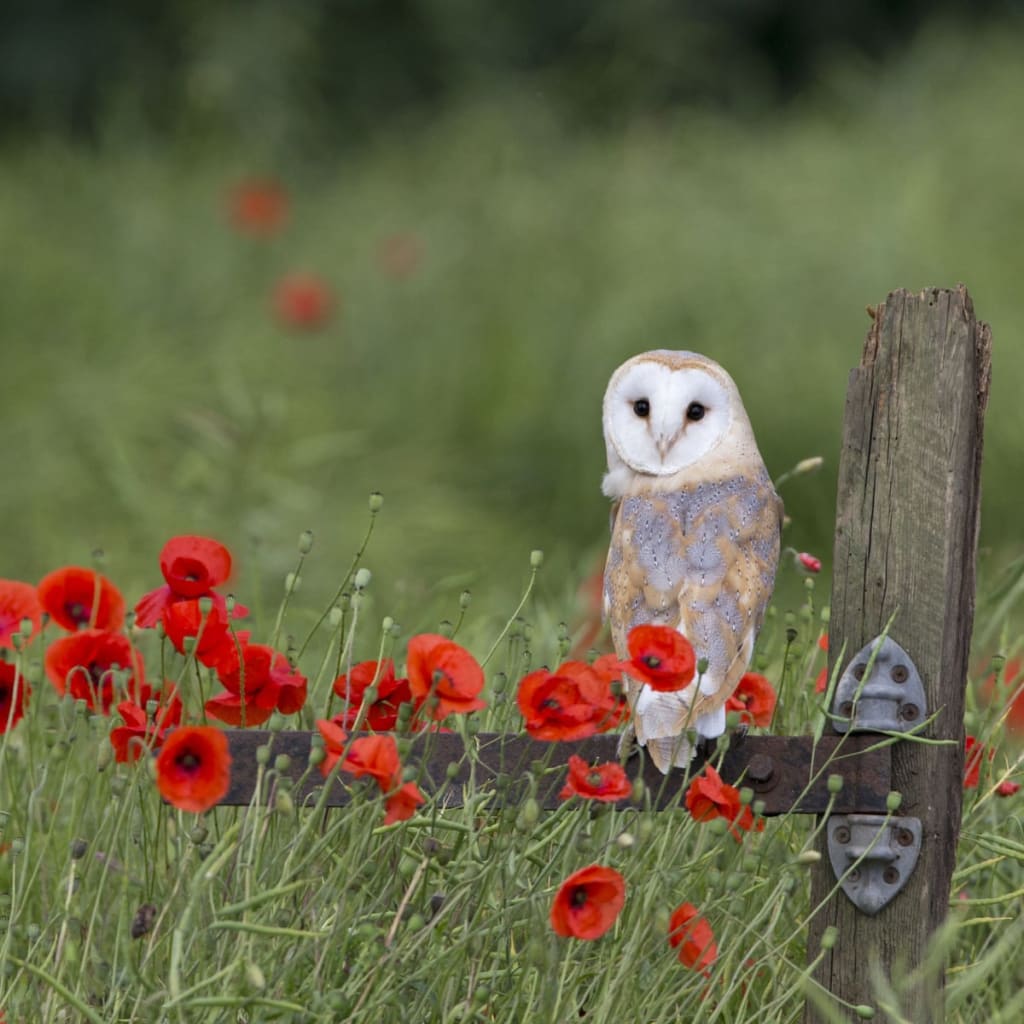
The owner of the voice emerged from its hiding place, swooping down to the bare branch just above the sprite’s head. It was a barn owl. Its white breast was luminous to behold, and its fathomless and wizened eyes blinked out from the face of a cloven apple.
‘Are you not my Lady Athena, the Wise One?’ Eurydice queried in sweet tones that made even the drooping flowers raise their weary heads.
‘I am but a messenger, fair one. Who am I? I only know that I am. Take heart. All is not lost. Your quest lies before you yet.’
The nymph furrowed her bushy eyebrows. ‘Of what quest do you speak, my friend?’
‘There is but one path to the Halls of Hades. It is dim and perilous, but at the throne of the fell judge, you might advocate for Orpheus, son of Apollo,’ replied the owl, turning its head this way and that, as if listening to the wondering murmurs of the trees who heard.
‘But none has softened the hard heart of the Dark Lord of the Underworld. I fear his wrath,’ Eurydice demurred, and yet her heart was filled suddenly with a hope she had not known since Orpheus died.
The owl tilted its head and spoke. ‘The Dark Lord has loved and is yet loved, dear one. Even now his beloved has returned to him with the falling of the leaves. His wisdom runs deep, and he is the wisest of all beings, for he has seen the deeds and intentions of all who pass through his black gate. And all pass through his black gate.’
Eurydice bit her budding lip, but her hesitation was brief. ‘I will go. But I do not know the way.’
The barn owl ruffled its feathers and preened. ‘It has been appointed to me to guide you to the gate of the dead. Come. Let us descend into the realm of the Dark Lord.’
With this proclamation, the barn owl swooped on tawny wings from its perch. Eurydice sprang forward on dancing feet after her companion, who led her deeper and deeper into the heart of the forest, to parts unknown even to her. The trees closed in on all sides, the air became darker and smothered, the pressure on her eardrums grew heavy, and when she spoke her voice was muffled. And yet the owl flew onward from tree to tree.
At last they came to a set of narrow stone stairs, leading down into a deep and dark cave. A small estuary from the river flowed swiftly down into the cave along the steps, and Eurydice, for a moment, faltered. She faltered not for fear, but for the cries of her woodland kin. For she was a creature of light, and of natural and living things. Even as she began to descend, she felt the tug on her heart from the thousands of trees and small creatures in her woody realm, begging her to return to the land of the living, to sing once more for them. For where her spirit was, there also was the forest and all that lived within.
The determined nymph stumbled down in the darkness, holding a hand out against the stony wall, for there was no support to hold on to. She felt her way forward, guided only by the whooshing sound of the barn owl’s wings.
Perhaps an hour had passed, or many days, before Eurydice discerned ahead the dim orange lights that trailed up the hinges of a massive black gate beyond which lay the realm of the dead.
‘Beware the hound and the Furies who guard the gates,’ the barn owl warned. ‘They are vigilant. They will not suffer the living to enter.’
‘What living creature would try?’ Eurydice wondered aloud. The owl seemed to shoot her a dry look.
The owl gave a small hoot and spoke. ‘It is here that I must leave you. You have a hope of returning to the land of the living beyond this point, but not I. Farewell, fair one. Remember that death is only the deprivation of life. You have all the skills to enchant the guardians of this realm.’
And with that, he flew away, back to the world of light and life.
It is universally known that nymphs are light of step and can pass as unnoticed as a shadow. But in a place as dark and lifeless as the Underworld, Eurydice shimmered with light, and her redolent fragrance heralded the invasion of life and nature. The paradoxical scent stunned the three-headed hound who guarded the gates, and he stared in wonder and fear at the strange apparition.
The nymph’s rosy face paled and she froze as Cerberus locked all six of his eyes upon her. He bared his many teeth and a low growl was beginning to rumble in his throats. The imminent failure of her quest, should Cerberus rouse the Furies, spurred her into action.
She began to sing. She sang softly and clearly, and as she laid a hand upon her chest, she lowered her eyes to the ground to show she was no threat. The growls ceased. The clarity of her voice shone forth like the thousands of stars that flicker out of the velvety obsidian on a clear night.
Instead of a warning bark, which surely would have aroused the fearsome Furies, the hound whimpered and sniffed at the sweet scent that rolled off the tree spirit. Laying his three heads on the ground, he whined quietly and inhaled his fill of nature, and he could see in his mind’s eye the constellations that he never had known to exist.
As Cerberus drifted off into a dreamless sleep, Eurydice slipped through the black gate and went on.
The stream that had flowed beside her gradually emptied into a large and rushing river, where a rickety barge bobbed up and down. A cloaked man hunched over a gnarled staff stood at the front of the barge, accepting each shade’s viaticum. She joined the queue slowly shuffling onto the boat that would bear them beyond to their judgement.
‘Fare?’ he said, not looking up. Having nothing else, Eurydice took a single red rose from her dark hair and placed it in the palm of the ferryman.
His hood fell and he stumbled back. A withered face peered out in astonishment at the fresh flower that he now held in his hand. The other travellers marvelled and murmured at the token from the living world.
The ferryman gasped, ‘How came you by this?’
‘It will not ever wither, for its life is drawn from the spirit of the woodland realm,’ replied Eurydice. ‘I trust its value is sufficient for my passage?’
When she sprang from the barge at the Halls of Hades, the ferryman bowed low to her as she passed. ‘Any length of punishment for ferrying a living being to Hades shall be worth the price of this living rose. But in Lord Hades dwells the wisdom of the just.’
And indeed, Charon treasured Eurydice’s viaticum until the end of the age.
The nymph stepped alone into the cavernous, empty hall of Hades. Dozens of enormous, marble pillars rose up into the darkness and continued on either side for as far as the eye could see. She approached the massive, ornate throne upon which the immortal judge sat, kingly and wise in countenance. Justice sat upon his brow, and in his eyes gleamed a gentleness that was yet stern and unyielding.
Eurydice found she had lost her voice, and she was surprised when he spoke first. ‘I know why you have come, child,’ he said softly.
She knelt down before him. ‘My Lord Hades…’
Hades leaned forward on his throne, and his eyes shone with unshed tears. ‘Death, my daughter, is nothing to hate or fear. Indeed, grief is the curse of the living.’ He reached forward and rubbed a thumb across her wet cheek.
Before her mind could even register what she would do next, her mouth opened and she sang forth the most beautiful lament ever sung on or under the earth, in the land of mortals or immortals alike, and it was so sublime that it softened the unyielding heart of Hades himself. For when Eurydice sang, it was as though the Underworld sprang to life.
Oh great Hades, Lord of the Dead,
I kneel before you trembl-ing;
In grief my path to you has led
Through dewy forests glimmering.
By aid of ancient gods of lore
Descended I here sorrowing;
Through caves of night to you implore,
Came I to gateway glittering.
I seek my love Apollo’s son,
Who under starlight glistening,
Where streams the forest bank o’errun,
Would pluck his lyre a-quivering.
The dawn was fair, the trees were green,
The day the serpent slithering
did bare its teeth with icy gleam
And strike through heather shivering;
Its bite was true, its poison grim,
My loved one's life extinguishing;
His voice grew faint, his eyes grew dim,
His speech was hushèd whispering.
And doom fell on Apollo’s son,
His shade from body sundering;
To halls of judgement I have come
To ransom him by harrowing.
For never was a greater love
Than that between us lingering;
Forever binding us above,
In Hades never withering.
Oh Lord of Shades, accept my plea,
This once to pity surrendering;
To take my love and from here flee
Above to daylight shimmering.
When Eurydice ended her lament, she dared to raise her face to meet the eyes of the Dark Lord Hades. He had stood from his throne and an exquisite pain was etched upon his face. He looked at her in wonder and shed tears he had not known he was capable of.
‘Go. Take Orpheus, son of Apollo, and go, child! Go, before my reason returns. Hurry!’
He slumped back down into his seat and buried a hand into his grief-stricken face.
Eurydice ran, propelled by fear and gratitude and joy, back to the entrance, where Orpheus was already awaiting her.
Hades spoke once more, his majestic voice echoing through the cavernous hall. ‘A warning, child. Do not either of you look back before you have both ascended into the realm of the living….’
Finis.
About the Creator
Keep reading
More stories from S.E. St John and writers in Futurism and other communities.
The Odyssey
Naoki Sato was a brilliant physicist and Nobel laureate who taught at Todai in the nation of Japan. His most popular course explored multiverse theories. It was so well-received that more than a few independent broadcasting companies had recorded his lectures to make them available to the general public. Naturally, everything was in English. The official language of Japan was British English, due to the lingering effects of the Empire occupation that never really had withdrawn. Only those living in provincial areas kept Japanese as their day-to-day language. Professor Sato found himself in high demand all around the world, but more often than not, he could be found in the depths of his underground lab, coding, running programmes, and testing different algorithms and formulas to open a portal to one of the parallel universes. He was dealing with dangerous and tiny particles that potentially could destroy the entire world and all alternate universes within it with a big bang, so he never let anyone, even his most trustworthy graduate students, know about his activities after they all had gone home.
By S.E. St John5 years ago in Futurism
About Binding Prometheus
I want to start actively advocating on behalf of my own work, and the most valuable part of my canon is, without a doubt, Binding Prometheus, the play I have been working on since 2019 and only finished in 2023 as part of my MA. The play itself is an amalgamation of a million different inspirations. On one end, it evokes the Ancient Greek myth-play, deriving its own title from the earliest extant work of Western drama we have, Aeschylus’s Prometheus Bound. On the other end, it borrows significantly from the sci-fi bulwarks from over the years, namely Mary Shelley’s Frankenstein and Karel Capek’s Rossum’s Universal Robots. The play could be an episode of Black Mirror, I fear. I don’t know. I’ve only ever seen one episode of Black Mirror.
By Steven Christopher McKnight24 days ago in Futurism
🅼🅸🅳🅽🅸🅶🅷🆃 🆂🅽🅰🅲🅺🆂
"It's 10 in Tuscon! We all know what that means... It's Time for Midnight Snacks with your man, Gerald Gee! Ready to spend the night together? Me too! I'm full of snacks and can't wait to regurgitate them all back into your hungry ears. Crack a brew! Pop some corn! Anything to get ready for one hell of a show where the talk maybe cheap but the words cut deep...
By Lamar Wiggins2 days ago in Fiction



Comments
There are no comments for this story
Be the first to respond and start the conversation.