
Europe Pharmaceutical Drug Delivery Market to Reach USD 703.19 Billion by 2031
Rising biologics utilization, chronic disease burden, and regulatory support position Europe as a strategic growth hub for advanced drug delivery systems through 2031
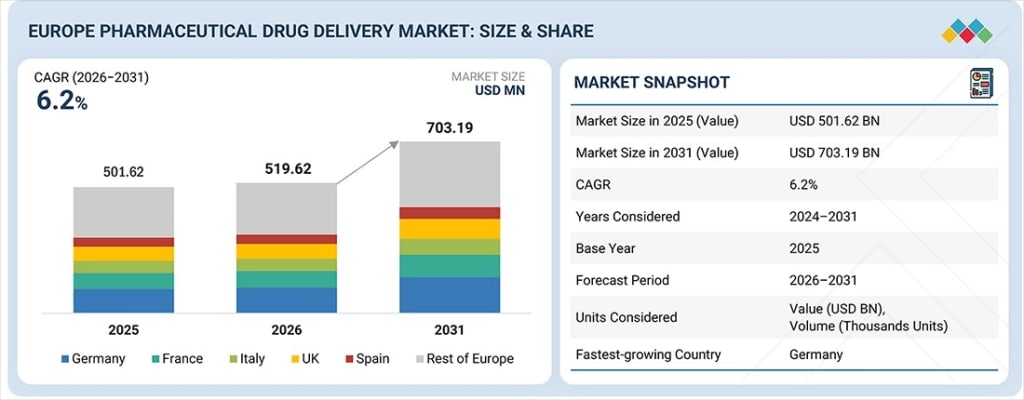
The Europe pharmaceutical drug delivery market is entering a decisive growth phase, reflecting how healthcare systems, pharmaceutical leaders, and device manufacturers are rethinking how medicines are administered, experienced, and scaled across diverse patient populations.
According to the Marketsandmarkets analysis, the Europe pharmaceutical drug delivery market is projected to grow from USD 519.62 billion in 2026 to USD 703.19 billion by 2031, registering a compound annual growth rate (CAGR) of 6.2%. This expansion underscores what is changing in European healthcare delivery, why innovation is accelerating now, and how manufacturers and healthcare stakeholders are responding to shifting clinical and economic priorities.
Download PDF Brochure of Europe Pharmaceutical Drug Delivery Market Report
What Is Driving Market Growth—and Why Now?
Market momentum is being fueled by the rising use of biologics and biosimilars, the increasing prevalence of chronic diseases, and the growing acceptance of advanced drug delivery devices such as auto-injectors, prefilled syringes, inhalation systems, and wearable injectors. These trends are converging at a critical moment, as Europe’s aging population, rapid adoption of home care models, and supportive regulatory frameworks push healthcare systems toward more patient-friendly, self-administered, and digitally enabled delivery solutions.
At the same time, governments and regulators across Europe are prioritizing therapies that improve adherence, reduce hospital burden, and support long-term disease management—making drug delivery innovation a strategic imperative rather than a supporting function.
Where Is Growth Concentrated Across Europe?
By geography, Germany is expected to be the fastest-growing country, expanding at a CAGR of 7.2% during the forecast period. Germany’s growth is underpinned by its advanced healthcare infrastructure, strong biologics prescription rates, extensive hospital network, and favorable government policies promoting superior delivery technologies such as auto-injectors, prefilled syringes, and wearable systems. France and the Nordic countries are also leading adoption, supported by higher healthcare spending and sustainability-driven device development policies.
How Are Market Segments Evolving?
From a delivery standpoint, injectable drug delivery remains dominant, accounting for 38.0% of market share in 2025, reflecting Europe’s reliance on biologics and biosimilars for oncology, autoimmune, and chronic diseases. Prefilled injectables, pens, and auto-injectors continue to gain traction due to their accuracy, portability, and suitability for self-administration.
By application, autoimmune diseases are expected to record the highest CAGR of 7.6% from 2026 to 2031, driven by rising incidences of rheumatoid arthritis, psoriasis, and inflammatory bowel disease, alongside increased adoption of targeted biologic therapies.
By care setting, hospitals held the largest share at 58.8% in 2025, owing to their central role in acute care, infusion therapies, oncology treatment, and early adoption of advanced delivery technologies. While home care is expanding rapidly, hospitals remain the primary hub for complex biologics and high-acuity treatments.
Who Are the Key Players Shaping the Competitive Landscape?
Established leaders such as Gerresheimer AG (Germany) and Novo Nordisk (Denmark) stand out as star players, leveraging strong regional footprints, established portfolios, and sustained leadership in advanced drug delivery technologies. Their continued investments in injectables, pens, and connected devices reinforce Europe’s transition toward precision and self-administration.
At the same time, emerging startups including Capa Valve Ltd (Belgium) and Pharma Latch (UK) are gaining visibility for their novel approaches that enhance dosing precision, usability, and patient experience—highlighting how innovation is occurring across both large-scale and niche segments.
Trends, Disruptions, and Strategic Implications
Key trends reshaping customers’ customers include the rise of sustainable drug delivery packaging, increased adoption of self-administration devices, and integration of digital functionalities for compliance and adherence management. These shifts are being accelerated by stricter European Union regulations, compelling manufacturers to innovate faster while balancing cost, sustainability, and regulatory compliance.
However, the market also faces challenges. Wide disparities in regulatory maturity and approval timelines across EU member states can slow market entry, particularly in Southern and Eastern Europe. In addition, intense competition from low-cost local players—especially in commoditized segments such as syringes and infusion components—puts pressure on margins and can limit investment in niche, high-value technologies.
Where Do Opportunities Lie?
Significant opportunities are emerging from the surge in demand for wearable injectors and home-care delivery solutions, supported by decentralized care models, digital health integration, and reimbursement pathways for biologics in major EU markets. Government investments in digital health and ongoing efforts toward harmonized device regulations further enhance Europe’s attractiveness as a launchpad for next-generation delivery platforms.
Why This Market Matters for Decision-Makers
For CEOs, CFOs, and strategy leaders, the Europe pharmaceutical drug delivery market represents more than growth—it reflects a structural shift in how therapies are designed, delivered, and differentiated. Companies that align delivery innovation with biologics expansion, home care adoption, and regulatory expectations will be best positioned to capture long-term value across Europe’s diverse healthcare systems.
About the Creator
Keep reading
More stories from Juan Martinez and writers in Futurism and other communities.
North America Healthcare Simulation Market Poised to Reach US$2.99 Billion by 2030
The North America healthcare simulation market is entering a decisive growth phase as healthcare systems, academic institutions, and regulators intensify their focus on patient safety, workforce readiness, and technology-enabled training. Valued at US$1.28 billion in 2024 and US$1.48 billion in 2025, the market is projected to expand at a robust CAGR of 15.1% from 2024 to 2030, reaching an estimated US$2.99 billion by the end of the forecast period.
By Juan Martinez3 days ago in Futurism
About Binding Prometheus
I want to start actively advocating on behalf of my own work, and the most valuable part of my canon is, without a doubt, Binding Prometheus, the play I have been working on since 2019 and only finished in 2023 as part of my MA. The play itself is an amalgamation of a million different inspirations. On one end, it evokes the Ancient Greek myth-play, deriving its own title from the earliest extant work of Western drama we have, Aeschylus’s Prometheus Bound. On the other end, it borrows significantly from the sci-fi bulwarks from over the years, namely Mary Shelley’s Frankenstein and Karel Capek’s Rossum’s Universal Robots. The play could be an episode of Black Mirror, I fear. I don’t know. I’ve only ever seen one episode of Black Mirror.
By Steven Christopher McKnight25 days ago in Futurism




Comments
There are no comments for this story
Be the first to respond and start the conversation.