
Europe Cleanroom Technologies Market poised to reach USD 3.61 billion by 2031
Europe Cleanroom Technologies Market Set for Sustained Growth as Biopharma, Semiconductors, and ESG Mandates Accelerate Adoption
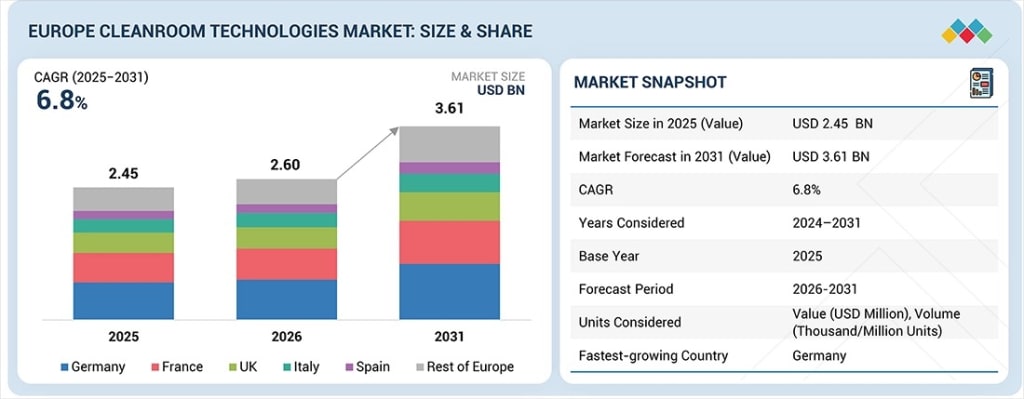
As Europe’s high-precision manufacturing sectors intensify their focus on quality, compliance, and sustainability, the Europe Cleanroom Technologies market is emerging as a strategic enabler of growth. Valued at USD 2.45 billion in 2025 and USD 2.60 billion in 2026, the market is projected to expand at a robust CAGR of 6.8% from 2026 to 2031, reaching USD 3.61 billion by the end of the forecast period. This growth reflects not only rising regulatory scrutiny, but also accelerating investments across pharmaceutical, biotechnology, semiconductor, and aerospace industries.
Download PDF Brochure of Europe Cleanroom Technologies Market Report
Market Overview: What Is Driving Growth and Why It Matters Now
What is fueling this momentum? The answer lies in Europe’s rapidly expanding biopharmaceutical ecosystem, increased production of biologics, vaccines, sterile injectables, and advanced therapy medicinal products (ATMPs), and the urgent need to comply with EU GMP and ISO 14644 standards. Why does this matter now? Because manufacturing leaders are under pressure to scale faster, ensure contamination-free environments, and align capital investments with long-term ESG and energy-efficiency goals.
When regulatory expectations tighten and production pipelines diversify, cleanroom technologies become mission-critical infrastructure. Where adoption is strongest—Germany, France, the UK, Italy, and Spain—industries are modernizing facilities or replacing legacy systems with modular, automated, and digitally monitored cleanrooms to reduce time-to-operation and lifecycle costs.
Industry Adoption: Who Is Leading Demand and How
The pharmaceutical industry remains the dominant end user, accounting for 48.4% of market share in 2025, as companies respond to rising chronic disease prevalence, personalized medicine pipelines, and global clinical trial activity. How are they responding? By investing in higher-grade cleanrooms, isolators, advanced HVAC systems, and real-time environmental monitoring—often in collaboration with contract development and manufacturing organizations (CDMOs).
Beyond pharma, Europe’s semiconductor, microelectronics, and aerospace sectors are accelerating adoption of ultra-low contamination production areas to support precision manufacturing. These industries are increasingly reliant on validated, scalable, and contamination-controlled environments to protect yields and maintain global competitiveness.
Segment Highlights: Where Growth Is Concentrated
By Country: Germany led the market with a 28.4% share in 2025, supported by its strong pharmaceutical, biotech, and microelectronics base and continued investment in automation and digital manufacturing.
By Product: The consumables segment is expected to register the highest CAGR of 7.9%, reflecting recurring demand for gloves, gowns, wipes, disinfectants, and sterile packaging in regulated environments.
By Type: Modular cleanrooms dominated with a 51.4% share in 2025, driven by rapid deployment, scalability, predictable validation, and lower CAPEX.
By End User: The pharmaceutical segment continues to lead, reinforcing cleanrooms as foundational infrastructure for compliant drug manufacturing.
Competitive Landscape: How Providers Are Differentiating
The European cleanroom technologies market is characterized by a mix of global leaders and agile specialists offering end-to-end solutions. Key players—including Exyte AG, Bouygues Group, Ardmac, Colandis GmbH, ABN Cleanroom Technology, Octanorm-Vertriebs-GmbH, Camfil, Parteco SRL, Airplan, Weiss Technik, and Atlas Environments—are recognized for their extensive reach, turnkey capabilities, and innovation in modular and sustainable cleanroom design.
Startups and SMEs such as ABN Cleanroom Technology, Asgatech Holding Ltd., Octanorm-Vertriebs-GmbH, and Parteco SRL are gaining traction by focusing on specialized applications, digital cleanroom platforms, and flexible service models tailored to veterinary, biotech, and advanced manufacturing needs.
Trends and Disruptions: How Technology Is Reshaping Cleanrooms
How are cleanrooms evolving? Digitalization is redefining operations through Industry 4.0 technologies, including real-time sensors, cloud-based monitoring, predictive analytics, and IoT-enabled environmental control. Turnkey and pre-engineered modular solutions are reducing construction timelines and enabling faster regulatory approvals. At the same time, sustainability is moving from a “nice-to-have” to a board-level priority, with manufacturers investing in energy-efficient HVAC systems, low-carbon materials, heat-recovery units, and lifecycle cost optimization.
Market Dynamics: Strategic Implications for Decision-Makers
Drivers: Rising demand for biologics and a booming European biopharmaceutical industry are accelerating investments in advanced, modular cleanrooms.
Restraints: High operational costs—driven by energy-intensive HVAC systems, skilled labor, consumables, and ongoing validation—remain a barrier, particularly for mid-sized manufacturers.
Opportunities: The growing focus on energy-efficient and sustainable cleanrooms presents a clear pathway to reduce operating expenses while meeting EU climate regulations and ESG commitments.
Challenges: Increasing customization requirements are extending project timelines and raising costs, challenging providers to balance flexibility with standardization.
Why This Market Matters for C-Suite Leaders
For CEOs, CFOs, and operations leaders, cleanroom technologies are no longer a tactical facility decision—they are a strategic investment tied directly to speed-to-market, regulatory risk, cost control, and sustainability performance. As Europe strengthens its position in biologics, semiconductors, and advanced manufacturing, cleanroom infrastructure will play a decisive role in enabling scalable, compliant, and future-ready production.
About the Creator
Keep reading
More stories from Juan Martinez and writers in Futurism and other communities.
Global Ophthalmology Drugs Market to Reach USD 26.28 Billion by 2030
The global ophthalmology drugs market, valued at US$18.34 billion in 2024, stood at US$19.52 billion in 2025 and is projected to advance at a resilient CAGR of 6.1% from 2025 to 2030, culminating in a forecasted valuation of US$26.28 billion by the end of the period. This growth trajectory reflects a convergence of demographic shifts, scientific breakthroughs, and strategic industry initiatives that are redefining the competitive landscape.
By Juan Martinez2 days ago in Futurism
About Binding Prometheus
I want to start actively advocating on behalf of my own work, and the most valuable part of my canon is, without a doubt, Binding Prometheus, the play I have been working on since 2019 and only finished in 2023 as part of my MA. The play itself is an amalgamation of a million different inspirations. On one end, it evokes the Ancient Greek myth-play, deriving its own title from the earliest extant work of Western drama we have, Aeschylus’s Prometheus Bound. On the other end, it borrows significantly from the sci-fi bulwarks from over the years, namely Mary Shelley’s Frankenstein and Karel Capek’s Rossum’s Universal Robots. The play could be an episode of Black Mirror, I fear. I don’t know. I’ve only ever seen one episode of Black Mirror.
By Steven Christopher McKnight23 days ago in Futurism
AI in Agriculture Market: Automation in Farming, Resource Efficiency & Growth Outlook
Rising need for higher crop productivity, resource efficiency, and sustainable farming is driving growth in the AI in agriculture market. Adoption of precision farming, predictive analytics, and smart sensors improves yield forecasting and input optimization. According to IMARC Group's latest research publication, The global AI in agriculture market size was valued at USD 2.6 Billion in 2025. Looking forward, IMARC Group estimates the market to reach USD 13.0 Billion by 2034, exhibiting a CAGR of 19.49% during 2026-2034.
By James Whitmana day ago in Futurism




Comments
There are no comments for this story
Be the first to respond and start the conversation.