
Email Marketing Best Practices: How to Craft Email that Covert
Email marketing remains one of the most effective channels.


Email marketing remains one of the most effective channels for engaging with your audience and driving conversions. However, to truly harness its potential, it’s essential to follow best practices that ensure your emails not only reach your audience but also resonate with them. Here’s a comprehensive guide to crafting emails that convert.
**1. Build and Maintain a Clean Email List**
The foundation of successful email marketing lies in a well-maintained list. Start by collecting email addresses through various channels, such as sign-up forms on your website, social media, or in-person events. However, focus on quality over quantity. Regularly clean your list by removing inactive or invalid addresses to maintain high deliverability rates and engagement levels.
**2. Personalize Your Emails**
Personalization goes beyond inserting the recipient’s name. Use data to tailor content to individual preferences and behaviors. Segment your audience based on demographics, purchase history, or engagement levels. For instance, send targeted offers to customers who have previously bought similar products, or tailor content to new subscribers based on their interests. The more relevant your email, the higher the chance of conversion.
**3. Craft Compelling Subject Lines**
Your subject line is the first thing recipients see, so make it count. Aim for clarity and curiosity. A well-crafted subject line should be concise, attention-grabbing, and relevant to the content of the email. Avoid using clickbait tactics, which can lead to high unsubscribe rates. Test different subject lines through A/B testing to determine what resonates best with your audience.
**4. Write Engaging and Relevant Content**
Once your email is opened, the content needs to engage and provide value. Start with a strong, personalized greeting and lead into content that addresses the recipient’s needs or interests. Use clear and concise language, and avoid jargon. Break up text with headings, bullet points, and images to make the email easy to read. Remember, the goal is to drive action, so your content should be compelling and relevant.
**5. Use a Clear Call-to-Action (CTA)**
A strong CTA directs recipients towards the desired action, whether it’s making a purchase, signing up for a webinar, or downloading a resource. Ensure your CTA is prominent and uses actionable language, such as “Shop Now,” “Download Here,” or “Get Started.” Position the CTA in a location where it’s easily visible, and consider including multiple CTAs if your email contains varied content.
**6. Optimize for Mobile Devices**
With a significant portion of emails being read on mobile devices, optimizing for mobile is crucial. Use responsive design to ensure your emails display correctly on all screen sizes. Keep your subject lines and preheaders short, as they can get cut off on smaller screens. Ensure that buttons and links are easily clickable, and avoid large blocks of text that may be cumbersome to read on a phone.
**7. Test and Analyze Performance**
Regular testing and analysis are key to refining your email marketing strategy. Conduct A/B tests on subject lines, email copy, images, and CTAs to see what performs best. Analyze metrics such as open rates, click-through rates, and conversion rates to gauge the effectiveness of your campaigns. Use these insights to continually improve your approach and adapt to changing audience preferences.
**8. Ensure Compliance with Regulations**
Adhering to email marketing regulations, such as the CAN-SPAM Act or GDPR, is essential to avoid legal issues and build trust with your audience. Ensure your emails include a clear unsubscribe link and respect opt-out requests promptly. Be transparent about how you collect and use personal data, and obtain consent where necessary.
**9. Focus on Timing and Frequency**
Timing can significantly impact the effectiveness of your email campaigns. Test different times and days to determine when your audience is most likely to engage. Be mindful of frequency; too many emails can lead to unsubscribes, while too few might result in decreased engagement. Find a balance that keeps your audience engaged without overwhelming them.
**10. Continuously Evolve Your Strategy**
Email marketing is not a static process but one that evolves with your audience and industry trends. Stay updated with the latest trends and best practices, and be willing to adapt your strategy accordingly. Regularly seek feedback from your audience to understand their preferences and adjust your approach to better meet their needs.
By implementing these best practices, you can craft emails that not only capture attention but also drive meaningful interactions and conversions. Remember, successful email marketing is about delivering value and building relationships, so always prioritize your audience's needs and preferences in your strategy.
About the Creator
About Tech
This is the biggest blog on technology. Here you can find all kinds of information of technology.
Keep reading
More stories from About Tech and writers in Futurism and other communities.
The Ultimate Guide to SEO: How to Rank Higher on google
### The Ultimate Guide to SEO: How to Rank Higher on Google Search Engine Optimization (SEO) is a critical component of digital marketing that can significantly impact your website's visibility and traffic. Ranking higher on Google is the ultimate goal for many businesses, as it leads to increased organic traffic and potential customers. This guide will walk you through essential SEO strategies to help you achieve better rankings on Google.
By About Techabout a year ago in Futurism
About Binding Prometheus
I want to start actively advocating on behalf of my own work, and the most valuable part of my canon is, without a doubt, Binding Prometheus, the play I have been working on since 2019 and only finished in 2023 as part of my MA. The play itself is an amalgamation of a million different inspirations. On one end, it evokes the Ancient Greek myth-play, deriving its own title from the earliest extant work of Western drama we have, Aeschylus’s Prometheus Bound. On the other end, it borrows significantly from the sci-fi bulwarks from over the years, namely Mary Shelley’s Frankenstein and Karel Capek’s Rossum’s Universal Robots. The play could be an episode of Black Mirror, I fear. I don’t know. I’ve only ever seen one episode of Black Mirror.
By Steven Christopher McKnight14 days ago in Futurism
Saudi Arabia Packaging Market: FMCG Demand, Lightweight Solutions, Innovation Drive & Vision 2030
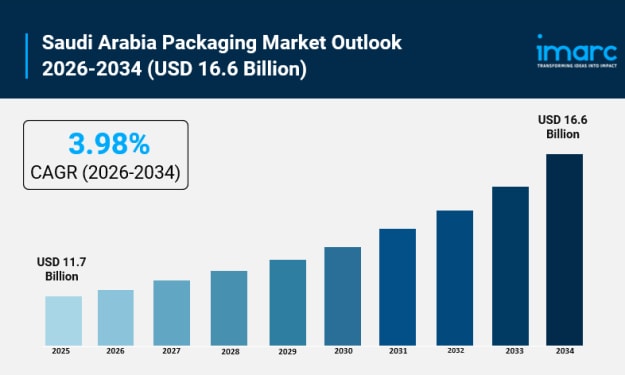
According to IMARC Group's latest research publication, Saudi Arabia packaging market size reached USD 11.7 Billion in 2025. The market is projected to reach USD 16.6 Billion by 2034, exhibiting a growth rate of 3.98% during 2026-2034.
By Jeffrey Wilson3 days ago in Futurism



Comments
There are no comments for this story
Be the first to respond and start the conversation.