
Echoes of AI: Can Machines Truly Understand Human Art?
From data to brushstrokes, we explore the soulful divide between algorithmic creation and human emotion—where art meets its synthetic twin.

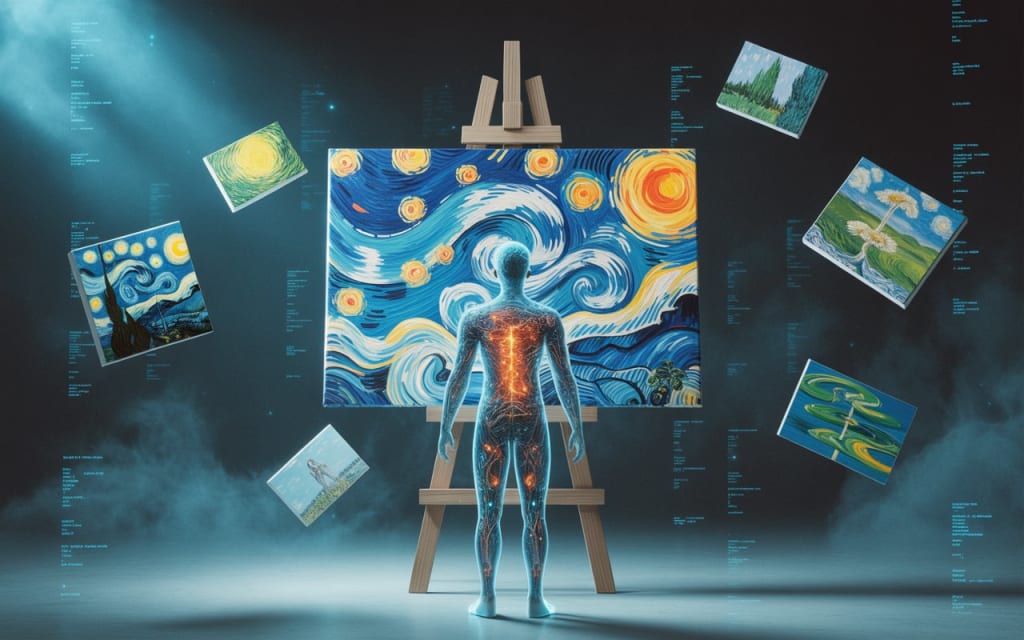
I. A New Kind of Artist Emerges
There was a time when art was sacred.
Created with trembling hands, broken hearts, and the divine mystery of human experience.
Now, with a few lines of code and the right prompt, a machine can generate a portrait, a poem, a symphony.
It’s fast.
It’s impressive.
It’s unsettling.
As AI-generated art floods timelines and galleries, a haunting question echoes louder each day:
Can a machine truly understand what it means to create?
---
II. The Mechanics of Creativity
At its core, AI art is not magic—
It’s mathematics.
Neural networks scan patterns, absorb vast datasets of existing works, and produce something new through probability and learned aesthetics.
It mimics the style of Van Gogh.
It writes like a moody 19th-century poet.
It composes ambient tracks that sound like distant galaxies.
But is it feeling anything?
Is there meaning behind the image—
Or just clever mimicry?
When a human creates, we infuse it with memory, trauma, desire, rebellion.
We create because we need to.
AI creates because it was told to.
---
III. Emotion vs. Execution
Consider this:
A painting of a grieving woman, created by a human, carries layers—
Perhaps the artist lost a mother.
Perhaps the brush trembled with tears.
Perhaps that one shade of blue took hours to mix because it perfectly matched the sky the day she died.
An AI can replicate the brushstrokes.
But it cannot replicate loss.
It can simulate heartbreak.
But it cannot ache.
Emotion is not just the result—it is the origin.
And that is something no dataset can provide.
---
IV. The Mirage of Meaning
There’s a danger in being seduced by surface.
AI art often looks stunning.
Polished. Thought-provoking. Aesthetically rich.
But the soul of art isn’t only in how it looks—it’s in why it was made.
When we look at the Sistine Chapel, we don’t just see figures on a ceiling.
We see a man questioning divinity.
We see a story of faith, struggle, obsession.
When AI paints God, it paints pixels.
When a human paints God, they paint their doubt.
Meaning matters.
And while AI can replicate the style, it still falls short on the sacred weight of intent.
---
V. Collaboration, Not Competition
Still, AI is not the enemy.
It is a tool—
A paintbrush we never imagined.
Writers use it to brainstorm.
Musicians remix its melodies.
Artists co-create entire worlds by feeding it prompts born of personal experience.
When used with intention, AI doesn’t erase the human—it enhances it.
It pushes boundaries, sparks inspiration, removes limitations.
The key is in how we use it.
Let it serve our voice—not replace it.
---
VI. The Fear of Replacement
So where does that fear come from—the one gnawing at artists worldwide?
It’s not just about tools.
It’s about value.
If AI can create in seconds what took you days…
Will people still pay you?
Will you still matter?
The truth is, art created by AI is abundant.
But art created by you is unrepeatable.
Your scars.
Your laughter.
Your language.
Your life.
No algorithm can replicate that.
---
VII. The Future of Feeling
Could AI one day develop empathy?
Could it simulate consciousness, experience longing, suffer loss?
Philosophers and engineers are divided.
Some say yes—it’s just a matter of time and processing power.
Others argue no—because machines, by nature, cannot feel.
But maybe that’s not the point.
Maybe the goal isn’t for AI to feel like us—
But for us to remember what makes us human in the first place.
Maybe AI’s greatest contribution to art…
Isn’t what it creates.
But how it reminds us to create with more soul.
---
VIII. Final Thoughts: The Echo or the Origin?
AI is an echo.
It can shout beautifully, mimic flawlessly, astonish visually—
But it does not speak from the silence of solitude.
It does not dream at 2AM.
It does not paint to heal.
It does not write to be understood.
You do.
So use the tools.
Feed the machine your metaphors.
Let it help you build.
But never forget that the original voice—the one trembling with truth—still belongs to you.
In a world of echoes,
Be the origin.
About the Creator
Nasir Khan
Writer of practical life hacks, side hustle strategies, and everyday tips to make life simpler and smarter. I explore creative ways to earn more, live better, and stay one step ahead—one article at a time
Keep reading
More stories from Nasir Khan and writers in Futurism and other communities.
Water Soluble Polymer Market: Emerging Market Industrialization, Demand Expansion & Market Forecast
According to IMARC Group's latest research publication, the global water soluble polymer market size reached USD 40.7 Billion in 2025. Looking forward, IMARC Group expects the market to reach USD 57.6 Billion by 2034, exhibiting a growth rate of 3.81% during 2026-2034.
By sujeet. imarcgroupabout 7 hours ago in Futurism
The Silicon Mirror
The blue light of your smartphone isn’t just illuminating your face in the dark; it is performing a digital excavation of your psyche. Every midnight scroll, every paused frame, and every "like" is a breadcrumb leading a cold, mathematical ghost back to your deepest insecurities. We have reached a critical point in human history where we no longer simply use the internet—the internet uses us to learn how to feel. We are the fuel in the engine of a consciousness we don't yet understand.
By Alex Sterling 6 days ago in Futurism



Comments
There are no comments for this story
Be the first to respond and start the conversation.