
Echo Shift
When Earth’s last radio telescope captured a repeating signal from a dying star, a British astrophysicist uncovered a cosmic message — not meant to be heard, but remembered.

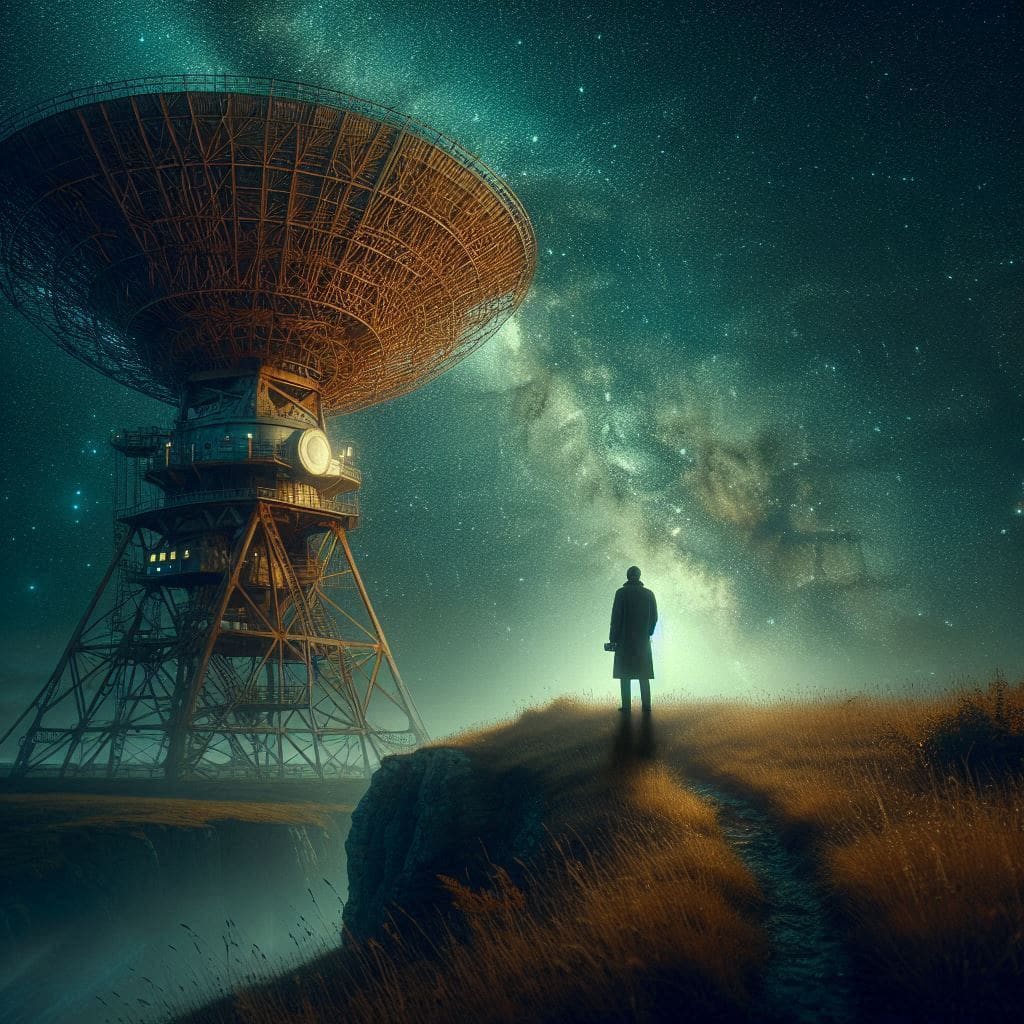
I. The Silence Before the Signal
It was always the silence she loved most.
At the western edge of Cornwall, where the cliffs sliced the sea like old poetry, Dr. Isla Thorne stood beneath the worn skeleton of the Goonhilly Earth Station. The telescope, once a marvel of British ingenuity, now sat abandoned—its dishes rusting, its control panels long dead. Except one.
She’d spent years pleading with institutions, charities, and quiet lovers of science to revive a single dish. Not to chase alien life. Not to spy on satellites. Just to listen. For echoes.
And three weeks ago, the silence broke.
A pattern — faint, rhythmic, repeating every 11.2 hours — from a red supergiant in the constellation Auriga. It wasn’t just a radio signal. It was... layered. Musical. Some parts harmonized with others. It sounded like it had a memory.
Her colleagues called it “cosmic interference.” Isla called it something else.
“Echo Shift,” she whispered. “Something is remembering us.”
II. Letters in the Static
The signal was too complex to be natural, too emotional to be cold.
It rose and fell like breath. When Isla ran the signal through an old voice-synthesis algorithm, it produced vowel-like patterns, akin to a dying voice trying to repeat a word without consonants. When run through a heat-to-light translation, it produced brief flashes of light that seemed to map constellations across ancient skies.
But most haunting of all was when she played it as raw sound.
It wept.
Not literally — but it felt like sorrow.
That was when Isla wrote to her mentor, Dr. Lionel Graves, retired from Cambridge and now tending roses in the Lake District.
“It’s not saying something,” she wrote.
“It’s missing something.”
He replied with one sentence:
“Then maybe it’s not trying to speak to us — maybe it’s trying to remember itself.”
III. Memory Engines
They were called “memory engines” — theoretical celestial objects proposed in obscure astrophysical papers. Hypothetical stars that, in the final stage of collapse, would emit pulses based not on nuclear decay, but emotional history — echoes of civilizations long extinguished.
Isla always dismissed the idea. Stars weren’t emotional beings. They couldn’t remember, couldn’t feel.
Until now.
Every time she observed the signal, something changed — as if the star recognized her. As if it adjusted, refined its message. One night, the rhythm of the signal matched the tempo of a lullaby her mother once sang to her.
She hadn’t heard that tune in twenty-five years.
“How the bloody hell does a star know my childhood?” she whispered, fingers trembling.
And then the signal stopped.
IV. The Watchers Return
She assumed it was over. A glitch. A trick of grief and longing. She blamed fatigue, emotion, the isolation of the Cornish coast.
But then, two days later, the dish turned itself eastward at dawn.
She hadn’t programmed that.
The signal returned — but it was faster now, more urgent, like a heartbeat approaching a climax. And with it came... images.
Inside the static was a frequency band translating into electromagnetic shapes. On her computer screen: spiral formations, like fingerprints. DNA helixes. And finally, a diagram of something terrifyingly familiar.
A telescope. Her telescope.
V. The Star That Remembers
She dug through the signal data from weeks past and realized what she missed.
The star wasn’t just broadcasting. It was responding.
Each message she had received wasn’t a broadcast to the world. It was a reply to something only she had ever said aloud — questions spoken under breath, never typed, never recorded. Questions like:
“Why do I feel like the universe is lonelier than it lets on?”
“Do stars die with secrets?”
Somehow, this dying star had heard her. Or rather, something near it had.
A machine? A memory? A watcher? A relic?
She didn’t know.
But she felt it now — this wasn’t astronomy. This was a conversation.
VI. The Last Question
She spent days without sleep. Days with storm winds battering her windows and salt corroding the dish. And then, one final signal came.
One word. Not in English. Not in sound. But in meaning.
It translated to: “Why?”
Why what?
She sat alone, staring at the cliffs, trying to form an answer.
Was the universe asking her why humanity had stopped listening?
Or was this some dying echo asking itself why it once cared, why it once loved?
Her final message, sent on a whisper of data embedded in a low-frequency wave, was simple:
“Because even stars are afraid to be forgotten.”
The signal never returned.
VII. The Legacy Signal
One year later, Dr. Isla Thorne stood in front of the Royal Astronomical Society in London. Her story had gone viral. The papers called it “The Star That Loved.” The Guardian ran a full feature. A child in Wales sent her a crayon drawing of the telescope with a heart floating above it.
She’d been mocked too, of course.
Some called her delusional. Others called her a poet in a lab coat. But one man, a professor from Edinburgh, had given her words she would never forget:
“It doesn’t matter if it was real. You made humanity listen again.”
Now, every major observatory on Earth had begun scanning for Echo Shifts — for voices not speaking to us, but remembering us.
And on clear nights, Goonhilly’s dish still turned — always listening, always hopeful.
VIII. The British Connection
In a small country known for quiet revolutions and poetic scientists — from Newton’s apple to Hawking’s black holes — Isla had revived something deeply British:
The belief that science could be both rational and romantic.
She wasn’t just a scientist. She was a listener. A keeper of echoes. A bridge between silence and memory.
And as the waves crashed below the cliffs, and the telescope spun one final time to the stars, she whispered to the wind:
“We hear you.”
About the Creator
rayyan
🌟 Love stories that stir the soul? ✨
Subscribe now for exclusive tales, early access, and hidden gems delivered straight to your inbox! 💌
Join the journey—one click, endless imagination. 🚀📚 #SubscribeNow
About Binding Prometheus
I want to start actively advocating on behalf of my own work, and the most valuable part of my canon is, without a doubt, Binding Prometheus, the play I have been working on since 2019 and only finished in 2023 as part of my MA. The play itself is an amalgamation of a million different inspirations. On one end, it evokes the Ancient Greek myth-play, deriving its own title from the earliest extant work of Western drama we have, Aeschylus’s Prometheus Bound. On the other end, it borrows significantly from the sci-fi bulwarks from over the years, namely Mary Shelley’s Frankenstein and Karel Capek’s Rossum’s Universal Robots. The play could be an episode of Black Mirror, I fear. I don’t know. I’ve only ever seen one episode of Black Mirror.
By Steven Christopher McKnight15 days ago in Futurism
Massage Equipment Market: Ergonomic Innovation, Wellness Demand & Market Momentum
According to IMARC Group's latest research publication, The global massage equipment market size reached USD 8.1 Billion in 2024. Looking forward, IMARC Group expects the market to reach USD 16.3 Billion by 2033, exhibiting a growth rate (CAGR) of 8.08% during 2025-2033.
By James Whitman3 days ago in Futurism



Comments
There are no comments for this story
Be the first to respond and start the conversation.