
E-Bike Market Trends: Smart Connectivity, Sustainable Transport Adoption & Industry Outlook to 2034
How lithium-ion battery improvements, lightweight frame technology, and smart connectivity features are enhancing performance and expanding consumer demand in the e-bike market.

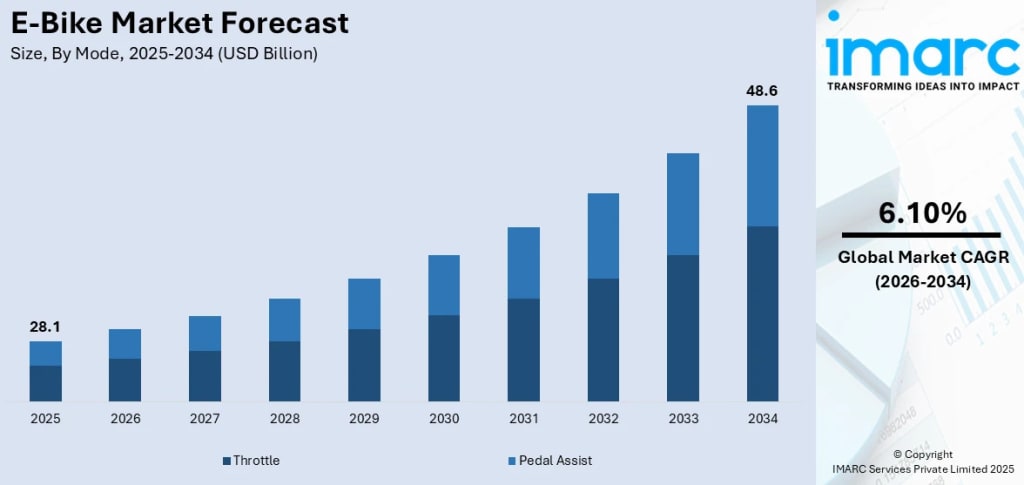
Rising urbanization, increasing traffic congestion, and growing environmental concerns are driving e-bike demand, supported by advancements in battery technology, government incentives, and expanding cycling infrastructure. According to IMARC Group’s latest data, the global e-bike market size was valued at USD 28.1 Billion in 2025. Looking forward, IMARC Group estimates the market to reach USD 48.6 Billion by 2034, exhibiting a CAGR of 6.10% from 2026-2034. Asia Pacific currently dominates the market, holding a market share of over 76.6% in 2025.
E-bikes have transitioned from a niche hobby to a cornerstone of modern urban mobility, with the global sector now valued well over USD 28 billion and showing consistent upward momentum. This surge is fueled by a shift toward sustainable "last-mile" transport, volatile fuel prices that make electric alternatives more attractive, and a rising interest in fitness-integrated commuting. Strategic infrastructure investments, such as the expansion of protected bike lanes in major metros, along with the rollout of more efficient lithium-ion battery systems, are lowering the barriers to entry for daily commuters. Key market segments include pedal-assist models, which hold roughly 66.9% of the market, as well as throttle-based and speed-pedelec options, as users increasingly prioritize range, reliability, and ease of use.
E-Bike Market Growth Drivers:
- Accelerated Urbanization and Traffic Congestion Management
As metropolitan populations swell, traditional vehicle transport often leads to gridlock, making e-bikes a superior solution for navigating dense city centers. These bikes allow riders to bypass traffic and use shortcuts unavailable to cars, significantly reducing commute times. Current industry data indicates that urban dwellers are increasingly adopting Class I e-bikes—which offer pedal assistance up to 20 mph—because they integrate seamlessly with existing bike paths. With nearly 83% of e-bike applications centered in city environments, the demand for agile, space-efficient transport is a primary catalyst for the market's ongoing expansion.
- Robust Government Incentives and Infrastructure Investment
Legislative support is playing a pivotal role in making e-bikes accessible to a broader demographic through subsidies and tax credits. For example, programs like Colorado’s point-of-sale credit offer instant discounts of up to USD 450, while France has extended purchase subsidies through 2027. These financial buffers, combined with massive investments in "cycle-highways" across Europe and North America, directly correlate with higher sales volumes. As cities redesign streets to prioritize micro-mobility over personal cars, e-bikes become the logical choice for eco-conscious and budget-minded travelers seeking reliable alternatives to gasoline-powered vehicles.
- Technological Breakthroughs in Battery and Motor Efficiency
Modern e-bikes are no longer heavy or cumbersome, thanks to the dominance of lithium-ion batteries which currently account for over 68% of the market. Manufacturers are now delivering units with torque outputs exceeding 100 Nm, such as the new DJI Avinox system, allowing for better performance on steep inclines and during heavy-load transport. These advancements extend the range of a single charge to over 100 km in many premium models, alleviating "range anxiety." Higher energy density and the development of compact mid-drive motors ensure that today's e-bikes offer a natural riding experience while remaining powerful enough for diverse terrains.
E-Bike Market Trends:
- Integration of Smart Connectivity and AI-Driven Features
The 2026 product landscape is defined by "smart-ready" e-bikes that function more like computers on wheels than traditional cycles. New models now feature integrated IoT modules for GPS tracking, anti-theft alarms, and remote diagnostics via smartphone apps. We are seeing a significant shift toward automatic transmissions, like the Enviolo Automatiq, which analyzes speed and cadence to shift gears without rider input. These AI-enhanced systems simplify the user experience for beginners and improve mechanical longevity by preventing gear strain. Connectivity is becoming a standard expectation for premium buyers who value data-driven performance and security.
- The Rise of High-Payload and Cargo E-Bikes for Logistics
A major shift is occurring as e-bikes move beyond personal use into the commercial and family sectors. XXL e-bikes and cargo models with load capacities exceeding 150 kg are becoming a common sight for last-mile deliveries and "school runs." Companies like Amazon and various local courier services are replacing delivery vans with electric cargo bikes to lower operational costs and meet zero-emission mandates. This trend toward "utility cycling" is supported by modular frame designs that can be fitted with child seats, weather protection, or delivery boxes, effectively making the e-bike a viable car replacement for many households.
- Premiumization and the Growth of Recreational E-MTBs
Beyond commuting, there is a booming demand for high-end electric mountain bikes (e-MTBs) and gravel bikes designed for adventure. Brands like Specialized and Trek are pushing the boundaries with carbon fiber frames and sophisticated suspension systems that mimic professional-grade traditional mountain bikes. This premium segment is attracting affluent consumers who view e-biking as a primary leisure activity. With features like "mullet" wheel setups and dual-chamber shocks, these bikes allow riders to explore rugged terrains that were previously inaccessible. This lifestyle-driven trend is particularly strong in North America and Europe, where recreational outdoor sports are a major economic driver.
Recent News and Developments in E-Bike Market
- January 2026: Specialized unveiled the Turbo Levo Gen 4, featuring a high-voltage 59V system and a massive 840Wh battery, setting a new benchmark for power and efficiency in the electric mountain bike category.
- November 2025: Segway officially entered the high-performance e-bike space with the Xyber, a "scrambler-style" bike delivering 175 Nm of torque, blurring the lines between traditional cycling and lightweight electric motorcycles.
- September 2025: Several European cities announced a 20% increase in dedicated cycling infrastructure funding for 2026, specifically targeting the creation of secure e-bike charging hubs and expanded lane networks.
Note: If you require specific details, data, or insights that are not currently included in the scope of this report, we are happy to accommodate your request. As part of our customization service, we will gather and provide the additional information you need, tailored to your specific requirements. Please let us know your exact needs, and we will ensure the report is updated accordingly to meet your expectations.
About the Creator
Andrew Sullivan
Hello, I’m Andrew Sullivan. I have over 9+ years of experience as a market research specialist.
Keep reading
More stories from Andrew Sullivan and writers in Futurism and other communities.
Gas Engine Market Trends: Distributed Power Demand, Low-Emission Technologies & Industry Forecast to 2033
Accelerating industrialization, the global push for cleaner energy, and the rise of decentralized power systems are driving gas engine demand. These systems are supported by the expansion of natural gas infrastructure, government incentives for combined heat and power (CHP), and the integration of hydrogen-ready technologies. According to IMARC Group’s latest data, the global gas engine market size was valued at USD 5.01 Billion in 2025. Looking forward, IMARC Group estimates the market to reach USD 8.08 Billion by 2034, exhibiting a CAGR of 5.61% from 2026-2034. North America currently dominates the market, holding a market share of over 42.1% in 2025.
By Andrew Sullivanabout 8 hours ago in Futurism
Europe Creator Economy Market worth USD 112.42 Billion By 2034
Europe Creator Economy Market Overview The Europe Creator Economy Market is projected to reach approximately USD 112.42 Billion by 2034, increasing from USD 14.3 Billion in 2024, reflecting a strong CAGR of 22.9% during the forecast period from 2025 to 2034.
By Roberto Crum5 days ago in Futurism
Hunger is looming over Yemen, urgent action is needed
Yemen is facing one of the most severe humanitarian crises in the world, with millions of people at risk of starvation as conflict, economic instability, and restricted access to aid converge to create a dire situation. Experts warn that without urgent international intervention, the country could experience catastrophic levels of hunger and malnutrition in the coming months. The crisis is driven by years of armed conflict between the internationally recognized government and Houthi rebels, compounded by regional geopolitical tensions, economic collapse, and the disruption of basic services. Humanitarian agencies have repeatedly highlighted that food insecurity is escalating rapidly, with children and vulnerable populations at particular risk. The Scale of the Crisis According to reports from United Nations World Food Programme, more than 20 million people in Yemen — nearly two-thirds of the population — face severe food insecurity. Of these, millions are on the brink of famine, unable to access adequate nutrition due to limited food supplies, rising prices, and blocked humanitarian corridors. The war has destroyed infrastructure, disrupted agricultural production, and limited the flow of imports, making food increasingly scarce and expensive. Fuel shortages exacerbate the problem by making transportation of goods more difficult, while inflation further erodes household purchasing power. Children and Vulnerable Groups at Risk Children are disproportionately affected by Yemen’s food crisis. Malnutrition rates among children under five have reached alarming levels, with tens of thousands at risk of life-threatening conditions such as severe acute malnutrition. International health agencies warn that without immediate intervention, the health and survival of an entire generation are at stake. Pregnant and lactating women, the elderly, and displaced populations are also particularly vulnerable. Limited access to healthcare and clean water compounds the risk of disease, further increasing the urgency for humanitarian support. Barriers to Aid Delivery Humanitarian operations in Yemen face immense challenges. Blocked ports, active conflict zones, and bureaucratic restrictions hinder the delivery of food, medical supplies, and essential services. Aid organizations report that in some regions, trucks carrying food are delayed for weeks due to inspections and restricted access imposed by local authorities. The situation is worsened by ongoing conflict, which disrupts supply chains and forces humanitarian agencies to navigate dangerous areas to reach vulnerable communities. Aid convoys often require extensive negotiation and security coordination, limiting the speed and volume of deliveries. International Response The international community has pledged support, but funding gaps continue to impede large-scale relief efforts. United Nations and partner organizations have repeatedly called for emergency funding to address Yemen’s food crisis, emphasizing that without rapid assistance, the risk of famine will increase dramatically. Several countries and humanitarian donors have contributed to food and medical aid, but the sheer scale of the need far exceeds available resources. Emergency appeals frequently highlight the need for cash assistance, nutritional support for children, and measures to restore basic services. Economic Collapse Compounds the Crisis Yemen’s economy has been devastated by years of war. Currency depreciation, high unemployment, and disrupted markets have left millions unable to afford food even when supplies are available. Analysts warn that without economic stabilization, humanitarian interventions alone may be insufficient to prevent widespread hunger. The collapse of local food production further intensifies the problem. Farmers struggle with lack of access to seeds, fuel, and water, while conflict limits transportation to markets, leading to shortages in urban and rural areas alike. Calls for Urgent Action Experts stress that immediate and coordinated action is essential. Expanding humanitarian access, increasing funding, and negotiating safe corridors for food delivery are critical steps to prevent mass starvation. Humanitarian advocates also urge the international community to press for ceasefires and conflict resolution measures that allow aid to reach those most in need. Without addressing the underlying political and security issues, temporary relief may only partially alleviate the crisis. The Humanitarian Imperative Yemen’s hunger crisis is a stark reminder of the devastating human cost of prolonged conflict. Families are being forced to make impossible choices, and children are suffering the consequences of disrupted food systems and limited healthcare. Global organizations continue to emphasize that starvation is preventable if the international community acts swiftly. Coordinated diplomatic, financial, and logistical support could save millions of lives and stabilize communities across Yemen. As the situation deteriorates, the world faces a moral imperative: to provide urgent assistance before the crisis escalates into widespread famine and the loss of countless lives. Immediate action is needed to deliver food, medical care, and protection to the most vulnerable, ensuring that hope is not lost amid the devastation.
By Fiaz Ahmed 2 days ago in Futurism




Comments
There are no comments for this story
Be the first to respond and start the conversation.