
Does the Moon Move with You? No, That's a Parallax.
Parallax or motion parallax is the phenomenon that an object's apparent position varies concerning another object or the background when viewed from different positions.


For example, if one moves to the right about the viewing direction (for example, while sitting in a vehicle looking to the left about the direction of travel), the direction in which one sees an object in the foreground will turn to the left faster than the direction in which an object in the foreground is seen. Background.
Distant objects thus seem to move partially with the observer's movement relative to nearby objects. The brain translates the relative depth from this. This is known as depth perception.
Photography.
An object to be photographed appears to be slightly different from the viewfinder of a simple viewfinder camera than from the recording lens. The lens and viewfinder are not in the same position or directly behind each other are a few centimeters apart.
With a photo of an object that is a few meters away from the lens, the parallax does not cause any major problems because the lens and viewfinder then 'see' almost the same. However, the closer an object is to the camera, the greater the difference between the viewfinder image and the actual picture being taken, the parallax.
With a two-eyed SLR camera, such as those made by Rollei, Yashica, and Mamiya, the parallax can be canceled by the parallax converter, which is located between the camera and the tripod.
After focusing through the top lens, the camera is lifted with the converter, and the recording lens is level with the viewfinder lens previously.
The recording is then the same as the observation.
However, this only works with stationary objects. There are also cameras such as the Mamiya C 330 that show a parallax correction in the viewfinder so that the above is not an issue.
A one-eyed SLR camera fundamentally solves the parallax problem. Because the viewfinder shows exactly what the lens sees, there are no differences between the viewfinder crop and the actual image.
What will occur is that there is more image on the image than previously seen. This is because most SLR cameras have a focusing screen of about 90%. Only (semi) pro cameras have a limit of 100%.
With this type of camera, the image is transferred by the recording lens via a mirror and a prism directly into the viewfinder.
The mirror will pop up momentarily during the actual recording. This creates a different kind of parallax, time parallax. You lose your subject for a while, which does not happen with a rangefinder camera.
There are also digital cameras where the viewfinder image is electronically transferred from the image sensor to a monitor (LCD). These cameras are also parallax-free.
Another parallax problem occurs when creating a panorama by stitching individual photos together: there are often areas where it cannot be properly fitted.
Measuring instruments.
When reading analog measuring instruments, errors may occur due to parallax.
Two types of parallax can be distinguished here, the parallax between the measuring instrument and object and the parallax in the measuring instrument itself. Digital readouts are parallax-free because the result does not depend on the observation.
Parallax between measuring instrument and object.
Parallax can occur between the scale of the measuring instrument and the object being measured.
A well-known example is a ruler that is placed on an object. If the scale is on top of the ruler, there is a distance between the scale and the object measured.
The observer who moves his head slightly to the left or right sees the parallax's effect: the scale appears to move relative to the object.
Even with a transparent ruler with the scale on the bottom, parallax can occur due to light refraction. If the observer cannot read straight from above, the scale is perceived slightly shifted.
The same amount shifts the part of the object below the ruler, but the part outside is not. Reading through the ruler gives the best result: the marking line and the point to be measured have the same deviation so that the parallax is, in fact, compensated.
The photo shows that the parallax compensation is best too close to the edge; further from the edge, parallax increases because the ruler's top is slightly inclined.
Parallax in the measuring instrument itself.
Parallax can also occur in the measuring instrument itself when reading a pointer against a scale's background. The simplest example is reading the time on an analog clock that is observed obliquely.
A commonly used method to combat this measurement error is the so-called mirror reading: just below or above the scale, there is a groove of approximately 5 mm wide in the dial, with a mirror behind it. By looking perpendicular to the dial, the mirror image and pointer coincide, and the observation is correct.
Another method, especially used in cheaper instruments, is the knife pointer, where the pointer's tip lies in a vertical plane. When the tip of the pointer appears as thin as possible, the field of view is perpendicular from above. This method is much less accurate than that with the mirror scale.
The essence of these corrections is to improve the reproducibility of the reading angle. Even if the mirror or pointer is misaligned, the result is the same as when calibrating the instrument.
Artillery.
When using artillery in a combat situation, the fire control system must consider the position differences of the individual guns.
Although this is not directly related to observation (usually geographic coordinates are the focus), this problem's geometric explanation is the same as for parallax.
Parallax is the basis for measurement methods.
The relative displacement or fall is photographically recorded in photogrammetry when taking aerial photographs from two different positions. In a stereoscope, the overlapping sets of photos can be viewed in three dimensions.
With a parallax meter equipped with a micrometer, the parallax difference of each point can be determined. The parallax shift is a measure of the height difference.
For example, height differences of buildings and objects can be determined, or terrain height maps can be made. In terrestrial photogrammetry, differences in distances are determined in photographs taken from the ground.
In astronomy, parallax is used to measure distances. The extent to which a star apparently shifts when observed from two opposite points of the Earth's orbit (i.e., taking two measurements at the same place on Earth, but with a six-month difference in time) is used as a measure to determine the distance.
The parsec (a contraction of parallax seconds) is a unit of distance used in astronomy, defined as the distance an object must lie to be seen from Earth with a parallax of 1 arc second.
The ability to perceive depth is partly due to parallax. Two images are perceived at slightly different angles with both eyes. The brain interprets this as 'depth.' The stereoscopy makes use of this.
Observation through binoculars provides a little less depth due to the magnification, just as with telephotos.
Prism viewers somewhat compensate for that depth loss by moving the lenses a little further apart, increasing the parallax.
About the Creator
Keep reading
More stories from Bryan Dijkhuizen and writers in Futurism and other communities.
Australia Vegan Cosmetics Market: Ethical Consumerism, Product Innovation & Retail Growth
According to IMARC Group, the Australia vegan cosmetics market reached USD 552.7 Million in 2025 and is projected to grow to USD 1,073.0 Million by 2034, exhibiting a compound annual growth rate (CAGR) of 7.42% during 2026–2034. The market’s robust expansion reflects the rapid rise of ethical consumerism and clean beauty awareness across Australia. Increasing adoption of vegan lifestyles, heightened demand for ingredient transparency, and growing environmental consciousness are reshaping purchasing decisions. With innovation in plant-based formulations and strong digital retail growth, Australia vegan cosmetics market share continues to strengthen within the broader beauty and personal care industry.
By Shrestha Roy6 days ago in Futurism
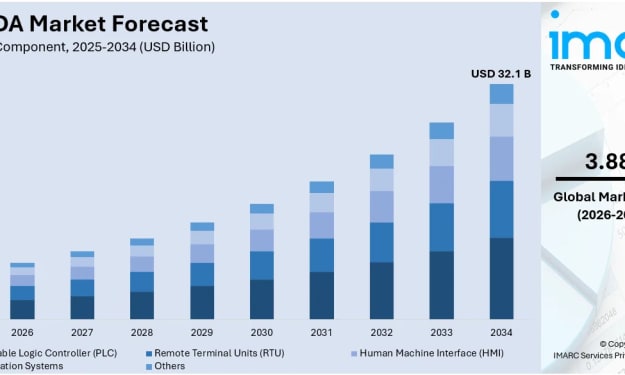
SCADA Market Trends: Smart Manufacturing Shift, Edge Computing Integration & Forecast to 2034
Rising demand for industrial automation, the rapid integration of the Industrial Internet of Things (IIoT), and the increasing need for real-time data monitoring across critical infrastructure are driving the SCADA market growth. These systems are becoming essential for optimizing operations in the oil and gas, power generation, and water management sectors, where reducing downtime and increasing efficiency are top priorities. According to IMARC Group’s latest data, the global SCADA market size was valued at USD 22.8 Billion in 2025. Looking forward, IMARC Group estimates the market to reach USD 32.1 Billion by 2034, exhibiting a CAGR of 3.88% from 2026-2034.
By Andrew Sullivan6 days ago in Futurism


Comments
There are no comments for this story
Be the first to respond and start the conversation.