
Disadvantages of Artificial Intelligence: Navigating the Challenges of AI
Artificial Intelligence (AI) has revolutionized industries, transformed everyday life, and opened up new frontiers of technology


Artificial Intelligence (AI) has revolutionized industries, transformed everyday life, and opened up new frontiers of technology. However, as with any powerful tool, AI comes with its own set of challenges and drawbacks. While its potential benefits are vast, the disadvantages of AI must be carefully considered to ensure it is developed and deployed responsibly. Here are some key disadvantages:
Job Displacement and Unemployment
One of the most frequently discussed drawbacks of AI is its impact on the workforce. As AI systems become more advanced, they are increasingly capable of performing tasks traditionally done by humans. This is particularly evident in industries such as manufacturing, retail, and customer service, where automation is replacing routine jobs. AI-powered machines can work faster, more efficiently, and without rest, leading to significant cost savings for businesses but leaving many workers redundant.
- Key Concern: While AI creates new opportunities in tech sectors, many lower-skill jobs are at risk, potentially leading to higher unemployment and economic inequality.
Bias and Discrimination
AI systems are only as good as the data they are trained on. Unfortunately, this data often reflects the biases present in society. AI algorithms, particularly in areas like hiring, policing, and healthcare, can perpetuate and even amplify existing biases. For example, facial recognition software has been found to misidentify people of color at higher rates than white individuals, leading to concerns about unfair treatment.
- Key Concern: AI can unintentionally reinforce systemic biases, resulting in discriminatory outcomes in critical areas such as criminal justice, healthcare, and employment.
*Lack of Accountability
AI systems, especially complex ones, can be difficult to understand, even for their creators. This lack of transparency, often called the "black box" problem, makes it challenging to determine why an AI made a particular decision. This becomes especially problematic in high-stakes environments such as healthcare, finance, and legal systems, where decisions have significant consequences.
- Key Concern: When something goes wrong, it can be difficult to assign responsibility, creating legal and ethical dilemmas. Who is accountable when an AI-driven medical diagnosis is incorrect or when a self-driving car causes an accident?
Security Risks
AI systems can be vulnerable to hacking and misuse. Malicious actors can manipulate AI models or use them for nefarious purposes, such as creating deepfakes, automated cyberattacks, or fake news. Moreover, AI can be employed by authoritarian regimes to enhance surveillance and control over populations, raising concerns about privacy and civil liberties.
- Key Concern: The widespread use of AI opens new avenues for cyber threats and misuse, posing risks to individual privacy, security, and even democratic governance.
High Costs
Developing and maintaining AI systems requires significant financial investment. From training large-scale machine learning models to purchasing the necessary hardware and infrastructure, AI can be prohibitively expensive for smaller businesses and developing nations. Additionally, the cost of hiring skilled professionals to build, monitor, and update AI systems adds to the burden.
- Key Concern: The high costs associated with AI development could exacerbate inequality between large corporations with deep pockets and smaller businesses or nations lacking resources.
Lack of Creativity
AI excels at tasks requiring speed, accuracy, and data processing, but it lacks creativity and emotional intelligence. AI systems can generate content based on patterns in existing data, but they cannot truly innovate or think "outside the box" in the way humans can. This limitation is particularly relevant in fields such as the arts, creative industries, and problem-solving domains where novel solutions are essential.
- Key Concern: AI’s inability to think creatively limits its application in tasks requiring human-like intuition, empathy, and innovation.
Ethical Concerns and Decision-Making
As AI becomes more integrated into decision-making processes, ethical concerns arise. For example, should an autonomous vehicle prioritize the safety of its passengers over pedestrians in an unavoidable accident? How should AI balance the need for efficiency with moral considerations? These ethical dilemmas are difficult for even humans to resolve, yet AI systems are increasingly being tasked with making decisions in complex, ambiguous situations.
- Key Concern: The ethical framework for AI is still underdeveloped, raising concerns about how machines should handle moral decisions, especially in life-and-death scenarios.
Dependence on AI
As AI becomes more ubiquitous, there is a growing risk that individuals, organizations, and even entire sectors will become overly reliant on AI systems. This dependency could lead to a lack of human expertise and critical thinking. In situations where AI fails, or where human oversight is required, this overreliance could result in catastrophic consequences.
- Key Concern: reliance on AI may erode human skills and decision-making abilities, potentially leading to dangerous overdependence.
Environmental Impact
Training AI models, particularly large-scale deep learning models, requires significant computing power, which consumes substantial energy. Data centers that house AI systems contribute to carbon emissions and environmental degradation, raising concerns about the ecological footprint of AI.
- Key Concern: The environmental costs of AI, particularly in terms of energy consumption and carbon emissions, are a growing issue as the technology scales.
Conclusion
While the promise of AI is undeniable, it is critical to approach its development and deployment with caution. Addressing the disadvantages of AI—such as job displacement, ethical concerns, and security risks—requires thoughtful regulation, ethical guidelines, and ongoing dialogue between stakeholders. By carefully managing the risks, society can harness the benefits of AI while mitigating its potential harms.
About the Creator
Keep reading
More stories from Muhammad Waheed Asghar and writers in Futurism and other communities.
Human Brain vs. Artificial Intelligence: A Complex Relationship
In recent years, the rapid advancements in artificial intelligence (AI) have sparked countless comparisons between human intelligence and AI. These comparisons often lead to discussions about whether AI can ever fully replicate the human brain. While both the human brain and AI systems can perform complex tasks and learn from data, the way they operate and the scope of their abilities are vastly different.
By Muhammad Waheed Asgharabout a year ago in Futurism
The Interactive Shift: Exploring the Future of Storytelling in Digital Age
For centuries, storytelling was a one-way street. We sat around campfires, listened to bards, turned the pages of novels, and watched silver screens. In these scenarios, the creator was the architect, and we—the audience—were the passive observers. We cried for characters we couldn't warn and cheered for heroes we couldn't help. But we are currently standing at a massive crossroads in cultural history.
By Muhammad Owais SEOabout 6 hours ago in Futurism
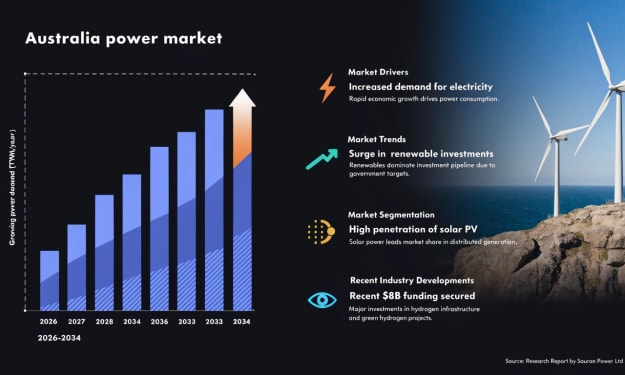
Australia Power Market: Renewable Energy Expansion, Grid Modernization & Electricity Demand Growth
According to IMARC Group, the Australia power market reached 285.7 TWh in 2025 and is projected to reach 377.0 TWh by 2034, growing at a compound annual growth rate (CAGR) of 3.04% during 2026–2034. The market’s growth is being shaped by accelerating renewable energy adoption, increasing electricity demand and large-scale investments in grid modernization. Government incentives supporting clean energy transition, combined with rising corporate sustainability commitments, are encouraging the expansion of solar, wind and battery storage infrastructure. At the same time, the gradual phase-out of coal-fired power plants is transforming the structure of Australia’s electricity generation mix. With emerging technologies such as hydrogen energy systems and virtual power plants gaining traction, Australia’s power sector is evolving into a more diversified, digitally integrated and sustainable energy ecosystem.
By Kevin Cooper4 days ago in Futurism
Hottest in the Office
Dear Rafi, You’re very distracting to work around. For the first second I saw you the other day, I thought you were some type of executive. It took a moment to realize no, you were just the new guy, dressed up for the job he wants. Be still, my heart.
By Gabriel Shames2 days ago in Pride


Comments
There are no comments for this story
Be the first to respond and start the conversation.