
Digital Evolution
The Evolution of Digital Design: From Logic Gates to AI Integration


Digital design has undergone a remarkable transformation over the decades, evolving from its foundational principles of logic gates to the complex integration of artificial intelligence (AI). This journey reflects the rapid advancements in technology and the growing demands for efficiency, scalability, and intelligence in modern systems.
The Foundations: Logic Gates and Early Digital Circuits
The inception of digital design can be traced back to the invention of logic gates, the fundamental building blocks of digital circuits. Developed from Boolean algebra, logic gates like AND, OR, NOT, and XOR enable binary operations that form the backbone of computation. In the mid-20th century, these gates were realized using vacuum tubes, which were later replaced by more reliable and compact transistors.
The transition to transistor-based logic circuits marked a significant milestone, enabling the creation of integrated circuits (ICs). These ICs allowed multiple transistors to be fabricated on a single silicon chip, drastically reducing size and power consumption while enhancing reliability. This era saw the birth of microprocessors, with early designs like the Intel 4004 paving the way for personal computing and embedded systems.
The Rise of Complex Systems: From RTL to HDL
As the complexity of digital systems grew, designing circuits manually became increasingly impractical. This challenge led to the development of register-transfer level (RTL) design, which introduced a higher abstraction level for describing digital circuits. RTL facilitated the modeling of systems using blocks like registers, multiplexers, and arithmetic units, focusing on data flow and control without delving into transistor-level details.
The advent of hardware description languages (HDLs) like Verilog and VHDL further revolutionized digital design. These languages enabled engineers to programmatically describe, simulate, and verify complex digital systems. Designers could now focus on functionality and performance while relying on automated tools to synthesize their descriptions into physical circuits. This approach significantly accelerated the development of application-specific integrated circuits (ASICs) and field-programmable gate arrays (FPGAs).
Automation and Optimization: CAD Tools and EDA
The explosion in design complexity brought forth the need for sophisticated computer-aided design (CAD) tools and electronic design automation (EDA) software. These tools offered automated placement and routing capabilities, timing analysis, and power optimization, streamlining the entire design process. With EDA, the industry transitioned from crafting individual components to assembling entire systems-on-chip (SoCs), which integrate processors, memory, and peripheral interfaces on a single chip.
The 21st century saw significant advances in low-power design, driven by the proliferation of mobile devices and IoT applications. Techniques like dynamic voltage scaling, clock gating, and multi-threshold CMOS became standard practices to extend battery life without sacrificing performance.
The AI Revolution: Intelligent Systems and Design
Today, AI integration is transforming the field of digital design. Modern systems demand not just computational power but also the ability to learn, adapt, and make decisions. This shift has introduced new paradigms in the design and application of digital circuits.
Neural networks, a cornerstone of AI, have spurred the development of specialized hardware accelerators like GPUs, TPUs, and neuromorphic chips. These devices are optimized for parallel processing and matrix operations, enabling real-time inference and training of AI models. Digital design now incorporates AI algorithms directly into hardware, reducing latency and power consumption compared to software-based implementations.
Moreover, AI is also being employed in the digital design process itself. Machine learning algorithms are used to optimize circuit layouts, predict system behavior, and even automate the synthesis of HDL code. These advancements have significantly shortened design cycles and enhanced the performance of final products.
Future Directions: Toward Quantum and Beyond
As digital design continues to evolve, emerging technologies like quantum computing are poised to redefine the field. Quantum gates, the analogs of classical logic gates, operate on qubits and enable computations that are infeasible with traditional systems. Although still in its infancy, quantum computing promises unprecedented capabilities in fields such as cryptography, optimization, and machine learning.
Additionally, the convergence of AI and edge computing drives innovations in energy-efficient, high-performance digital systems. Integrating AI into edge devices ensures real-time data processing while minimizing reliance on cloud infrastructure.
Conclusion
The evolution of digital design from simple logic gates to sophisticated AI-integrated systems reflects a journey of relentless innovation and adaptation. Each technological breakthrough has built upon the foundations of its predecessors, paving the way for more advanced and intelligent systems. As we look to the future, combining digital design with cutting-edge technologies like quantum computing and AI will undoubtedly unlock new possibilities, shaping the next era of human ingenuity.
About the Creator
Oren Gall
Dr. Oren Gall, Penn State professor and entrepreneur, founded OZG Systems Engineering and enjoys family, car shows, and powerlifting.
About Binding Prometheus
I want to start actively advocating on behalf of my own work, and the most valuable part of my canon is, without a doubt, Binding Prometheus, the play I have been working on since 2019 and only finished in 2023 as part of my MA. The play itself is an amalgamation of a million different inspirations. On one end, it evokes the Ancient Greek myth-play, deriving its own title from the earliest extant work of Western drama we have, Aeschylus’s Prometheus Bound. On the other end, it borrows significantly from the sci-fi bulwarks from over the years, namely Mary Shelley’s Frankenstein and Karel Capek’s Rossum’s Universal Robots. The play could be an episode of Black Mirror, I fear. I don’t know. I’ve only ever seen one episode of Black Mirror.
By Steven Christopher McKnight26 days ago in Futurism
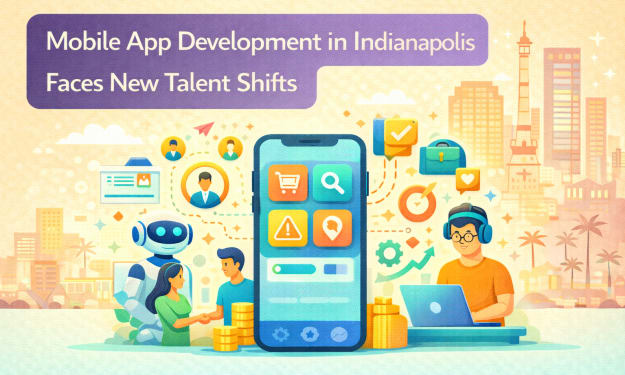
Mobile App Development in Indianapolis Faces New Talent Shifts
The meeting begins the same way it always has. A manager reviews hiring plans. Timelines are discussed. Budgets are checked. Then someone points out that the last three candidates turned down offers, not because of pay, but because of flexibility, project scope, or long-term growth.
By Samantha Blake6 days ago in Futurism
TUS NUA - ch 49
TUS NUA – ch 49 New Beginnings – Mia and Midnight (*)(*)(*) As Mia spoke on the phone to Ali’s sister, Ellen, Finola slipped quietly away and walked to the stream behind Tus Nua. Carefully, she put a block on her family so no one could know what she was about to do.
By Margaret Brennan2 days ago in Fiction



Comments
There are no comments for this story
Be the first to respond and start the conversation.