
Digital Banking Platform Market Trends: Mobile-First Strategies, UX Optimization & Industry Forecast to 2033
How mobile-first strategies, intuitive UX design, and real-time payment capabilities are redefining convenience, accessibility, and customer expectations in digital banking platforms.

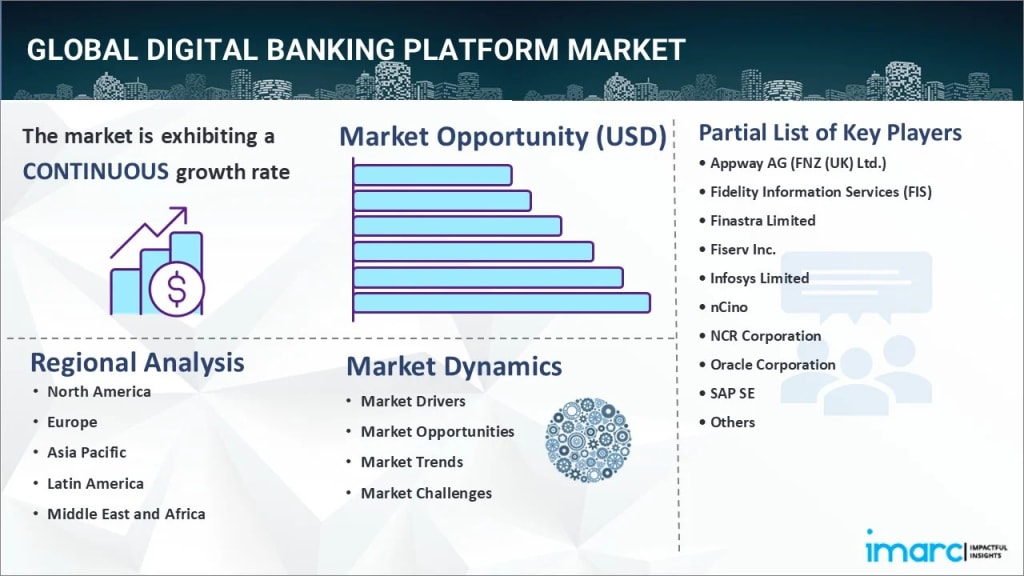
Rising demand for seamless, 24/7 financial access and the rapid adoption of smartphones are fueling the digital banking platform market, supported by cloud integration, AI-driven personalization, and favorable government initiatives promoting cashless economies. According to IMARC Group’s latest data, the global digital banking platform market size reached USD 7.3 Billion in 2024. Looking forward, IMARC Group expects the market to reach USD 19.0 Billion by 2033, exhibiting a growth rate (CAGR) of 10.66% during 2025-2033.
Digital banking platforms have transitioned from a luxury to a fundamental necessity, now representing a multi-billion-dollar industry that is fundamentally reshaping the global financial landscape. Growth is propelled by a shift in consumer behavior toward "mobile-first" banking, the rise of neo-banks, and the integration of Open Banking APIs that allow for a more interconnected financial ecosystem. Banks are increasingly investing in microservices architecture to ensure scalability and security, while also focusing on hyper-personalization to deliver tailored financial advice. Key segments include corporate and retail banking, with the latter seeing massive uptake due to features like instant account opening, biometric security, and real-time transaction monitoring.
Grab Your Free “Digital Banking Platform Market” Sample Report
Digital Banking Platform Market Growth Drivers:
- Rapid Proliferation of Smartphones and High-Speed Internet
The global surge in mobile device ownership acts as the primary gateway for digital banking adoption. With over 6.8 billion smartphone users globally, consumers now expect to manage their entire financial lives via apps. This shift is particularly visible in emerging economies where "leapfrogging" occurs—users bypass traditional physical branches entirely for mobile-only solutions. High-speed 5G connectivity further enables complex features like real-time video KYC and seamless biometric authentication. Consequently, financial institutions are prioritizing mobile-centric platform designs to capture this massive, connected demographic that values accessibility above all else.
- Growing Consumer Demand for Personalization and UX
Modern banking customers, particularly Millennials and Gen Z, demand intuitive interfaces and personalized financial insights similar to their experiences with big-tech platforms. Digital banking platforms now utilize Artificial Intelligence to analyze spending patterns, offering automated budgeting tools and customized product recommendations. Statistics indicate that banks offering high levels of personalization see a significant increase in customer satisfaction scores. By providing a frictionless user experience—reducing clicks for loan approvals or fund transfers—banks can drastically lower churn rates. This drive for "human-centric" digital design is pushing legacy banks to overhaul their front-end platforms urgently.
- Supportive Government Initiatives and Regulatory Frameworks
Governments worldwide are championing digital transformation to enhance financial inclusion and transparency. Initiatives such as India’s UPI (Unified Payments Interface) and the UK’s Open Banking standards have created a fertile ground for platform expansion. Regulatory shifts, like the PSD2 directive in Europe, mandate that banks share data with third-party providers, fostering a competitive ecosystem of fintech innovation. These mandates force traditional banks to upgrade their digital infrastructure to remain compliant and competitive. Furthermore, national "Digital India" or "Smart Nation" programs provide the necessary legal and technical frameworks that encourage citizens to migrate toward digital-first banking environments.
Digital Banking Platform Market Trends:
- Integration of Artificial Intelligence and Machine Learning
Financial institutions are embedding AI and Machine Learning into their core platforms to automate customer service and enhance security. AI-powered chatbots now handle over 70% of routine inquiries, providing instant support while reducing operational costs for banks. Beyond service, ML algorithms play a critical role in fraud detection, identifying suspicious patterns in milliseconds to prevent unauthorized transactions. Real-world applications include predictive analytics that alert users about upcoming bills or potential overdraws. This trend toward "Intelligent Banking" is turning platforms from simple transaction portals into proactive financial assistants that add tangible value to the user's daily life.
- The Rise of Cloud-Native Banking Architectures
There is a massive industry shift toward cloud-native platforms, allowing banks to move away from rigid, expensive on-premise legacy systems. Cloud integration offers unparalleled scalability, enabling banks to handle peak transaction volumes—such as during holiday shopping seasons—without system crashes. This trend supports the "Banking-as-a-Service" (BaaS) model, where traditional banks lease their infrastructure to fintechs. By adopting a multi-cloud strategy, financial institutions improve their disaster recovery capabilities and accelerate the time-to-market for new features. Industry data suggests that nearly 70% of banking executives view cloud migration as a top priority for achieving operational agility and long-term cost efficiency.
- Focus on Cybersecurity and Biometric Authentication
As digital transactions soar, platforms are prioritizing advanced security measures to combat increasingly sophisticated cyber threats. The industry is moving away from traditional passwords toward multi-modal biometrics, including facial recognition, fingerprint scanning, and even behavioral biometrics (analyzing how a user types or holds their phone). Banks are implementing "Zero Trust" architectures and end-to-end encryption to protect sensitive data. The implementation of blockchain technology for secure, immutable record-keeping is also gaining traction. These innovations are crucial for building consumer trust, as security concerns remain the primary barrier for older demographics transitioning to fully digital banking environments.
Recent News and Developments in Digital Banking Platform Market
- October 2024: JPMorgan Chase announced a multi-billion dollar investment into its digital infrastructure to integrate generative AI, aiming to provide customers with hyper-personalized financial planning tools directly within their mobile banking application.
- November 2024: Temenos launched its next-generation AI-driven core banking platform on the cloud, specifically designed to help mid-sized banks compete with larger incumbents by reducing deployment times for new digital services by nearly 50%.
- January 2025: HSBC successfully expanded its "Zing" international payments app, showcasing a strategic move by traditional giants to launch standalone digital-first platforms to compete directly with nimble neo-banks in the foreign exchange space.
- February 2025: A major partnership was formed between Microsoft and a leading global bank to leverage Azure’s cloud capabilities, focusing on enhancing the security and speed of cross-border corporate digital banking transactions.
Note: If you require specific details, data, or insights that are not currently included in the scope of this report, we are happy to accommodate your request. As part of our customization service, we will gather and provide the additional information you need, tailored to your specific requirements. Please let us know your exact needs, and we will ensure the report is updated accordingly to meet your expectations.
About the Creator
Andrew Sullivan
Hello, I’m Andrew Sullivan. I have over 9+ years of experience as a market research specialist.
Keep reading
More stories from Andrew Sullivan and writers in Futurism and other communities.
Levulinic Acid Market Analysis: Specialty Chemicals, Pharma Applications & Industry Outlook to 2033
The increasing shift toward renewable chemicals, the surge in sustainable agricultural practices, and the growing application of bio-based solvents are fueling the demand for levulinic acid. Supported by green chemistry initiatives, rising investments in carbon-neutral manufacturing, and the expansion of the personal care and pharmaceutical sectors, the market is witnessing significant transformation. According to IMARC Group’s latest data, the global levulinic acid market size was valued at USD 29.7 Billion in 2024. Looking forward, IMARC Group estimates the market to reach USD 42.6 Billion by 2033, exhibiting a CAGR of 3.9% during 2025-2033.
By Andrew Sullivana day ago in Futurism
Crypto Market Outlook: What Could Shape the Next Big Move?
The cryptocurrency market never stays quiet for long. Even when the market isn't moving, big changes are happening below the surface, like how investors act changing and how blockchain is used changing.
By Muhammad Talha Ahmad7 days ago in Futurism
The Future of Blockchain Utility and Digital Asset Valuation in 2026
The cryptocurrency market in 2026 is no longer driven purely by hype cycles and short-term speculation. Over the past few years, the focus has steadily shifted toward infrastructure, real-world integration, and enterprise adoption. Investors today are not just evaluating tokens based on community size or social media momentum. They are analyzing ecosystems, partnerships, transaction volumes, and long-term sustainability.
By Muhammad Irfan Afzal7 days ago in Futurism
When Amazon Says You’re a Disappointment
Yesterday, for the first Wednesday in months, I didn’t publish a piece on Vocal. Believe me, I wanted to. I had it all written up and ready to go. I was going to share the news that I had officially become a published author.
By Sandy Gillman7 days ago in Writers




Comments
There are no comments for this story
Be the first to respond and start the conversation.