
Cryptocurrency Market: Regulatory Developments, Market Volatility & Investment Trends
How market volatility, macroeconomic factors, and risk management tools are influencing trading behavior and portfolio strategies

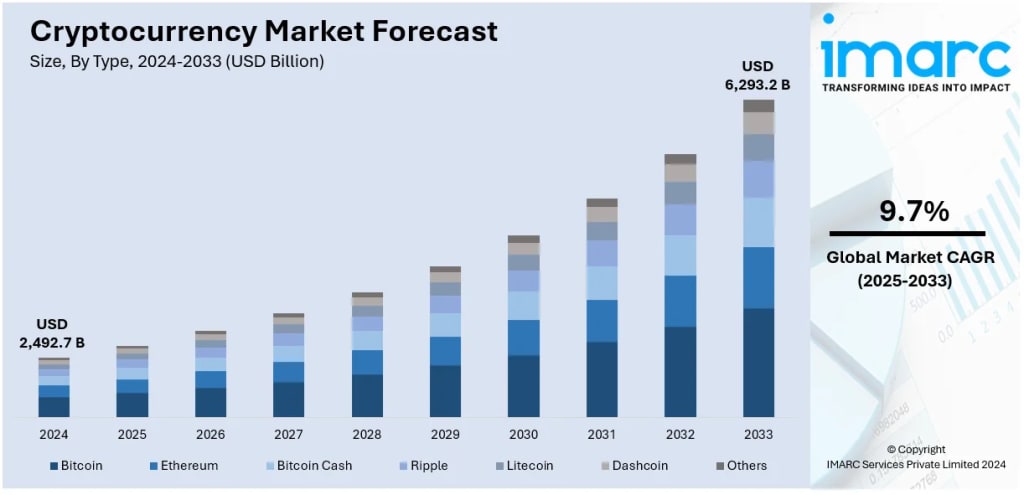
According to IMARC Group's latest research publication, global cryptocurrency market size reached USD 2,492.7 Billion in 2024. Looking forward, IMARC Group expects the market to reach USD 6,293.2 Billion by 2033, exhibiting a growth rate (CAGR) of 9.7% during 2025-2033.
How AI is Reshaping the Future of Cryptocurrency Market
- AI-Powered Trading and Market Analysis: Machine learning algorithms process millions of data points from exchanges, social media, and news to predict price movements and optimize trading strategies with precision impossible for human traders.
- Enhanced Security and Fraud Detection: AI systems monitor blockchain transactions in real-time, detecting suspicious patterns and preventing fraudulent activities. Advanced neural networks identify anomalies 40% faster than traditional security methods.
- Smart Contract Optimization and Auditing: AI-powered tools automatically audit smart contracts for vulnerabilities, reducing security risks by 30%. These systems analyze code patterns, identify potential exploits, and suggest improvements before deployment.
- Automated Portfolio Management and Yield Optimization: AI-driven platforms dynamically allocate assets across DeFi protocols, maximizing returns while managing risk. Automated systems rebalance portfolios in milliseconds based on market conditions.
- Decentralized AI Infrastructure and Token Ecosystems: Blockchain-based AI platforms like Bittensor create decentralized machine learning networks where AI models collaborate and earn tokens. The AI-crypto market value surged from USD 4.5 billion to USD 21 billion.
Cryptocurrency Industry Overview:
The cryptocurrency ecosystem is undergoing unprecedented institutional transformation as traditional finance embraces digital assets. Bitcoin spot ETFs attracted nearly USD 15 billion in net inflows during early periods, while spot Ethereum ETFs joined the regulated investment landscape. The US GENIUS Act, passed in July, established the first federal stablecoin framework, marking a pivotal shift from enforcement-driven regulation to clear, supportive guidelines. Europe's MiCA regulation took full effect across all 27 member states, enabling companies to secure authorization in one country and operate throughout the bloc. In Asia, Hong Kong launched its stablecoin framework in August, quickly becoming a regional benchmark with clearly defined reserve requirements and AML obligations. Major banks received regulatory approval for crypto services, with institutions committing substantial resources to custody and stablecoin offerings after years of regulatory uncertainty.
Access the Free “Cryptocurrency Market” Industry Trends Report
Cryptocurrency Market Trends & Drivers
Stablecoins are revolutionizing global payments infrastructure, processing over USD 52.9 trillion in transactions annually—surpassing Visa and Mastercard combined. Corporate adoption accelerated dramatically, with B2B stablecoin volume doubling to USD 6.4 billion monthly. The total stablecoin market capitalization expanded 50% to USD 305 billion as enterprises discovered their efficiency advantages. Remittance fees dropped to 2.5% from 5% via traditional banking, while real-time settlement capabilities eliminated multi-day waiting periods. Over 25,000 merchants worldwide now accept stablecoin payments, with Shopify and Stripe integrating crypto checkout options. Major payment networks like Visa and Mastercard support stablecoin transactions across 10+ global networks. Fireblocks processes 15% of global stablecoin volume through 300+ banks and payment providers, handling 35 million transactions monthly. Regulatory clarity through frameworks like GENIUS Act and MiCA regulation provided the confidence traditional financial institutions needed to deploy stablecoin solutions at scale.
Institutional participation fundamentally reshaped cryptocurrency markets as regulated investment products gained mainstream acceptance. MicroStrategy acquired 257,000 BTC, establishing a USD 2+ billion corporate treasury strategy that inspired pharmaceutical and technology companies to allocate USD 2.6 billion+ to digital assets. Record daily ETF inflows of USD 1.38 billion following political developments showcased institutional confidence, with total inflows reaching USD 6.96 billion. Custody solutions and prime brokerage services matured, enabling banks to offer crypto services without regulatory barriers after SAB 122 rescinded previous accounting restrictions. Citigroup announced cryptocurrency custody services for institutional clients targeting 2026 launch, while JPMorgan expanded into crypto asset trading. Base, Coinbase's Layer 2 solution, captured USD 4.94 billion in total value locked—43.5% market share—demonstrating infrastructure scaling capabilities. Nearly 300 pro-crypto candidates won election to US Congress, signaling sustained political support for digital asset frameworks and reduced enforcement uncertainty.
Decentralized finance protocols and real-world asset tokenization expanded dramatically, creating new investment opportunities beyond speculative trading. DeFi platforms offer attractive yields compared to traditional financial instruments, with total value locked remaining strong despite market volatility. BlackRock launched its first tokenized asset fund BUIDL, attracting USD 240 million in the first week and validating institutional interest in blockchain-based securities. The RWA tokenization market expanded from USD 8.5 billion to USD 33.91 billion—380% growth—significantly outpacing traditional asset management's 5-8% annual expansion. Decentralized physical infrastructure networks (DePIN) emerged as ambitious blockchain applications, with projections reaching USD 3.5 trillion by 2028. Helium network provides 5G cellular coverage to 1.4 million daily active users across 111,000+ user-operated hotspots. AI-crypto integration accelerated as projects like Bittensor and Autonolas built decentralized AI agents that collaborate and monetize knowledge autonomously, positioning blockchain as essential infrastructure for trustworthy artificial intelligence systems.
Leading Companies Operating in the Global Cryptocurrency Industry:
- Advanced Micro Devices Inc.
- Alphapoint Corporation
- Bitfury Holding B.V.
- Coinbase Inc.
- Cryptomove Inc.
- Intel Corporation
- Microsoft Corporation
- Quantstamp Inc.
- Ripple Services Inc.
Cryptocurrency Market Report Segmentation:
By Type:
- Bitcoin
- Ethereum
- Bitcoin Cash
- Ripple
- Litecoin
- Dashcoin
- Others
Bitcoin dominates the market with approximately 72.9% share, serving as a primary entry point for various investors and regarded as digital gold.
By Component:
- Hardware
- Software
Software leads with around 70.0% market share, facilitating applications and protocols essential for managing digital assets and driving innovation in the cryptocurrency ecosystem.
By Process:
- Mining
- Transaction
Transactions account for about 67.6% of the market, representing the primary function of cryptocurrencies as mediums of exchange with high liquidity and fast settlement times.
By Application:
- Trading
- Remittance
- Payment
- Others
Trading leads the market with approximately 40.6% share, encompassing exchanges and speculative activities, characterized by high volumes and dynamic trading strategies.
Regional Insights:
- North America (United States, Canada)
- Asia Pacific (China, Japan, India, South Korea, Australia, Indonesia, Others)
- Europe (Germany, France, United Kingdom, Italy, Spain, Russia, Others)
- Latin America (Brazil, Mexico, Others)
- Middle East and Africa
Europe holds over 39.5% of the market share, driven by regulatory frameworks and increasing blockchain adoption, particularly in countries like Germany and the UK.
Recent News and Developments in Cryptocurrency Market
- October 2025: Citigroup announced plans to launch a cryptocurrency custody service by 2026, targeting institutional clients and asset managers. The offering, in development for 2-3 years, will support native cryptocurrencies like Bitcoin and Ethereum. Citi also revealed ongoing exploration into stablecoins and tokenized deposits as part of its broader digital asset strategy.
- October 2025: JPMorgan announced plans to offer crypto asset trading services to clients, expanding its presence in blockchain. This move reflects growing institutional interest and changing attitudes toward digital assets within traditional finance.
- October 2025: Cryptocurrency exchange Gemini launched its Australian arm, Gemini Intergalactic Australia, to offer localized crypto exchange services. The firm, led by the Winklevoss twins, aims to tap into Australia's rising crypto adoption, which reached 31%. The move follows Gemini's Nasdaq debut and USD 425 million IPO.
- October 2025: CME Group announced plans to offer 24/7 cryptocurrency futures and options trading starting in early 2026. This move aims to meet the growing demand for continuous crypto market access. The extended hours will allow clients to manage risk and trade digital assets anytime.
- January 2025: Flockerz officially launched its $FLOCK cryptocurrency, raising over USD 14 million in presale and introducing a Vote-to-Earn (V2E) governance model. This system allows holders to earn rewards for participating in project decisions, aiming to set a new standard in community-driven crypto governance.
Note: If you require specific details, data, or insights that are not currently included in the scope of this report, we are happy to accommodate your request. As part of our customization service, we will gather and provide the additional information you need, tailored to your specific requirements. Please let us know your exact needs, and we will ensure the report is updated accordingly to meet your expectations.
About the Creator
Andrew Sullivan
Hello, I’m Andrew Sullivan. I have over 9+ years of experience as a market research specialist.
Keep reading
More stories from Andrew Sullivan and writers in Futurism and other communities.
Spices and Seasonings Market: Organic Offerings, Ethnic Flavors & Global Growth Drivers
According to IMARC Group's latest research publication, the global spices and seasonings market size reached USD 28.53 Billion in 2024. Looking forward, IMARC Group expects the market to reach USD 41.87 Billion by 2033, exhibiting a growth rate (CAGR) of 4.91% during 2025-2033.
By Andrew Sullivan10 days ago in Futurism
About Binding Prometheus
I want to start actively advocating on behalf of my own work, and the most valuable part of my canon is, without a doubt, Binding Prometheus, the play I have been working on since 2019 and only finished in 2023 as part of my MA. The play itself is an amalgamation of a million different inspirations. On one end, it evokes the Ancient Greek myth-play, deriving its own title from the earliest extant work of Western drama we have, Aeschylus’s Prometheus Bound. On the other end, it borrows significantly from the sci-fi bulwarks from over the years, namely Mary Shelley’s Frankenstein and Karel Capek’s Rossum’s Universal Robots. The play could be an episode of Black Mirror, I fear. I don’t know. I’ve only ever seen one episode of Black Mirror.
By Steven Christopher McKnight17 days ago in Futurism
Top-12 AI Agents Development Services in the 2026
AI agents are no longer experimental tools. In 2026, they sit at the core of how modern companies automate workflows, support customers, analyze data, and make decisions at scale. Autonomous customer support agents and multi-agent enterprise systems coordinate complex operations. Businesses actively seek partners capable of designing, building, deploying, and maintaining production-ready AI agents.
By CEO A&S Developers6 days ago in Futurism



Comments
There are no comments for this story
Be the first to respond and start the conversation.