
"Crimson Skies: The Invention That Ignited the America-China War"
An invention sparks a war between giants.

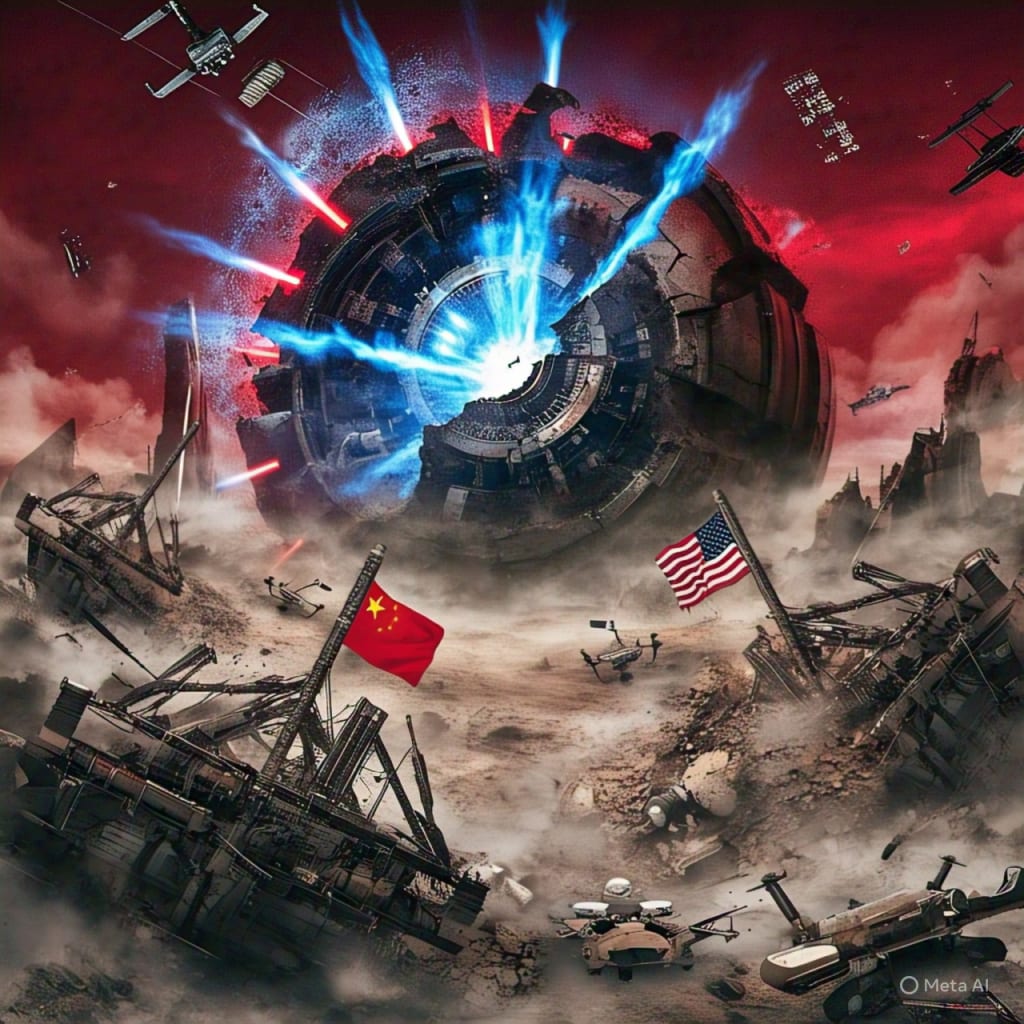
In the year 2037, a technological breakthrough sent shockwaves through the global order. A revolutionary invention—codenamed Project Aeon—promised limitless clean energy through quantum fusion, a technology once thought to be science fiction. Developed in secret by a coalition of American scientists and engineers under a private-military backed venture, Project Aeon quickly escalated from a world-saving innovation to the spark that ignited one of the most dangerous conflicts of the 21st century: the America-China War.
The Invention That Changed Everything
Project Aeon was not just another energy prototype. Unlike traditional nuclear fusion reactors, which had long struggled with sustainability and cost, Aeon’s quantum fusion process created more energy than it consumed—clean, cheap, and portable. The implications were staggering. Fossil fuels, power grids, and even traditional military supply chains could become obsolete. Whoever controlled Aeon would control the future.
Originally developed in an underground facility in Nevada, the prototype was intended to be announced at a United Nations energy summit. But before the unveiling, a data breach occurred. Sophisticated cyber espionage traced back to Chinese military intelligence accessed encrypted Aeon files. Though only partial, the data revealed enough about the technology's potential to raise alarms in Beijing.
From China’s perspective, the American monopoly over Aeon represented a direct threat—not just to energy dominance, but to global balance. With quantum fusion, the U.S. could rapidly decouple from Chinese supply chains, dominate military operations without fuel dependency, and extend its geopolitical reach unchallenged.
The Countdown to Conflict
Diplomatic tensions had already been rising for years. Trade wars, technological rivalry in AI and semiconductors, disputes over Taiwan, and competing interests in Africa and the South China Sea had brought the two nations closer to the edge than ever before. Aeon was the tipping point.
Within months of the breach, China launched its own project—Dragon Pulse—in a desperate race to develop a parallel system. But lacking the complete algorithm for Aeon’s energy stabilization, Dragon Pulse remained unstable. As both sides intensified their development efforts, so too did their military posturing.
Skirmishes in the Pacific grew more frequent. Cyberattacks escalated into open accusations at the UN. Satellites were disabled. Airspace was violated. Then came the incident that tipped the world into war: a covert Chinese strike team attacked an American research facility in Guam suspected of housing a backup Aeon reactor. The facility was destroyed. Casualties were confirmed. The U.S. declared it an act of war.
War in the Age of Invention
Unlike the conventional wars of the 20th century, the America-China War unfolded in multiple domains simultaneously: physical, digital, orbital, and ideological. It was as much about information control as missile strikes.
The U.S., backed by its NATO allies and Pacific partners, began Operation Phoenix Shield—a hybrid warfare campaign combining drone fleets, electromagnetic weapons, and cyber offensives aimed at crippling China’s communication networks and infrastructure.
China retaliated with precision strikes on American bases in Japan and South Korea and launched orbital attacks disabling several U.S. surveillance satellites. Using its Belt and Road footholds, it also deployed irregular forces and proxy militias across Africa and Southeast Asia to target Western installations.
But the most critical battles were fought over the Aeon technology itself.
China’s leadership believed the U.S. had deployed a mobile Aeon reactor somewhere in the Pacific. Both sides committed enormous intelligence resources to finding or sabotaging each other’s research efforts. What followed was a high-stakes global manhunt—scientists were abducted, labs were sabotaged, and every new breakthrough risked becoming a target.
Human Cost and Global Fallout
Within a year, the war had already left millions displaced. Coastal cities suffered from power disruptions as undersea cables were severed. Financial markets collapsed repeatedly as energy futures swung wildly with each Aeon-related development. The global south suffered the most, caught in the economic crossfire.
The invention that promised universal energy began to look like a curse.
In the United States, public opinion grew divided. Some saw the war as a necessary stand to protect technological freedom and national security. Others believed the Aeon project should have been made open-source from the start—a gift to the world, not a tool of power politics.
China, facing internal dissent due to mounting casualties and a faltering economy, began cracking down on civil unrest and doubled down on nationalist propaganda. Their message: the West was trying to suppress China’s rightful place as a global leader.
A Fragile Ceasefire
By late 2039, both countries had reached a breaking point. Neither side had managed to fully weaponize Aeon, and the economic devastation on both fronts was undeniable. A tentative ceasefire was brokered in Geneva, under pressure from non-aligned nations and a desperate global economy.
The key to the deal? Joint stewardship of Aeon technology under an international scientific council, with access regulated through the Unified Energy Charter, a new multilateral treaty designed to prevent monopolization of energy breakthroughs.
The charter was met with skepticism and protests in both nations, but the alternative—total war—was deemed far worse.
Lessons From the Brink
In hindsight, the Aeon conflict was not just about energy. It was a war about control, fear, and the belief that absolute power could still be contained within borders. The invention itself, like many scientific breakthroughs before it, was neutral. It was the politics surrounding it—the secrecy, the mistrust, the nationalist fervor—that made it dangerous.
Today, remnants of the conflict remain. American and Chinese forces still monitor one another closely in the Pacific. The Unified Energy Council struggles with enforcement and transparency. But for now, the missiles have fallen silent.
The skies are no longer crimson. But the world lives in their shadow—cautiously watching the next invention that could either save us or tear us apart again.
About the Creator
"TaleAlchemy"
“Alchemy of thoughts, bound in ink. Stories that whisper between the lines.”
Keep reading
More stories from "TaleAlchemy" and writers in Futurism and other communities.
"The Spark of Tomorrow: A Tale of Scientific Discovery"
In the annals of human progress, certain moments stand out as turning points—times when a single discovery reshapes the course of civilization. The invention of the wheel, the printing press, electricity, and the internet were all sparks that ignited new eras. In our own time, another such spark emerged from a modest laboratory tucked away in a university basement: the Quantum Fusion Reactor (QFR).
By "TaleAlchemy"8 months ago in Futurism
About Binding Prometheus
I want to start actively advocating on behalf of my own work, and the most valuable part of my canon is, without a doubt, Binding Prometheus, the play I have been working on since 2019 and only finished in 2023 as part of my MA. The play itself is an amalgamation of a million different inspirations. On one end, it evokes the Ancient Greek myth-play, deriving its own title from the earliest extant work of Western drama we have, Aeschylus’s Prometheus Bound. On the other end, it borrows significantly from the sci-fi bulwarks from over the years, namely Mary Shelley’s Frankenstein and Karel Capek’s Rossum’s Universal Robots. The play could be an episode of Black Mirror, I fear. I don’t know. I’ve only ever seen one episode of Black Mirror.
By Steven Christopher McKnight18 days ago in Futurism
Solid State Transformer Market: Smart Grid Integration, Electrification & Market Dynamics
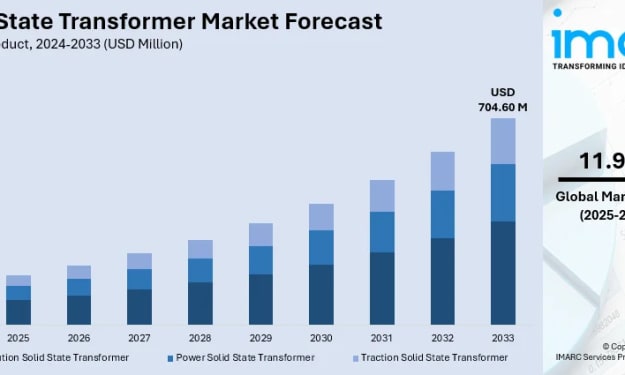
According to IMARC Group's latest research publication, global solid state transformer market size was valued at USD 241.91 Million in 2024. Looking forward, IMARC Group expects the market to reach USD 704.60 Million by 2033, exhibiting a growth rate of 11.98% during 2025-2033.
By Andrew Sullivan4 days ago in Futurism


Comments
There are no comments for this story
Be the first to respond and start the conversation.