
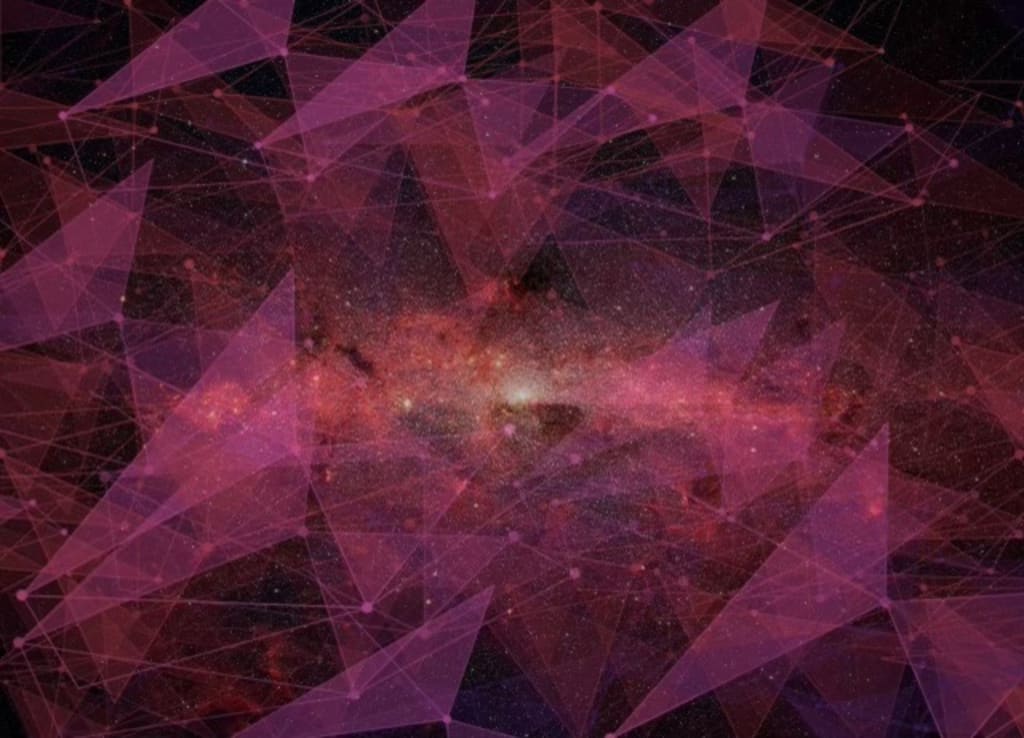
“Nobody can hear you scream in the vacuum of space, or so they say.”
Trite, jejune. Even a little threatening, thought Bri. She rolled her eyes and groaned. Evidently, her upcoming assignment had been shared with the neighborhood. Seeing those words scrawled in huge psychedelic graffiti on the outside of her battered apartment building, visible from her far-off vantage point, made her cringe. There will always be people who use fear and intimidation to undermine the common good, she thought. She had never had much use for people who made noise with no purpose. In fact, she didn’t have use for anything done in excess. She read once, although she couldn’t recall who wrote it, that we are products of the times in which we live. That was in some ways very true, she thought. Nothing in excess. Nothing more than we need.
The wars had left few buildings intact. Technically, the graffiti was illegal, as people no longer had a right to publicly express their own opinions outside of monitored forums. This rule had never bothered Bri because she saw unbridled opinions as the reason for the global wars that began and ended before she was born. People divided people over polarizing opinions for the sole purpose of gaining money and power. Money, which now had no meaning, and power, which often depended more on what one wanted than what one needed.
Bri had always had what she needed–food, shelter, a uniform, all supplied in some form by the Regional Council. Most luxury items were destroyed in the wars. Lack of resources prohibited new production of many goods, and although keeping a few mementos was allowed, materialism was popularly discouraged. A few people hoarded damaged goods from the Time Before, but they kept quiet about their possessions. Such self-serving offenses resulted in crowd-sourced derision, which had proven effective in maintaining order.
Bri smiled to herself. She had always had her own opinions anyway, even if she kept them to herself. Nobody could keep her from thinking. Her one guilty pleasure was reading, which had formed the basis for many of her opinions. She had been slipping into the old library for years, even before she was allowed to go there for training. Although not strictly prohibited, access to the library was limited because the route from the city was treacherous, beyond the Toxic Zone, and a radiation badge was recommended if traveling there. As a result, she usually found the library completely deserted. Her father had shown her a little-known underground route that bypassed the Toxic Zone, and the ruins had become her safe haven long ago. In fact, she thought of herself as a secret renegade, devouring poetry and old books, and sometimes listening to the old music when she could steal a few moments alone. Most people were uninterested in the Time Before, busily eking out their daily existence, content not to render opinions at all. Still, small bands of people periodically wandered the streets looking for any platform on which to take a position or voice their discontent. Hence the graffiti.
Climbing the steep hill to her residence, navigating the rubble and makeshift stairs, Bri returned to mentally reviewing the flight plan. Her pod would be jettisoned from the Interdimensional ArcPort two days from now. Once the pod escaped Earth’s gravitational field, she would pass through the Mayan Gate–named for the ancient civilization who wrote the Unitarity Stones. The discovery and decoding of the Stones had led to the reverse entropy algorithms and quantum chain equations that made distant space travel possible. After passing through the Mayan Gate, her pod would then accelerate as programmed through the Median Quantum Extremal Slipstream on precise coordinates and emerge at Gliese 1061C, the third exoplanet circling Gliese 1061, a red dwarf star 3.7 parsecs away, within the borders of the Horologium constellation of the Milky Way.
Quantum computing had led to crucial advances in Quantum Gravity theory–the unification of Quantum Mechanics on a subatomic scale and General Relativity with respect to gravity and spacetime on a colossal scale. Theoretical and observational physicists fed data, equations, and postulates on what was understood into the computers beginning before the wars, and in time, the computers began improving themselves. We didn’t even know what we didn’t know, yet through computer-generated development of neural networks, these computers began to decipher the cosmos itself. With added information from the Unitarity Stones, they began to unravel the information encoded in thousands of black holes, demonstrating that time is not at all linear as we had long supposed. Mathematical proof that the past, present, and future all coexist simultaneously, and that space and time are one discreet, shared dimension, had allowed discovery of thousands of interdimensional tunnels so far. These tunnels corresponded to turnover portals specific to the event horizons of specific black holes. Each tunnel connects to specific termini across the galaxy. Intergalactic tunnels were now also suspected to exist, but had not yet been proven.
Whoever first said “fate is written in the stars,” Bri thought, must have meant “the entropic information linking us to our past, present, and future is encoded in the event horizon of every black hole.” That certainly sounds less poetic, Bri mused. Regardless, fate would soon take her to the star system Gliese 1061.
Many of the world’s scientists were lost in the wars, but the Mayan Gate had been completed, and a few probes had been sent through before the last wars shut everything down. Most quantum computers eventually restarted themselves after the wars, and far from dominating mankind, as many had feared, the computers taught the surviving population how to use the resources that remained to survive. They taught a new generation of scientists, the Data Keepers, how to interpret data, improve crop production, and create survival strategies. The computers worked together with each other, sharing information, and they worked with people. With dwindling food and water supplies on our hot, dying planet, these computers suggested space exploration to save us from extinction.
Two years ago, the Data Keepers had deployed a StarGate, an orbital telecom and multifunctional probe, ahead of Bri through the Mayan Gate. The StarGate, smaller than her pod by technical necessity, was now circumnavigating the exosphere above Gliese1061C. It had finally sent back enough information to confirm that G1061C was an exoplanet habitable for humans, with a rich biosphere, abundant resources, a tolerant atmosphere, and plenty of water, all conducive to supporting human life.
This was a one-way trip: neither she nor the StarGate could return to Earth. There was no way to build or deploy a Mayan Gate on the other side, which was necessary to make the quantum leap. She would go with supplies to survive for two years, build shelter, and study the planet. She would establish the best location for colony development, and she would grow crops. She would send information she gathered back through the StarGate, received on Earth almost instantaneously thanks to quantum gravitational effects on space-time at the turnover point of the black hole that was linked to G1061C. The Data Keepers on Earth would then analyze the data and decide if the mission should continue.
She wasn’t the first to go through the Mayan Gate. But she was the first to go to G1061C. If she survived the trip, conducted her experiments, and sent information back to Earth supporting that G1061C met requirements for settlement, others would come. So far, however, none of the previous explorations had met the Data Keepers criteria to continue the missions.
As she approached the entrance to her apartment building, Bri slowed her pace, closed her eyes, and sighed deeply. She knew what was waiting for her inside. Another argument.
Bri ascended the apartment stairs, now open-air as a result of significant damage to the exterior walls during the wars. The building used to be six stories tall and architecturally beautiful, she was told, although now it was more like two and a half stories, and every pane of glass was broken to some degree. She stopped on the second-floor landing, walking quietly past the first door. The old man in the first apartment, Mr. G., had lost his wife in the last war. He refused to go to city housing, even though he was getting too old to make the five kilometer walk to the city center for food and supplies. He had always been kind to Bri, but these days he was often either desperately sad or desperately angry and wanted to reminisce about his wife, and Bri didn’t have time for that today. She left half a loaf of bread, a small bag of lentils, and a can of water at his doorstep and slipped into the second apartment. She heard Mr. G. open his door as she closed hers.
“Did you get it?” Lisse called from the next room. They were lucky enough to have two fairly complete rooms. They used one for a bedroom and washroom, while the front room served as a sitting and dining area, with a makeshift kitchen in one corner.
“Yes,” Bri answered. She took out the other loaf of bread, setting it on the table with a bag of rice, a bag of peas, and a can of water. She set her backpack on the floor by the door and sat down on one of only two chairs in the room. Her gray cargo pants were dusty, as were her well-worn black leather boots. She kept her jacket on out of habit.
Lisse came out and inventoried the table. She looked at Bri and saw the square bulge in her jacket pocket. She pursed her lips and cocked her head to the side.
“You’ve been to the library again, haven’t you? Taken another book?” Lisse scolded.
“I’m allowed,” Bri answered dismissively. “It’s part of my training.”
“You bring home a lot of books that are not part of your training,” Lisse said accusingly, adding, “Well? Where is it?”
“Where’s what?” Bri asked, her face blank, feigning confusion.
“You said you got it,” Lisse said, now a little impatient. “I wanted it today.”
“Oh,” replied Bri nonchalantly. “I thought you meant, did I get the assignment? I did.”
“No, Bri!” Lisse wailed. The color drained from her face. She sat down. “You promised you wouldn’t go!”
“I said I’d think about it,” Bri said.
Bri knew Lisse saw life mostly through how circumstances affected her personally. She had always had a little trouble with empathy, except when it came to plants. Lisse was good with plants. Bri now sensed in Lisse a combination of fear at being left alone, jealousy at being passed over for the mission, and annoyance at having been defied. At least Bri had managed to distract her from her original question for a while.
Lisse was actually quite pretty, Bri thought, smiling slightly. Lisse’s light blue eyes caught the afternoon’s hazy sun and her honey-colored hair flowed past her shoulders, contrasting sharply with Bri’s own dark brown hair, bluntly cut at the angle of her jaw, and her dark eyes that couldn’t decide if they were brown or amber. Lisse was pretty, Bri thought, when her face wasn’t scrunched up in a massive pout.
“Lisse,” Bri continued. “I was built for this mission. I’ve trained my whole life for it.”
Lisse folded her arms and stared at the floor, brooding. She knew Bri was right. Earth was dying. But why did it have to be Bri that went?
In the aftermath of the wars, roads were destroyed, along with most cities. Transportation capability was extremely limited and no longer used for leisure due to lack of manpower, disrupted supply chains, and lack of fuel. Production of nonessential goods stopped, rendering consumerism moot. There were no financial institutions, private merchandisers, or hospitals. No organized law enforcement or juris system remained, and with no resources to maintain them, cultural centers fell into decay.
Crops requiring much water, fertilizer, or labor became impossible to grow, and even crops that were genetically modified to survive this harsher climate were now harder to cultivate. Many men and women were sterile from chemical exposure, malnutrition, and disease. Although there were occasional births, infant mortality was exceptionally high, rivaling prehistoric times, when one in four infants died.
Political structures had collapsed worldwide, and countries ceased to formally exist. The world became an amalgamation of loosely defined territories, willingly sharing what resources remained. Through a series of conferences across the globe, Regional Councils formed, taking on the grave responsibility of making decisions and distributing goods to support human survival day-to-day and year-to-year. There was a stark cohesiveness among these leaders to support all people. Those people with polarizing views, as could be expected, had been almost universally annihilated, and the few who remained either assimilated and learned or became marginalized, unwilling or unable to contribute meaningfully to the task of community survival.
Regional Councils agreed to focus technologic and resource capabilities on two endeavors. The first was negating luxuries, channeling resources to products vital to keeping the current population subsisting. In this way, luxury and excess of any kind had come to be seen by leaders and the general population as taboo and selfish, an attempt to assure mankind’s demise. The second resolution was the formation of the Data Keepers, combining knowledge and resources with the commitment to developing space exploration in search of one or more habitable exoplanets. The hope was to save mankind from certain obliteration.
Most able-bodied people now worked in some capacity for the common good of the local or regional community. Some born into this era were identified early as having the aptitude to contribute to the second venture, development of space exploration. These people were allowed access to the most precious resources and groomed as scientists, builders, architects, or pilots. Bri tested into this last category. She had been flying solo since she was twelve years of age, and a few years ago was chosen for the Space Exploration Program. She was educated in astronomy, physics, mathematics, navigation, bioscience, and agriculture–skills she would need if she ever landed as an advance team on a new world. She was also allowed unfettered access to The Archives–information on every topic not lost in the wars, including the old library.
“But how will I survive here if you go?” Lisse whined.
Number one, Bri thought. Fear.
“You’ll be fine,” Bri replied. “Just keep growing your crops, and make sure Mr. G gets some food every week.”
“It’s not fair that you always get to do the exciting stuff. You get the best clothes, the best food, and you get to learn anything you want.”
Number two. Jealousy.
“I tested into this field at five years old, just after you tested into botany and agriculture,” Bri responded. “Neither of us had any idea what any of this meant. And I eat the same food as you. And we both wear clothes, not too ragged, that serve their purpose. And unless it has to do with plants, you hate reading.” Bri had strung the “ands” together for emphasis, and because she knew Lisse hated it.
“I cannot believe you are defying me, Octobriella! I told you to join a support team, not an exploration team,” Lisse finished, as if Bri had said nothing.
Number three. Annoyance.
“You are not my mother, Gemmelisse,” Bri snapped. Bri hated being called by her full name and had deleted it from all her databases. Only Lisse knew it, although she had no idea that they were both given hybrid names taken from mid-twentieth century graphic novel heroines of dubious character. Their grandmother had named them, as their mother had died in childbirth. Bri had been mortified when she found the source of their names while leafing through the old graphic novels in her grandmother’s basement when she was ten. Evidently, Gran had had a warped sense of humor and a fetish for oddities. As an afterthought, Bri wondered if Gran might have given the fraternal twins their singular names, in part, because many children became foundlings in the wars, wandering in search of their families. Unusual names would have stood out if they had gone missing.
“And I don’t have to listen to you just because you’re a few minutes older,” Bri continued. “Dad was clear about our responsibility to others, and he helped guide us to find our optimal aptitudes. Just because he’s gone doesn’t give us permission to question that obligation.”
Their father had been a pilot and scientist during and after the last war. When the girls had come of age, he had been one of the first explorers to go through the Mayan Gate. Bri frequently monitored his StarGate for radio traffic, but it had remained silent.
“I...I wasn’t questioning Dad,” Lisse stammered, biting her lower lip.
“I’m going,” Bri said curtly, putting an end to the discussion.
As she watched Lisse walk to the window and stare silently at the horizon, Bri suddenly felt she had been too harsh. She was sure Lisse was crying. She walked over to Lisse, pulling a small tin box from the left leg pocket of her pants. She offered the box to her sister.
“Here,” Bri said quietly.
Lisse sniffled, then turned and took the box. She opened it slowly, and inside she found soft paper gently wadded around two small hen’s eggs.
“Oh! You did get it. And you brought two!” she exclaimed. “Thank you!” She gave Bri a quick hug and rushed to the kitchen corner.
Eggs were a precious commodity. Lisse did not usually ask for special items, so Bri had pulled a few favors to get them. Bri was leaving in two days, anyway, so it wasn’t likely she’d get a chance to call in all the favors she was owed.
“What’re the eggs for?” Bri queried.
“You’ll see,” was all Lisse would say, busying herself with bowls and canisters and spoons.
Bri glanced out the window. She went to the door and picked up her backpack. “I’m going next door to check on Mr. G.,” she said.
“Fine,” Lisse said, distracted. “Be back in an hour. And bring Mr. G. and a chair.”
Bri tapped on Mr. G.’s door gently. Sometimes he took an afternoon nap, and she didn’t want to disturb him. He answered the door promptly, however, opening it a few inches.
“Mr. G., I’ve told you to ask who is at the door before you open it. These are uncertain times,” Bri said.
“All times are uncertain,” Mr. G. said with a grin, opening the door widely and beckoning Bri to enter. Bri stepped inside. Mr. G. closed the door and fastened the three locks. He then turned, raised his bushy gray eyebrows, and asked, “Tea?”
“Yes, of course,” Bri replied, dropping her backpack by the door and stepping further into the room. It could be the last cup of tea she had with him. It could be her last cup of tea, period, she realized.
“So, I hear you got your assignment,” Mr. G. said, igniting the induction hotplate under an old kettle. Brie and Lisse had worked with Mr. G. a few years ago to repair the geothermal power to their apartment building and the one next door, making it possible for them and a few others to function outside of the city center.
“I did,” Bri answered, although it hadn’t really been a question. Bri liked Mr. G., really. He didn’t waste anything, not even words. Except when he talked about his wife. She must have really been something.
Bri wandered along Mr. G.’s bookshelves. He had rebuilt them from scraps after the war. Nobody had begrudged him using the debris, nor keeping his surviving books for company, as he was alone and would not easily have made it to the library. She bent over and fingered some of the many books on the lower shelves he had let her play with as a child. In fact, he had taught her to read while her father had worked long hours and Lisse had played with her rag dolls and repotted weeds to decorate the window sill. Bri was a little surprised at her own nostalgia, realizing for the first time that she would miss her time with Mr. G. perhaps more than she would miss Lisse.
Bri stirred at the sound of rattling china, teacups reverberating precariously on their saucers in Mr. G.’s trembling hands, hot tea lapping nervously at the rims. Bri reached forward swiftly, gently taking the cups and saucers and ferrying them to the wooden table by the window. Mr. G. followed with a small plate of cookies.
“Cookies!” Bri exclaimed. “Where did you get them?” She literally meant where on Earth, because nobody had cookies anymore.
“I told Ms. Tante that we had a special occasion to celebrate, so she made them,” Mr. G. replied. “Help yourself.”
Bri picked up a cookie and took a nibble. She was determined to savor it.
“Cinnamon?” she asked.
“Well, something like cinnamon,” Mr. G. said with a smile. He reached into the pocket of his cardigan. He kept his hand there, watching Bri sip her tea, as if waiting for the right moment. Finally, when she put her cup down, he slowly pulled out a small tattered cardboard box, partially covered in gold-colored foil, held together by a length of brown twine. He set it in the middle of the table and pushed it toward her.
“A gift?” Bri understood the occasion. She was leaving the planet forever and would never see him again, but she found the attention disconcerting. Cookies, a gift, whatever Lisse was planning. Every day was precious, not more so because she was leaving. But she also understood (more from books than from experience) the human need to find occasions to celebrate.
“I know how you feel about stuff,” Mr. G. said, as if reading her mind. “But this is important.”
“Thank you,” Bri said. She turned the box over in her hands. She wanted to prolong the experience, to remember it more deeply in years to come. The last gift she had been given had been from Lisse on their last birthday. Carrots from Lisse’s garden, wrapped in a dishcloth and tied with a bow. Bri was not sure she had ever been given a gift that was not meant to be immediately feasted upon.
Bri slowly untied the twine, and as it dropped to the table, the box all but fell apart. Inside was a pale blue silk handkerchief, frayed at the edges, embroidered with a matching pale blue letter “B” on one corner.
“It belonged to my wife, Bella,” Mr. G. said, urging Bri on. “Open it.”
Bri only now realized that Mr. G. had never told her his wife’s name in the many stories he had told about her beauty and grace and their time together. And Bri had never asked. She slowly opened the kerchief to reveal a three-inch round gold locket on a long golden chain. She pressed the knob at the top, and the front opened, revealing the locket to be an exquisite pocket watch. The watch hands were of delicate gold filigree; the alabaster face was flawless and imprinted with one word–Bella.
“My wife was a brilliant scientist,” said Mr. G. “She knew many things even computers do not know. She made this watch.”
“She made this?” Bri found watch-making to be an unusual hobby for a scientist. “Why?”
“Because she wanted me to have it,” Mr. G. replied. “You see, it does quite a bit more than tell time.”
Bri's eyes were glued to Mr. G., waiting for him to continue. Mr. G. sensed that Bri’s mind was flooding with questions, so he continued.
“A complicated story is best told from the beginning,” Mr. G. asserted. “Bella was among the first scientists to study the Mayan Stones. As she translated the text, she became aware of two things. First, that many of the phrases could have two or three literal meanings, and in cultural and historic context, could contain even more subtle notions. She kept much of this to herself, because she wasn’t sure she could prove her findings. Moreover, if she could prove her theories, the implications were so powerful that it could tempt others to misuse the information. We Sapiens do not have the best track record for respecting natural laws. We tend to break our toys,” he finished wryly.
Bri nodded, took a sip of tea and a bite of cookie, then another, her gaze rapt with curiosity.
“Yes, yes,” Mr. G. encouraged. “Drink up while it’s hot. You see, Bella realized a second crucial point. In addition to the mathematical order of the universe that eventually led to building the Mayan Gate, the Stones suggested that other interdimensional time ‘folds’ exist on planets and in the matrix of space, apart from black holes. These folds are smaller than the tunnel you will use two days hence. The folds are also dynamic, with myriad configurations at any given moment. She found that if the markings were read in a nonlinear manner, the Stones gave explicit instructions for building such a device. A quantum timepiece, if you will.”
“But what does it do?” Bri asked impatiently, glancing down at the watch and back up at Mr. G.
“It allows the one who possesses it to travel along these folds, to other configurations,” Mr. G. said simply.
Bri didn’t find this simple at all. “You mean time travel? Without Extremal Rims and Mayan Gates?” Bri was thunderstruck.
“No, of course not,” Mr. G. said flatly, as if correcting a child. “The timepiece executes movement in both time and space, through all that was, is, and will be. Nothing truly exists in isolation, uninfluenced by what is around it. Spacetime. The two cannot be separated,” he finished, as if that settled the matter.
Mr. G. watched as Bri worked this new information into what she already knew of quantum gravitational theory.
“You mean to say,” Bri posited, “that I can use this to go anywhere and anytime I choose?”
“Hmm. Not exactly,” said Mr. G. “It’s more like traveling along the folds of a complex masterpiece of cosmic origami. You didn’t fold it, so you cannot choose how the folds are oriented. But you could, with practice, travel along multiple folds to arrive at an intended destination. It can also take you away from a dangerous or painful situation.”
“Magic?” Bri could not believe the word was coming from her mouth, but she could not fathom the mechanism.
“Don't be silly, now” Mr. G. admonished. “Magic is just science we haven’t worked out yet.”
“But how could the Mayans have built this? They didn’t have the technology in glass and metalworks, with cogs and springs,” Bri said. She had taken apart a few broken analog watches a few years ago.
“The metal casing is built to look like a pocket watch,” Mr. G. answered. “Quite clever of Bella to avoid attracting attention to the device. The inner workings are an intricate, specific arrangement of crystals and magnetic stones, actually. The Mayans did have those. And some of their high priests likely used such devices to study their past, view the future, and ‘predict’ events that would help them maintain power to protect their people. It is also likely the reason the Unitarity Stones were so well hidden. They likely knew how future civilizations would misuse knowledge.”
Bri was suddenly struck by a profound realization. “You’ve been using this to visit your wife,” she said quietly. “So why give it to me?”
Mr. G. smiled softly, confirming Bri’s suspicion without openly admitting it.
“Because it could keep you from danger on your new planet,” Mr. G. said gently. “And it could help you explore it more completely, bringing a settlement to Gliese1061C faster. It might help ensure your survival.”
“But you won’t be able to see Bella again,” Bri said, dismayed.
“You have the greater need,” said Mr. G. “Bella would want you to have it.”
Lisse knocked sharply on the wall, indicating her surprise was ready. Bri and Mr. G. cleaned up the teacups and wrapped the last cookie for Lisse. Bri wrapped the timepiece back in the silk kerchief and put it in its shabby box, re-tying the twine. She slipped it into her backpack and picked up a chair, as Mr. G. followed her next door.
“I’ll show you how it works tomorrow,” he whispered as Lisse opened the door to invite them in.
Bri’s mind was in a blur throughout dinner, an excellent casserole of peas and rice, with canned tuna and pepper from the city stores as surprise elements. Bri and Mr. G. complimented Lisse on her amazing resourcefulness, and conversation steered toward Lisse’s garden and her contribution to the community. Lisse and Mr. G. promised to look after each other, and no more mention was made of Bri’s assignment, so as not to distress Lisse. After dinner, Lisse presented her creation–a small cake with real icing to celebrate their last dinner together. Lisse had known that Bri was going. Bri would stay in the city tomorrow evening in preparation for her departure. As the sun set, Mr. G. thanked Lisse profusely for her kindness, bid them farewell, and gave a little bow. As he closed the door, he winked at Bri to remind her of their date in the morning. He needn’t have. It was all Bri could think about.
As Lisse cleared the table, Bri walked to the window and watched dark storm clouds gathering thickly on the horizon. She felt excitement and foreboding in equal measure at the anticipation of exploring ‘cosmic origami.’ She tried to shake off the foreboding. What could possibly go wrong?
About the Creator
Three-Wheeler Market: Electric Vehicles, Sustainable Transport & Growth Trends
Rising demand for affordable urban mobility, last-mile connectivity, and low operating costs is driving growth in the three-wheeler market. Expansion of e-commerce and logistics boosts usage in goods transport. Government support for electric mobility, improving battery technology, and stricter emission norms accelerate adoption. Increasing urbanization and preference for compact, fuel-efficient vehicles further support sustained market expansion. According to IMARC Group's latest research publication, The global three-wheeler market size was valued at USD 11.58 Billion in 2024. Looking forward, IMARC Group estimates the market to reach USD 23.57 Billion by 2033, exhibiting a CAGR of 8.17% during 2025-2033.
By James Whitman6 days ago in Futurism
Saudi Arabia Vegan Ice Cream Market: Dairy-Free Indulgence, Flavor Innovation & Market Expansion
According to IMARC Group's latest research publication, Saudi Arabia vegan ice cream market size reached USD 6.6 Million in 2025. The market is projected to reach USD 9.5 Million by 2034, exhibiting a growth rate (CAGR) of 4.14% during 2026-2034.
By Kishan Kumar5 days ago in Futurism


Comments
There are no comments for this story
Be the first to respond and start the conversation.