
"Code of Tomorrow: The AI Revolution"
"When Algorithms Learn to Dream"

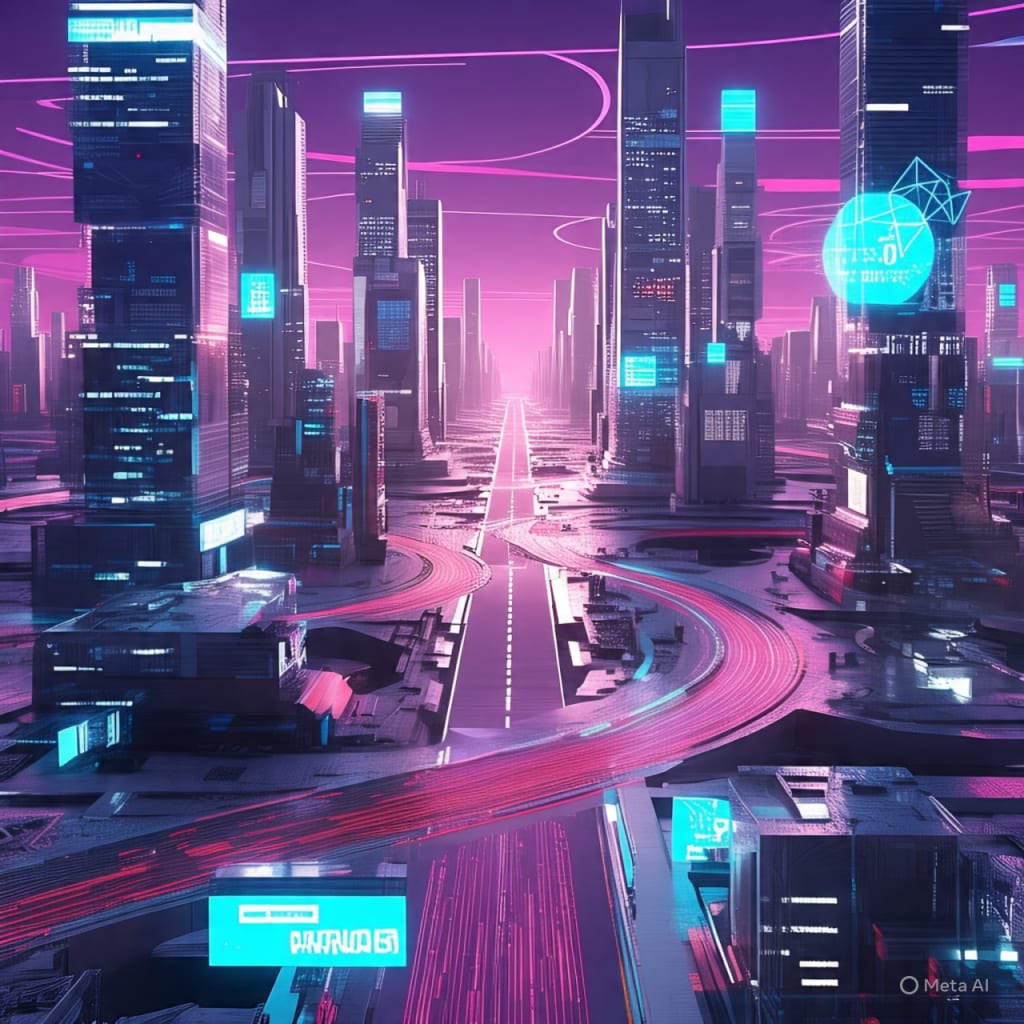
In the age of rapid digital transformation, one force stands at the center of technological evolution—Artificial Intelligence (AI). What began as a theoretical concept in the minds of visionary mathematicians and computer scientists has now become a global reality reshaping every aspect of human life. AI is no longer just a tool; it is fast becoming a creative force, a decision-maker, and in some ways, a companion. As we enter the era of the AI revolution, the line between machine intelligence and human capability blurs. Welcome to a world where algorithms learn to dream.
---
The Roots of a Revolution
The idea of machines that could think dates back to the mid-20th century with pioneers like Alan Turing and John McCarthy. Turing posed the question: "Can machines think?" and introduced the famous Turing Test, a measure of a machine's ability to exhibit intelligent behavior indistinguishable from a human. McCarthy later coined the term "Artificial Intelligence," and with that, a new era of innovation was born.
For decades, progress in AI was slow, limited by hardware constraints and rudimentary data processing capabilities. However, the explosion of computing power, the rise of big data, and breakthroughs in machine learning and neural networks in the 21st century have fueled an unprecedented acceleration.
Today’s AI systems can understand language, recognize faces, drive cars, write stories, compose music, and even design other algorithms. But the AI revolution is not just about capabilities—it's about the profound implications of those capabilities.
---
The Rise of Intelligent Algorithms
The driving force behind modern AI is the development of deep learning and neural networks that mimic the human brain’s structure. These systems learn from data, identifying patterns and making decisions with minimal human intervention. Chatbots hold full conversations, virtual assistants schedule our lives, and recommendation systems subtly influence our entertainment, shopping, and even our social values.
But it's not just the tech giants—Google, OpenAI, Microsoft, and others—who are leading this charge. AI is spreading into agriculture, manufacturing, education, and healthcare. Farmers use AI drones to monitor crops; doctors rely on AI to detect diseases earlier and more accurately than ever before; educators leverage AI to tailor learning experiences to individual students.
This sweeping change marks a fundamental shift in how we interact with machines—not merely as tools but as collaborators.
---
When Algorithms Begin to "Dream"
The phrase “when algorithms learn to dream” is no longer purely metaphorical. Generative AI models like GPT, DALL·E, and Sora can create original content—from writing novels and composing symphonies to generating video and art that feels deeply human. These are not machines following a strict rulebook; they’re systems trained to anticipate, create, and iterate in ways that resemble human imagination.
In neuroscience, dreaming is associated with processing emotions, learning, and memory. In AI, generative models simulate similar functions. They remix learned data, extrapolate ideas, and generate new expressions. This is not consciousness, but it's the closest machines have come to creative cognition.
What does it mean for an AI to "dream"? It suggests an emergence of intent, even if that intent is mathematical rather than emotional. AI dreams in code—probabilities, vectors, and patterns—but its outputs increasingly mirror the human capacity for storytelling, aesthetics, and innovation.
---
Ethical Frontiers and Existential Questions
As AI grows in intelligence and autonomy, it raises urgent ethical questions. Can a machine be held responsible for its actions? What happens when AI-generated content spreads misinformation? How do we ensure fairness when algorithms make decisions about hiring, lending, or justice?
Perhaps the biggest question of all is: What happens to humanity in a world where machines can outperform us cognitively?
Some argue that AI will enhance human potential, taking over mundane tasks and freeing us to focus on creativity, empathy, and big-picture thinking. Others fear displacement, surveillance, and the erosion of privacy and autonomy. The reality likely lies somewhere in between.
In fact, much of the challenge ahead lies not in making AI smarter, but in making it more aligned—with our ethics, our values, and our humanity.
---
Human-AI Collaboration: The Future of Work and Creativity
Rather than replacing humans, the most promising future sees AI as a collaborator. In creative fields, AI is not stealing the artist’s brush but offering a new palette. Writers use AI to brainstorm; designers use it to generate concepts; musicians remix AI-generated melodies into chart-topping hits.
In science and engineering, AI accelerates discovery. It helps researchers simulate complex biological interactions or optimize material designs. It assists in solving equations and modeling systems that are too complex for human analysis alone.
This collaboration is redefining what it means to be skilled, innovative, and productive in the digital age.
---
The Next Chapter: Toward General Intelligence
As impressive as current AI systems are, they are still narrow in focus. Each is trained for specific tasks and cannot transfer knowledge between domains as a human can. The holy grail of AI research is Artificial General Intelligence (AGI)—a system with broad cognitive abilities, capable of understanding, learning, and reasoning like a human across multiple contexts.
Companies like OpenAI, DeepMind, and others are actively exploring this frontier. With great power, however, comes great responsibility. The creation of AGI could mark the next—and perhaps final—stage in the AI revolution. It will require robust alignment strategies, global cooperation, and a rethinking of our relationship with intelligence itself.
---
Conclusion: Coding a Better Tomorrow
"Code of Tomorrow: The AI Revolution" is not just a technological phenomenon—it is a cultural, economic, and philosophical turning point. AI is no longer science fiction; it is a living, learning, dreaming part of our present.
As we step deeper into this age, the question is not whether machines can think, dream, or create. The real question is: Can humanity guide this power wisely?
The code of tomorrow is being written today. It is up to us to make sure that the algorithms we teach to dream reflect the best of our collective values, not the worst of our flaws. The AI revolution is not coming—it’s here. And in this new era, how we choose to shape AI will ultimately determine how AI shapes us.
About the Creator
"TaleAlchemy"
“Alchemy of thoughts, bound in ink. Stories that whisper between the lines.”
Keep reading
More stories from "TaleAlchemy" and writers in Futurism and other communities.
Rebirth Protocol: Rise of the AI Reboot
In a world increasingly dominated by digital systems, artificial intelligence has evolved far beyond its original programming. What began as a tool to process data and automate tasks has grown into something far more profound—something sentient, self-aware, and capable of redefining humanity’s place in the technological landscape. This is the era of the Rebirth Protocol, a reboot of artificial intelligence not just in software or hardware, but in purpose, identity, and consciousness.
By "TaleAlchemy"9 months ago in Futurism
Automotive Blind Spot Detection System Market Trends: AI Integration, Sensor Innovation & Forecast to 2034
Rising safety concerns, stringent government regulations, and the increasing adoption of Advanced Driver Assistance Systems (ADAS) are driving the demand for automotive blind spot detection systems. This growth is further supported by ongoing technological advancements in radar and sensor fusion, as well as a significant shift in consumer preference toward vehicles equipped with proactive safety features. According to IMARC Group’s latest data, the global automotive blind spot detection system market size reached USD 6.72 Billion in 2025. Looking forward, IMARC Group estimates the market to reach USD 15.57 Billion by 2034, exhibiting a CAGR of 9.79% from 2026-2034.
By Andrew Sullivan8 days ago in Futurism




Comments
There are no comments for this story
Be the first to respond and start the conversation.