
China Takes Off
The future takes off while the world watches.

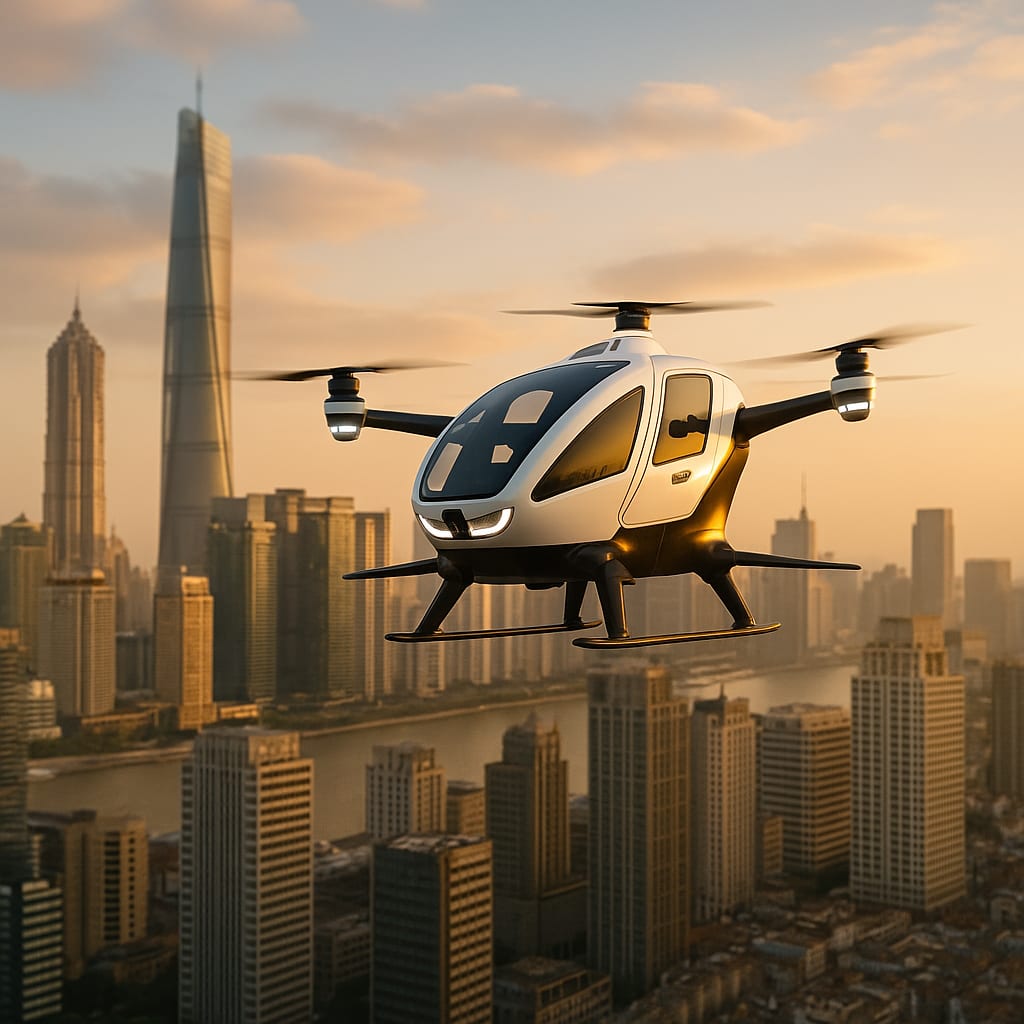
For decades, flying cars and airborne taxis have been the stuff of science fiction, from Back to the Future to The Fifth Element. These films promised a world where traffic jams disappeared into the sky, where technology redefined mobility, and where cities adapted to vertical transportation. That future always seemed distant, like a dream postponed. Until now. Because today, that vision is no longer fiction. It’s taking off—in China.
The Chinese government has officially authorized the commercial use of autonomous flying taxis in Shenzhen, making it the first country in the world to turn this concept into reality. The EHang EH216-S, a two-seater drone developed by Chinese company EHang, has passed all necessary certifications. It is 100% autonomous, piloted by AI, and runs on electricity. Its primary goal: revolutionize short urban travel without the need for pilots or traditional road infrastructure. With more than 30 successful demonstration flights and growing interest from airports, city planners, and tourism operators, China has just opened a door that others barely dare to knock on.
What makes this development even more striking is not just the technology itself, but the speed at which it is being implemented. While the United States and Europe are still entangled in debates over regulation, privacy, and safety, China is already building the landing pads, rewriting its traffic rules, and inviting citizens to step aboard. It’s a leap that combines state ambition, industrial coordination, and a cultural readiness to embrace the future—even if that future looks like a sci-fi movie.
But there’s more than just innovation here. The drone taxi project reflects something deeper about China’s current trajectory. Over the past two decades, China has transformed from a global manufacturing hub into a technological heavyweight. From high-speed trains to space missions, AI development to renewable energy, the country is increasingly setting the pace in fields that used to be dominated by the West. The launch of flying taxis is not an isolated stunt—it’s part of a broader strategic vision to lead the Fourth Industrial Revolution.
The symbolism is powerful. While Europe is still trying to harmonize its drone regulations across member states, and the U.S. grapples with FAA bureaucracy, China is flying over these delays. The difference isn’t just technical—it’s political, cultural, and structural. In China, long-term goals are shaped by central plans, executed by both public and private actors, and accepted by a population that often associates technological progress with national pride. In contrast, many Western societies are more cautious, fragmented, and risk-averse, often slowed down by legal complexity and public distrust.
This divergence raises questions that go far beyond flying taxis. Are Western democracies structurally too slow to adapt to rapid technological change? Can liberal systems that prioritize individual rights, transparency, and decentralized governance keep up with authoritarian models that can move faster and break more ground? The flying taxi becomes a metaphor for a broader race—one that involves innovation, regulation, and above all, vision.
There are, of course, serious concerns. Safety remains a key issue: What happens in the event of a crash, system failure, or hacking? Urban airspace is not easy to manage, especially if dozens of these vehicles begin to circulate simultaneously. There’s also the question of noise, visual pollution, and inequality—who will really have access to this service, and will it improve mobility for all or just serve the wealthy few? But these concerns, while valid, are not stopping China from moving forward. Instead, they are being addressed in parallel with deployment—not used as reasons to wait indefinitely.
The rest of the world is watching, sometimes with fascination, sometimes with fear. Because once again, China isn’t just copying—it’s leading. And for many governments and industries, this shift is uncomfortable. The Western imagination has long associated high-tech breakthroughs with Silicon Valley, Airbus, or NASA. Seeing a drone lift off over a Chinese skyline challenges that narrative. It forces a reckoning: What if the future is being built elsewhere?
Meanwhile, public opinion in Europe and North America remains skeptical. The idea of a flying taxi still feels like a gimmick to many, a luxury product with little relevance to everyday life. But that perception may change rapidly once the service becomes normalized in Asian cities. Just like smartphones, high-speed rail, or mobile payment systems, what starts in East Asia often spreads—first to the Global South, then to the rest of the world. If flying taxis prove safe, efficient, and economically viable, they could redefine what modern cities look like within a decade.
So where does that leave us? Perhaps the real question is not whether flying taxis will succeed, but whether the rest of the world is ready to follow. China has made its move. The sky, quite literally, is no longer the limit.
About the Creator
Bubble Chill Media
Bubble Chill Media for all things digital, reading, board games, gaming, travel, art, and culture. Our articles share all our ideas, reflections, and creative experiences. Stay Chill in a connected world. We wish you all a good read.
Keep reading
More stories from Bubble Chill Media and writers in Futurism and other communities.
The Grand Israel Vision
The Myth and Reality of “Greater Israel”: Vision, Rhetoric, or Strategy? Is there a hidden plan to reshape the Middle East’s borders forever? The phrase “Greater Israel” has sparked debate, suspicion, and controversy for decades. Some say it’s a myth. Others believe it’s a geopolitical ambition slowly unfolding. But what is the truth behind the concept of “Greater Israel,” and is such a vision even possible in today’s world of shifting alliances, regional instability, and international law? Beyond conspiracy theories, the idea has roots in history, ideology, and politics—and understanding it may shed light on the complex dynamics driving conflict and diplomacy in the Middle East today.
By Bubble Chill Media 8 months ago in Futurism
Deadline Looms as Anthropic Rejects Pentagon Demand to Remove AI Safeguards
A showdown is unfolding between Anthropic and the U.S. Department of Defense after CEO Dario Amodei formally rejected a Pentagon ultimatum to loosen safeguards on the company’s AI model, Claude.
By Behind the Techa day ago in Futurism
Australia Wealth Management Market: HNWI Growth, Digital Transformation & Regulatory Evolution
According to IMARC Group, the Australia wealth management market reached USD 118.6 Million in 2025 and is projected to expand to USD 222.2 Million by 2034, exhibiting a compound annual growth rate (CAGR) of 7.00% during 2026–2034. This sustained expansion reflects structural changes in capital accumulation, digital advisory platforms and regulatory oversight across Australia. Wealth management services—including portfolio advisory, retirement planning, tax structuring and estate planning—are increasingly critical as individuals accumulate assets through entrepreneurship, property investments and superannuation growth. As high-net-worth individuals (HNWIs) expand in number and financial sophistication, demand for tailored, transparent and digitally enabled advisory services continues to rise.
By Kevin Cooper5 days ago in Futurism




Comments
There are no comments for this story
Be the first to respond and start the conversation.