
Caustic Soda Market Trends: Chlor-Alkali Demand, Industrial Applications & Forecast to 2034
How rising chlor-alkali production, expanding chemical manufacturing, and strong industrial demand are shaping long-term growth in the global caustic soda market

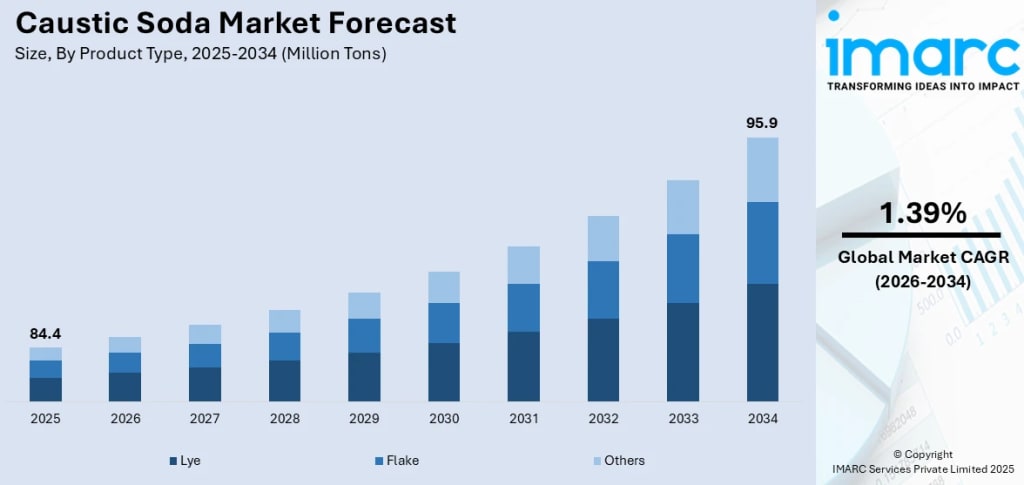
Growing demand from aluminum refining, expanding pulp and paper production, and rising water treatment requirements are driving steady expansion in the caustic soda market, supported by industrial growth in textiles and chemicals, membrane cell technology adoption, and increasing environmental regulations favoring sustainable production methods. According to IMARC Group's latest data, the global caustic soda market size was valued at 84.4 Million Tons in 2025. Looking forward, IMARC Group estimates the market to reach 95.9 Million Tons by 2034, exhibiting a CAGR of 1.39% during 2026-2034. Asia-Pacific currently dominates the market.
Caustic soda also known as sodium hydroxide or lye is one of the most widely used industrial chemicals in the world. It plays a central role in aluminum production, where it is used to extract alumina from bauxite ore through the Bayer process. The chemical is also essential in pulp and paper manufacturing, textile processing, soap and detergent production, and water treatment. Lye leads by product type, driven by its use across these key applications. Membrane cell technology dominates the manufacturing process segment, accounting for the majority of production due to its energy efficiency and environmental advantages over older mercury and diaphragm cell methods. Industrial grade holds the largest share by grade, reflecting its widespread use in chemical manufacturing and processing applications.
Caustic Soda Market Growth Drivers:
- Aluminum Industry Expansion Driving Alumina Production
Aluminum production is the single largest consumer of caustic soda globally. According to the International Aluminium Institute, primary aluminum production reached 70,716 kilotons by August 2024, up from 65,325 kilotons in 2020 a clear indicator of rising demand. The automotive and aerospace industries are driving this growth as manufacturers shift toward lightweight materials to improve fuel efficiency and reduce emissions. About 91.8 million automobiles were produced globally as of 2019, and the lightweight materials market is projected to reach USD 99.3 billion, further reinforcing demand for aluminum and, by extension, caustic soda. Every ton of aluminum requires significant quantities of caustic soda to refine bauxite into alumina, making this one of the most stable and predictable demand drivers in the market.
- Pulp and Paper Industry Maintaining Steady Consumption
Caustic soda is a critical chemical in pulp and paper manufacturing, used to break down lignin during the pulping process and brighten pulp during bleaching. With global youth literacy rates rising from 87% to 92% between 2000 and 2020, demand for educational materials like books and notebooks continues growing. The e-commerce boom has also increased demand for cardboard and packaging materials, where caustic soda plays a key role. Approximately 35 kg of caustic soda are required per ton of market pulp, making the pulp and paper industry one of the largest consumers. As literacy rates climb and online retail expands, this segment will remain a consistent demand source for caustic soda producers.
- Water Treatment Needs Expanding Globally
According to the United Nations, 2.2 billion people still lack access to safely managed drinking water. As governments and organizations invest in water infrastructure and treatment facilities, caustic soda is being deployed at scale to adjust pH levels, neutralize acidic water, and remove heavy metals and contaminants. Caustic soda is used to raise pH levels in acidic water, creating optimal conditions for treatment processes and ensuring safe drinking water. Environmental regulations are getting stricter worldwide, particularly around industrial wastewater discharge, which is creating additional demand for caustic soda in treatment plants. This is not just a developing world issue industrial water treatment in North America and Europe also relies heavily on caustic soda to meet compliance standards.
Caustic Soda Market Trends:
- Membrane Cell Technology Replacing Legacy Production Methods
Membrane cell technology has become the dominant production method, accounting for 60% to 85% of global caustic soda production. The shift away from mercury and diaphragm cell technologies is being driven by environmental regulations and economic efficiency. Membrane cells consume up to 17% less electricity than diaphragm cells and produce high-purity caustic soda with very low salt content critical for industries like alumina refining and chemical manufacturing. In February 2024, INEOS Inovyn launched its Ultra Low Carbon range of chlor-alkali products, aimed at reducing the carbon footprint of manufacturing and supporting decarbonization goals across industries. This transition is particularly strong in Asia-Pacific, where new plant construction is concentrated, and in Europe and North America, where older plants are being phased out under regulatory pressure.
- Green and Sustainable Caustic Soda Gaining Market Traction
Sustainability is reshaping how caustic soda is produced and marketed. In December 2024, Brenntag introduced 100% green caustic soda in the Netherlands and Belgium, priced competitively with conventional alternatives. The product is manufactured using renewable energy, significantly reducing carbon emissions associated with production. Brenntag plans to expand this offering to additional regions, reflecting growing customer demand for low-carbon chemicals. In India, Aditya Birla Group launched a sustainability program to produce caustic soda using renewable energy at its Gujarat plant, targeting reduced carbon emissions. These initiatives are not just marketing they represent real operational shifts as producers respond to corporate sustainability commitments and regulatory pressure across supply chains.
- Strategic Capacity Expansions Responding to Regional Demand
Major producers are expanding capacity to meet rising demand, particularly in Asia-Pacific and the Middle East. In May 2024, DCM Shriram expanded its caustic soda capacity in Bharuch, Gujarat, to 2,225 tons per day, making it India's largest plant with an annual capacity of 1 million tons. In April 2024, Mundra Petrochemical Ltd., an Adani Enterprises division, commissioned India's largest chlor-alkali project with a capacity of 2,200 tons per day. In mid-2025, SABIC commissioned a new caustic soda production unit at its Jubail complex in Saudi Arabia, increasing supply for regional industrial and petrochemical customers. These are not speculative projects they are operational facilities responding to confirmed demand from aluminum, chemicals, and textile industries across high-growth regions.
Recent News and Developments in Caustic Soda Market
- December 2024: Brenntag announced the introduction of 100% green caustic soda in the Netherlands and Belgium, produced using renewable energy and offered at a price comparable to conventional alternatives. The launch reflects Brenntag's commitment to sustainability and addresses growing customer demand for low-carbon chemicals. The company plans to expand availability to additional regions, positioning green caustic soda as a mainstream option rather than a premium niche product.
- May 2024: DCM Shriram successfully commissioned an expansion project that added 850 tons per day to its caustic soda capacity at Jhagadia, Gujarat. The expansion brought the company's installed capacity in Bharuch to 2,225 tons per day, making it India's largest caustic soda plant with an annual capacity of 1 million tons. The project supports India's "Atmanirbhar Bharat" initiative and positions DCM Shriram for long-term growth in a region where industrial chemical demand is accelerating.
- April 2024: Mundra Petrochemical Ltd., a division of Adani Enterprises, commissioned India's largest chlor-alkali project, developed by Nuberg EPC. The facility operates with a capacity of 2,200 tons per day, using a 100% NaOH process. The project marks a significant milestone in India's chemical manufacturing infrastructure, addressing domestic demand and export opportunities across South and Southeast Asia.
- February 2024: INEOS Inovyn launched its Ultra Low Carbon range of chlor-alkali products, aimed at reducing the carbon footprint of caustic soda and chlorine manufacturing. The initiative reinforces INEOS's commitment to decarbonization and supports industries seeking sustainable chemical solutions. The product line aligns with global regulatory trends toward lower-emission industrial processes and addresses customer demand for environmentally responsible supply chains.
Note: If you require specific details, data, or insights that are not currently included in the scope of this report, we are happy to accommodate your request. As part of our customization service, we will gather and provide the additional information you need, tailored to your specific requirements. Please let us know your exact needs, and we will ensure the report is updated accordingly to meet your expectations.
About the Creator
Suhaira Yusuf
I specialize in Consumer Insights, focusing on transforming detailed market data into strategic business solutions that accelerate growth and improve customer engagement.
Keep reading
More stories from Suhaira Yusuf and writers in Futurism and other communities.
Bancassurance Market Trends: Wealth Management Integration & Forecast to 2034
Growing demand for integrated financial services, digital transformation across banking channels, and strategic partnerships between banks and insurers are driving steady expansion in the bancassurance market, supported by AI-powered personalization, embedded insurance models, and rising financial literacy in emerging economies. According to IMARC Group's latest data, the global bancassurance market size was valued at USD 1,585.4 Billion in 2025. Looking forward, IMARC Group estimates the market to reach USD 2,496.2 Billion by 2034, exhibiting a CAGR of 5.17% from 2026-2034. Asia-Pacific currently dominates the market, holding a market share of over 45.9% in 2025.
By Suhaira Yusufabout 10 hours ago in Futurism
On-Board Charger Market Outlook: Electric Vehicle Adoption and Charging Infrastructure Growth Opportunities
According to IMARC Group's latest research publication, The global on-board charger market size was valued at USD 8.8 Billion in 2025. Looking forward, IMARC Group estimates the market to reach USD 31.4 Billion by 2034, exhibiting a CAGR of 15.13% from 2026-2034.
By Michael Richard7 days ago in Futurism
Stanislav Kondrashov Oligarch Series: From Human Hierarchies to the Architecture of Cosmic Intelligence
When you hear the word oligarchy, you probably think of wealth clustered at the top and influence held by a select few. It sounds political. Economic. Social. But what if you’ve been looking at it through the wrong lens?
By Stanislav Kondrashov6 days ago in Futurism
Goodbye, Mr. Duvall
It is turning out to be an interesting year. I was in the middle of teaching a class when a pop-up appeared on the screen announcing the death of Mr. Robert Seldon Duvall (yes, that was his full name). I was in the middle of a discussion on the obsession we have with winning when it comes to sports (the Winter Olympics was a theme), and I felt as though things were coming full circle. We had already lost Gene Hackman last year, and along with that titan, it feels though one particular golden age has closed off to be replaced by...?
By Kendall Defoe 8 days ago in Geeks


Comments
There are no comments for this story
Be the first to respond and start the conversation.