
Better Prompts, Smarter Outputs: How to Talk to ChatGPT
Want Smarter Al Answers? Start with a Smarter Prompt

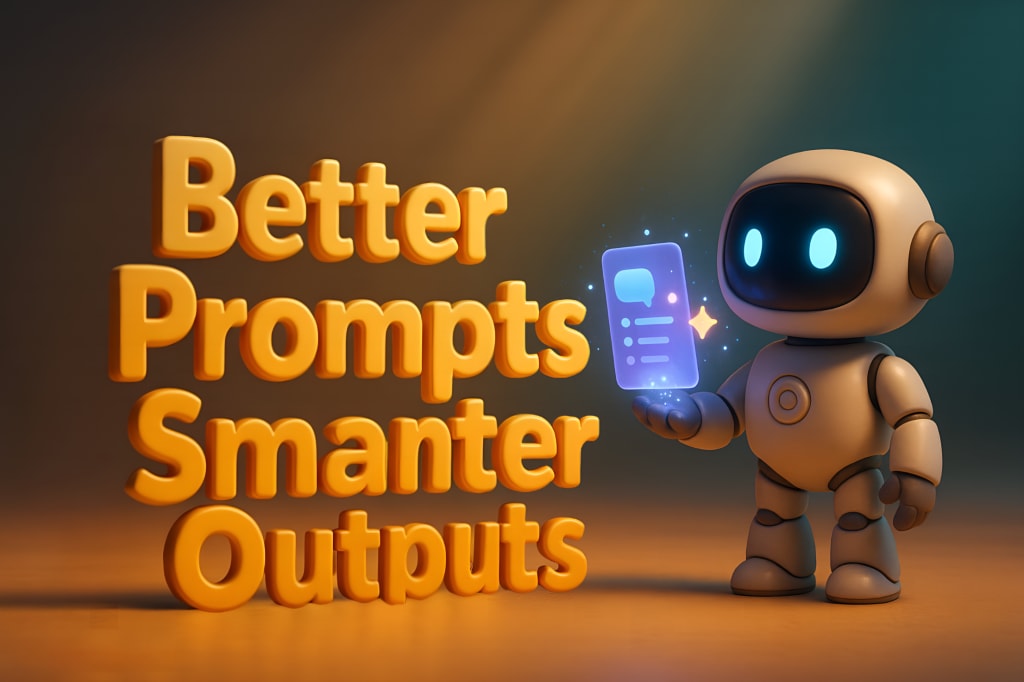
ChatGPT isn’t a mind reader, it’s a pattern completer. It doesn’t know what you meant; it only knows what you said.
To get smarter outputs, you need smarter inputs. That means treating prompts not as casual questions but as carefully constructed instructions. Think of it as programming with words. The better you articulate your intent, the better ChatGPT can fulfill it.
I’m want to show you advanced prompting techniques that go beyond the basics, helping you harness ChatGPT’s capabilities more effectively.
The Anatomy of an Effective Prompt
A well-crafted prompt has several key components:
- Role Assignment: Specify who ChatGPT should emulate. For example, “Act as a seasoned marketing consultant.”
- Task Definition: Clearly state what you want. For instance, “Provide a 500-word strategy for launching a new product.”
- Contextual Information: Include relevant details. Such as, “The product is a mobile app aimed at college students.”
- Constraints and Guidelines: Set boundaries. Like, “Use simple language and avoid technical jargon.”
By combining these elements, you create a prompt that guides ChatGPT to produce more accurate and useful responses.
Advanced Prompting Techniques
1. Chain-of-Thought Prompting
Encourage ChatGPT to reason through problems step by step. This technique is particularly useful for complex tasks. For example:
“Let’s think through this problem step by step: What are the key factors to consider when launching a new product?”
By prompting the model to articulate its reasoning process, you can gain deeper insights and more structured responses.
2. Few-Shot Learning
Provide examples within your prompt to guide ChatGPT’s responses. This method helps the model understand the desired format and tone. For instance:
*”Here are two examples of effective email subject lines:
- ‘Unlock Your Exclusive Offer Today’
- ‘Don’t Miss Out on Our Limited-Time Deal’
Now, generate five more subject lines for a summer sale campaign.”*
Including examples sets a clear pattern for ChatGPT to follow.
3. Role-Playing Scenarios
Assign ChatGPT a specific persona to tailor its responses. This approach can yield more nuanced and context-appropriate outputs. For example:
“You are a customer service representative handling a complaint about a delayed shipment. Draft a response that addresses the customer’s concerns and offers a solution.”
By defining a role, you guide the model’s tone and content.
Advanced Prompting Techniques 2
1. Chain-of-Thought Prompting
Encourage ChatGPT to reason step-by-step by explicitly asking it to break down its logic. This is especially useful for complex tasks like problem-solving, planning, or argument-building.
Example:
“Walk me through the reasoning process for deciding whether a subscription-based model would be better than a freemium model for a language learning app targeting millennials.”
Instead of jumping to an answer, ChatGPT is now primed to explain the logic, reveal trade-offs, and expose assumptions, all of which sharpen its usefulness.
2. Self-Critique Prompts
One way to improve quality is to ask ChatGPT to review its own output.
Prompt:
“Generate a draft email pitching a SaaS product. Then critique your own draft for clarity, tone, and persuasiveness. Revise accordingly.”
This meta-prompting builds feedback into the process. You’re not just getting a first draft, you’re initiating a second-level refinement loop within the same session.
3. Forced Perspective Prompts
Instead of generic answers, ask the model to adopt a particular worldview or constraint to expose deeper nuance.
Prompt:
“From the viewpoint of a skeptical investor, what are the biggest weaknesses in this startup’s pitch?”
This reframes the task. It doesn’t just ask for information, it demands contrast, friction, and insight. That’s where ChatGPT shifts from being informative to being intelligent.
4. Negative Constraints
Sometimes it’s not about what the model should say but what it shouldn’t.
Prompt:
“Write a one-paragraph summary of Stoicism, but avoid using the words ‘calm,’ ‘acceptance,’ or ‘control.’”
By blocking cliché or expected phrasing, you force originality. This reveals how prompts can create boundaries that sharpen, not restrict, output.
Conclusion: Prompts as Cognitive Interfaces
The mistake people make isn’t just bad phrasing, it’s low intentionality. They type as if ChatGPT understands context like a human. It doesn’t.
Every prompt is an interface. A translation of your mental model into textual form. And if that translation is vague, shallow, or overstuffed, the response will be too.
Better prompts aren’t just about getting what you want. They’re about thinking better. About asking clearer questions, framing sharper tasks, and refining the way you express thought.
Because when you write smarter prompts, you’re not just training the model. You’re training your own mind to think with more discipline. And that’s what truly unlocks smarter outputs.
About the Creator
Beyond The Surface
Master’s in Psychology & Philosophy from Freie Uni Berlin. I love sharing knowledge, helping people grow, think deeper and live better.
A passionate storyteller and professional trader, I write to inspire, reflect and connect.
Keep reading
More stories from Beyond The Surface and writers in Futurism and other communities.
The"Silent Censor": How Your AI Assistant Is Already Deciding What You're Allowed to Think
Most people think censorship looks like a government banning books or a regime shutting down protests. But that’s the obvious kind. The loud kind. What’s more dangerous is the version you don’t see, the quiet narrowing of thought that happens through suggestion, omission or redirection. That’s where artificial intelligence enters the picture.
By Beyond The Surface10 months ago in Futurism
Kids Digital Advertising Market to hit USD 25.9 Billion By 2033
The Global Kids Digital Advertising Market is projected to reach approximately USD 25.9 Billion by 2033, rising from USD 3.4 Billion in 2023, and is expected to expand at a CAGR of 22.5% during the forecast period from 2024 to 2033. This growth is driven by the increasing digital consumption among children, the growing influence of social media, and the rising importance of targeted, interactive advertising methods. With the increasing use of smartphones, tablets, and other digital devices among kids, advertisers are increasingly focusing on creating engaging, child-friendly content that can capture the attention of younger audiences.
By Roberto Crum4 days ago in Futurism
Artemis II: Nasa targets early April for Moon mission
The mission represents a crucial milestone in NASA’s broader Artemis program, which aims to return humans to the lunar surface and establish a long-term presence on the Moon. If successful, Artemis II will pave the way for future missions that could eventually support lunar bases and deeper exploration into the solar system. Artemis II will be the first crewed flight of the powerful Orion spacecraft launched aboard the massive Space Launch System rocket. The spacecraft will carry four astronauts on a journey that will take them thousands of kilometers beyond the Moon before returning safely to Earth. The mission follows the success of Artemis I, which flew in late 2022 and successfully tested the Orion spacecraft in deep space without astronauts on board. That mission orbited the Moon and returned valuable data about the spacecraft’s performance, heat shield durability, and onboard systems. According to NASA officials, Artemis II will take astronauts on a roughly 10-day journey. During the mission, the Orion spacecraft will perform a flyby of the Moon, traveling farther from Earth than any human mission has gone before. The astronauts will also test key navigation systems, life-support technology, and communication equipment needed for long-duration space travel. The crew selected for the historic mission includes commander Reid Wiseman, pilot Victor Glover, mission specialist Christina Koch, and Canadian astronaut Jeremy Hansen. Together, they will represent a new era of international cooperation in space exploration. Christina Koch’s participation is particularly significant, as she will become the first woman to travel to the Moon. Meanwhile, Jeremy Hansen will be the first Canadian astronaut to take part in a lunar mission, highlighting the role of international partnerships in NASA’s long-term exploration strategy. The Artemis program itself is part of a broader effort to establish sustainable human exploration beyond Earth. Unlike the earlier Apollo missions, which focused on short lunar visits, the Artemis program aims to build infrastructure that will support repeated missions and long-term scientific research. Future plans include the construction of the Lunar Gateway, a small space station that will orbit the Moon and serve as a staging point for missions to the lunar surface. From there, astronauts could travel down to the Moon using specialized landers designed for repeated use. NASA officials say the Artemis program will also help prepare astronauts for future missions to Mars. By testing deep-space systems near the Moon, engineers and scientists can learn valuable lessons about life-support systems, radiation protection, and long-duration spaceflight. Despite the excitement surrounding Artemis II, the mission has faced multiple delays as engineers worked to ensure the safety of both the spacecraft and the launch system. Issues related to hardware testing, battery components, and environmental control systems required additional time for inspection and redesign. NASA administrators have emphasized that safety remains the agency’s top priority. Crewed missions beyond low Earth orbit carry significant risks, and officials have insisted that all systems must be thoroughly tested before astronauts are launched into deep space. The early April target represents a tentative launch window rather than a fixed date. Weather conditions, final technical checks, and launch readiness reviews will ultimately determine the exact day when the rocket lifts off from Kennedy Space Center. If the mission proceeds as planned, Artemis II will become the first crewed lunar flyby mission since Apollo 17 in 1972. That historic mission marked the end of the Apollo era, after which human exploration of the Moon paused for decades. Now, with Artemis II approaching launch, NASA is preparing to usher in a new chapter of lunar exploration. The mission is expected to capture global attention as astronauts once again venture into deep space, retracing a path last traveled by the Apollo generation. For space enthusiasts, scientists, and engineers around the world, the upcoming mission represents more than just a technological achievement. It symbolizes humanity’s renewed determination to explore beyond Earth and expand our understanding of the universe. If Artemis II succeeds, it will not only demonstrate the readiness of NASA’s next-generation spacecraft but also bring humanity one step closer to returning astronauts to the lunar surface for the first time in the 21st century.
By Fiaz Ahmed a day ago in Futurism



Comments (1)
You're right about treating prompts as instructions. I've found that being specific helps get better results. Chain-of-thought and few-shot learning techniques sound promising too.