
B&B Review: The Electric State
Or, how our book club read a dystopian novel during a pandemic

One thing our book club loves is booze. Our book club also loves dystopian works mixed with straight-up existentialism. The next book on the Booze & Book Club list brought us back to our roots of dystopia by painting (literally) an alternate reality of 1997. I present to you, dear reader: The Electric State by Simon Stålenhag.
[Side Note: I realize the hilarious coincidence in reading a book about a dystopian world during a pandemic. I assure everyone that this was not on purpose and that we pick our books ahead of time. Regardless, or perhaps more so, it was a humbling, yet oddly comforting, reading experience, especially as the days went on.]
I went into this book not knowing anything about it, other than it was dystopian science fiction and fairly new. I had no idea it was self-published, nor that it was self-published by an artist. Or that artist (Simon Stålenhag) already had a really impressive resume, including an artbook that has already been adapted into an RPG. The biggest shock was the most obvious: that it was a graphic novel.
The layout also caught me by surprise as it did not follow the standard layout of most graphic novels that I've read. The layout reminded me of a picture book. I'm not sure if that was intentional, but as a reader, I appreciated it. The layout made me feel nostalgic, since I was a tiny child in 1997. It also made the book feel more eerie, due to the subject matter and the ending.
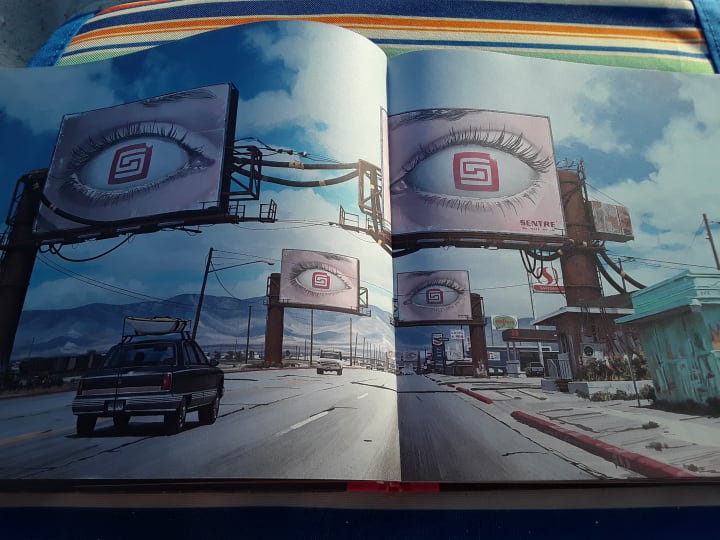
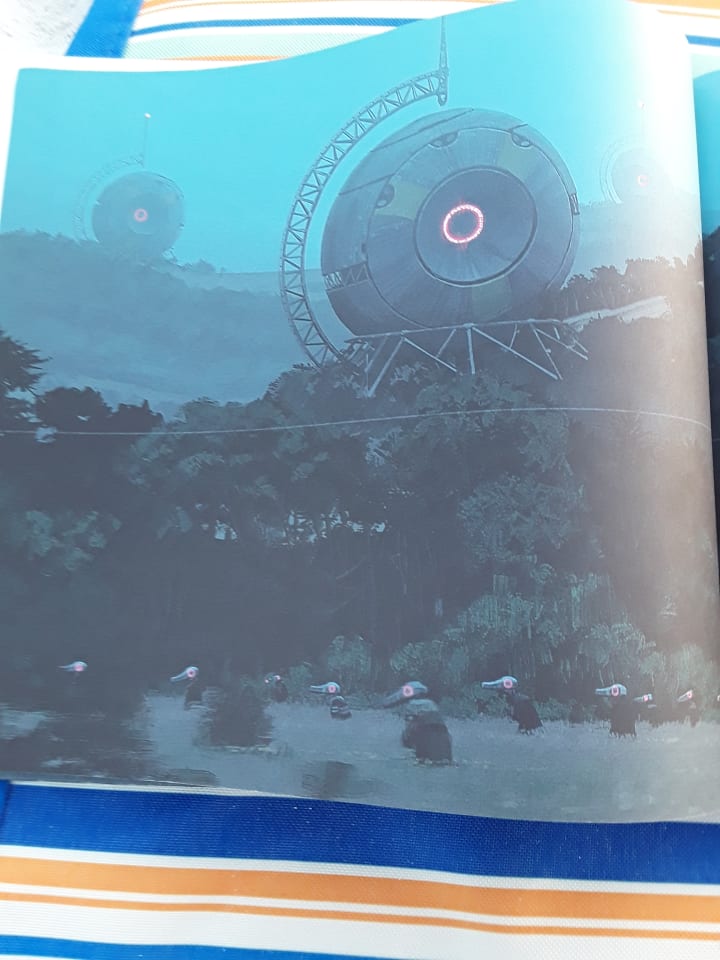
When I first opened the novel, I found myself mesmerized by the art. Each scene was incredibly detailed, with more being noticed with the second read through. Visual clues to the end goal are scattered among the illustrations, most of which I did not notice on my first read through. I also noticed homages in the art, whether intentional or not, from other sci-fi works. These works include Snow Crash (more on that later), Portal, Fallout New Vegas, and Cars (cars takes place in a dystopian world where mankind has gone extinct, you cannot change my mind). There's even an illustration that reminds me of the scene in The Great Gatsby where Nick describes a billboard featuring the desolate eyes of Dr. T.J. Eckleburg. Although I recognize that The Great Gatsby is not a science fiction novel, the billboard of Dr. T.J. Eckleburg more or less represents the despair and isolation that the main characters experience. Isolation is a major theme in The Electric State.
Even with the similarities to other science fiction, The Electric State became its own work. This became apparent with the similarities to Snow Crash, which was technically the first science fiction novel we read for our club, many years ago. I know a lot of science fiction fans are going to let me know that I should be referring more to Necromancer for these upcoming comparisons, however, I haven't read that one yet and feel that it would be unfair for me to include literary critique on this book against a work I have not read.
Snow Crash is significant to our club because we've read other books that deal with virtual reality's effect on society, and although it is not the first book to do so, it is one of the more well known (and earlier) books to do so. Snow Crash more or less is a parody for the cyberpunk genre, but has thematic elements of society's reliance on escapism. We also see that in Ready Player One (RPO) and in The Electric State, where the neurocasters in the latter fairly resemble the purpose of OASIS in RPO and the Metaverse in Snow Crash.
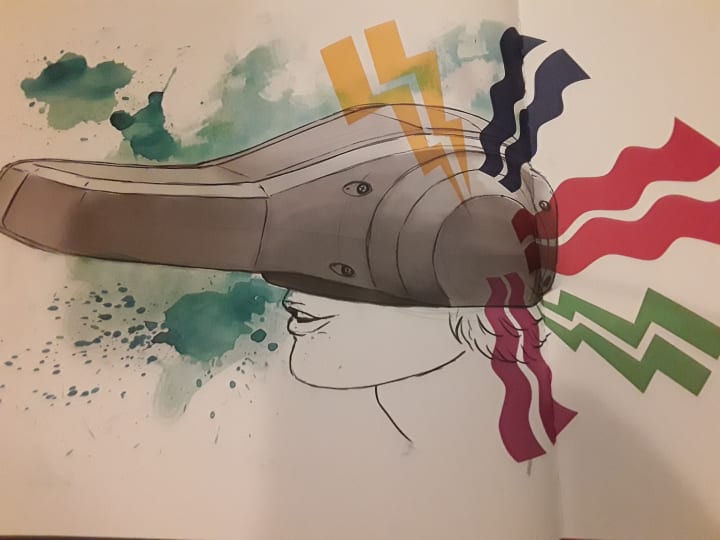
This is not Snow Crash nor is it RPO. The more interesting parts of The Electric State are not the nifty technological advancements, but rather the journey of the protagonist and her motivation for this journey. People are addicted to the neurocasters because the VR systems offer them a better reality than what real life has to offer, as seen with OASIS and the Metaverse. This is a much overused thematic element, and while authors can still write interesting stories around that plot line, it is refreshing to see a new perspective. We do get portions of history of the alternate reality throughout the novel, but for the most part, most of the dystopian world is featured solely in the illustrations. Where the main points of conflict in Snow Crash and RPO are the VR systems taking over actual reality, The Electric State uses it more as a backdrop.
The story itself is a journey, both metaphorically and literally, against isolation. Throughout this journey, we catch glimpses of Michelle's past and what she's dealing with in the present. Her motivation for this journey and her destination seem vague and slightly ambiguous. She is not technically alone as she has her silent robot companion, Skip, along for the ride, but you as the reader still can see how alone she feels. The fact that she has a companion may seem to negate the theme of isolation, but I would argue that there is a big difference between robot companionship with human interaction, especially in the foreground of what is essentially neurological warfare. Near the end of the story, as Michelle and Skip get closer to their destination, the reader finally understands the end goal. As stated earlier in this review, the ending and motive are heavily implied in the accompanying illustrations and subtext, as well as an opening verse from the beloved Psychedelic Furs song, Love My Way.
It is not a Hero's Journey. As much as I love The Hero's Journey and Joseph Campbell, I do not feel that Michelle meets enough of the key criteria for it to be a Hero's Journey tale. She is our hero, by default, and she does go on a journey, but she doesn't come back changed or transformed in the end. There's virtually no character development, at least in the traditional sense. We see her character develop from her memories, but her memories really serve as an explanation as to why this journey is so crucial for her. We experience her issues with abandonment with key figures in her life: her mother, her grandfather, her foster parents, her childhood friend (and perhaps first love, either perspective could be argued).
The Electric State also features simultaneous arcs between Michelle and a man named Walter. From Walter's passages, we learn how this reality came to be and see him traveling to the same destination as Michelle, though from first read through, this may not be obvious. Walter's passages are inverted and in italics, visually distancing his story arc from Michelle's. It also implies why the neurocaster doesn't work on Michelle, instead of a throwaway line she says to Amanda's father. Without giving away too many spoilers, I feel that Walter was more in search of Michelle than he was with her destination. This is all through subtext and illustration as it is never explicitly stated what Walter's objective was.
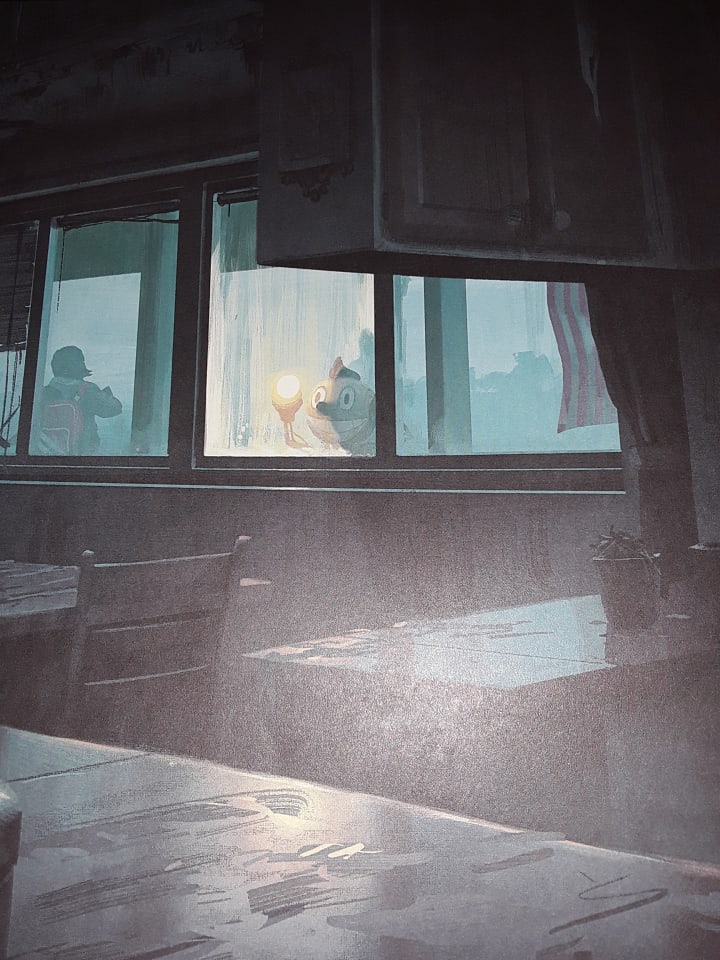
The best part of this book for me were the pages that had no narration or dialogue. For me, those pages told the most story through context clues and featured the most emotional scenes. The ending pages are all illustrations and open to interpretation from the reader as to what exactly happened to Michelle and Skip. The ambiguous ending seems bleak, but at the same time, you are hoping for the best. Perhaps it's because we are unsure of what the future will bring, but hope is what drives us, as we see throughout Michelle's journey.
Overall, I do recommend reading this book if you are a fan of sci-fi and/or graphic novels. I do feel as though the story and art is compelling enough to hold a reader's attention, even if they aren't a fan of either. There are a couple of plot holes, but for the most part, those plot holes can be interpreted in numerous ways and don't really contribute too much to the main narrative.
About the Creator
Australia Private Equity Market: Capital Inflows, Deal Activity & Strategic Exits
According to IMARC Group, the Australia private equity market reached USD 23.9 Billion in 2025 and is projected to grow to USD 48.5 Billion by 2034, exhibiting a compound annual growth rate (CAGR) of 8.21% during 2026–2034. The market’s expansion reflects increasing capital inflows, rising institutional participation, and strong deal-making activity across key sectors in Australia. Demand for buyout funds, venture capital investments, and infrastructure-focused portfolios is accelerating as investors seek higher returns and portfolio diversification. With strong opportunities in technology, healthcare, renewable energy, and real estate, Australia private equity market share continues to expand within both domestic and cross-border investment ecosystems.
By Kevin Cooper4 days ago in Futurism
L.A. School Board Delays Decision on Superintendent After FBI Raids
The Los Angeles Unified School District Board of Education met behind closed doors for four hours Thursday but reached no decision about the future of Superintendent Alberto Carvalho, one day after the FBI raided his home and district office.
By Behind the Tech7 days ago in Futurism



Comments
There are no comments for this story
Be the first to respond and start the conversation.