
Automotive Brake System Market Outlook: Vehicle Safety Advancements and Growth Opportunities
The automotive brake system market is experiencing steady growth, driven by increasing vehicle production, rising safety regulations, and growing consumer demand for advanced braking technologies.

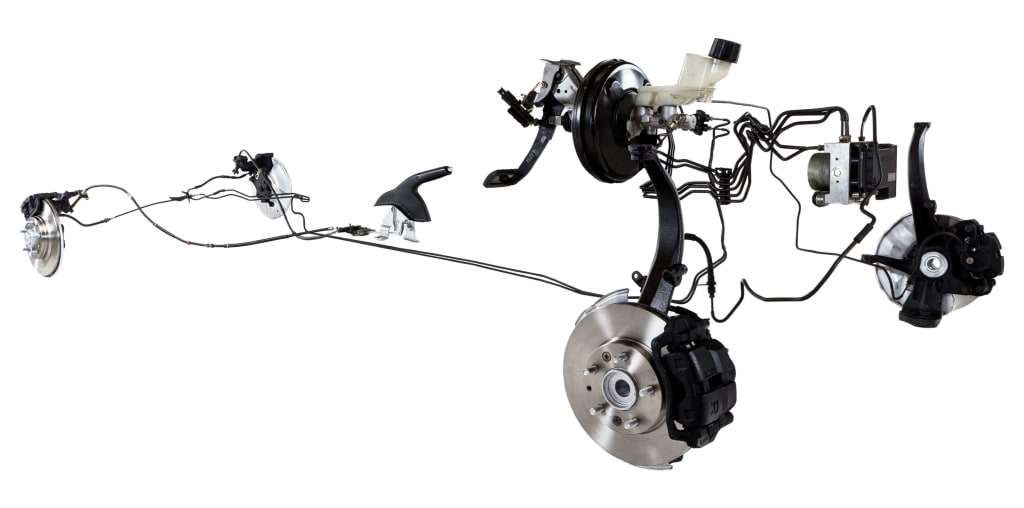
According to IMARC Group's latest research publication, The global automotive brake system market size was valued at USD 51.50 Billion in 2024. Looking forward, IMARC Group estimates the market to reach USD 76.33 Billion by 2033, exhibiting a CAGR of 4.25% from 2025-2033.
How AI is Reshaping the Future of Automotive Brake System Market
- Predictive Fade Warning Systems: Machine learning models analyze dynamometer data to predict non-linear brake behaviors during high-energy scenarios. Neural networks trained on temperature, speed, and power inputs enable fade warning algorithms, helping drivers avoid overheating risks without physical prototypes.
- Regenerative Braking Optimization: AI-powered energy management systems use deep reinforcement learning to optimize regenerative braking in electric vehicles. These algorithms balance energy recovery with driver comfort, improving battery life by preventing overcharging while extending vehicle range through intelligent kinetic energy capture.
- Autonomous Emergency Braking Intelligence: AI-driven automatic emergency braking combines 3D LiDAR sensors with computer vision to detect obstacles faster than human reflexes. Systems using clustering algorithms on point clouds achieve real-time collision prediction, automatically engaging brakes when sensing imminent accidents even in complex urban environments.
Automotive Brake System Industry Overview:
The automotive brake system sector is experiencing a technological revolution driven by vehicle electrification and autonomous driving development. ZF Friedrichshafen produced its 250 millionth Electric Park Brake unit in October 2024, marking a major manufacturing milestone that demonstrates the rapid shift from mechanical to electronic braking solutions across the industry.
Automotive Brake System Market Trends & Drivers
Governments worldwide are implementing stricter safety regulations that mandate advanced braking technologies in new vehicles. The U.S. National Highway Traffic Safety Administration announced in 2024 that all passenger vehicles must include automatic emergency braking by September 2029, with systems capable of detecting pedestrians and performing automatic braking at speeds up to 90 mph. Similarly, the European Union mandated AEB systems in all new vehicles starting May 2024, while Euro 7 regulations effective July 2025 cap brake particulate emissions at 7 mg/km, pushing manufacturers toward copper-free pads and low-drag calipers to meet environmental standards.
The explosive growth of electric and hybrid vehicles is fundamentally transforming brake system requirements and creating massive demand for specialized technologies. Electric vehicle sales in the United States increased by approximately 10%, exceeding one in ten cars sold in 2024 according to the International Energy Agency, while EV sales in Brazil doubled during the same period with over 85% coming from Chinese manufacturers. These electric vehicles require regenerative braking systems that capture kinetic energy during deceleration to recharge batteries, along with specialized components that accommodate different weight distributions and lighter vehicle designs compared to traditional internal combustion engines.
Breakthrough innovations in brake-by-wire technology are revolutionizing system architecture and performance capabilities. In 2024, ZF announced a comprehensive brake-by-wire platform designed for electric and automated vehicles that operates entirely on electronic signals without hydraulic components, supporting up to Level 4 automation. Brembo partnered with Michelin in 2025 to launch the Sensify smart braking system, which uses real-time data and electric actuation to tailor braking at each wheel for improved safety and control. These systems enable precise wheel-specific control, reduce mechanical complexity, improve response times, and integrate seamlessly with autonomous driving features, representing the future direction of automotive braking technology.
Leading Companies Operating in the Global Automotive Brake System Industry:
- Aisin Corporation
- Akebono Brake Industry Co. Ltd
- Astemo, Ltd.
- Brembo N.V.
- Continental AG
- HELLA GmbH & Co. KGaA
- HL Mando Corp.
- Knorr-Bremse AG
- Performance Friction Corporation
- Robert Bosch LLC
- Tenneco Inc.
- ZF Friedrichshafen AG
Automotive Brake System Market Report Segmentation:
By Type:
- Disc Brakes
- Drum Brakes
Disc brakes represent the largest segment with 66.4% market share, as they offer superior heat dissipation, enhanced braking strength, and better reliability compared to drum brakes.
By Component:
- Master Cylinder
- Brake Pad
- Calipers
- Disc
- Vacuum Servo Brake
- Brake Drums
- Others
Master cylinder dominates the component segment due to its essential role in converting mechanical force into hydraulic pressure for effective brake operation.
By Technology:
- Anti-Lock Braking System (ABS)
- Traction Control System (TCS)
- Electronic Stability Control (ESC)
- Electronic Brake Force Distribution (EBD)
Anti-lock braking system holds 31.9% market share as it prevents wheel lockup during emergency braking, improving steering control and reducing accident risk.
By Vehicle Type:
- Passenger Cars
- Commercial Vehicles
Passenger cars lead with 75.6% market share due to high production volumes, continuous safety innovations, and growing demand for comfort and performance features.
By Sales Channel:
- Original Equipment Manufacturers (OEMs)
- Aftermarket
Based on the sales channel, the market has been segmented into original equipment manufacturers (OEMs) and aftermarket.
Regional Insights:
- North America (United States, Canada)
- Asia Pacific (China, Japan, India, South Korea, Australia, Indonesia, Others)
- Europe (Germany, France, United Kingdom, Italy, Spain, Russia, Others)
- Latin America (Brazil, Mexico, Others)
- Middle East and Africa
Asia Pacific dominates with 47.4% market share driven by robust automotive manufacturing capabilities, significant technological advancements, and increasing focus on safety regulations.
Recent News and Developments in Automotive Brake System Market
- January 2025: ZF introduced a new modular brake system integrating advanced electronic controls with traditional braking components. The system enhances vehicle safety through improved responsiveness and adaptability across different driving conditions, supporting the evolving needs of modern automotive engineering.
- January 2025: Bosch successfully tested its hydraulic brake-by-wire system over 2,050 miles to the Arctic Circle, marking its first public road trial. The system eliminates mechanical connections using redundant electric signals, demonstrating the viability of next-generation braking technology in extreme conditions.
- May 2025: Bajaj updated the Pulsar NS400Z motorcycle with new sintered brake pads, replacing older organic compounds to improve braking power and reduce fade. The enhancement aims to deliver better lever feel and overall braking performance despite retaining Grimecca brake calipers.
- April 2025: Nexteer Automotive introduced its electro-mechanical brake-by-wire system, replacing traditional hydraulic components with software-controlled actuators. The system enhances braking precision, supports advanced driver assistance system integration, and optimizes regenerative braking for electric vehicles while improving design flexibility.
- April 2025: Brembo partnered with Lucid to provide brake calipers for the Lucid Gravity SUV. The collaboration highlights the growing demand for high-performance braking solutions in the premium electric vehicle segment as manufacturers seek specialized components for next-generation models.
Note: If you require specific details, data, or insights that are not currently included in the scope of this report, we are happy to accommodate your request. As part of our customization service, we will gather and provide the additional information you need, tailored to your specific requirements. Please let us know your exact needs, and we will ensure the report is updated accordingly to meet your expectations.
About the Creator
James Whitman
With years of experience in analyzing global industries, I specialize in delivering actionable market insights that help businesses stay ahead in an ever-changing landscape.
Keep reading
More stories from James Whitman and writers in Futurism and other communities.
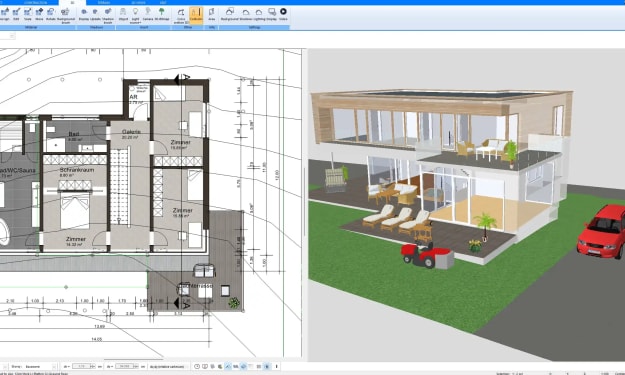
Real Estate Software Market Outlook: Digital Property Management and Growth Opportunities
According to IMARC Group's latest research publication, The global real estate software market size was valued at USD 12.2 Billion in 2024. Looking forward, IMARC Group estimates the market to reach USD 28.2 Billion by 2033, exhibiting a CAGR of 9.27% during 2025-2033.
By James Whitman3 days ago in Futurism
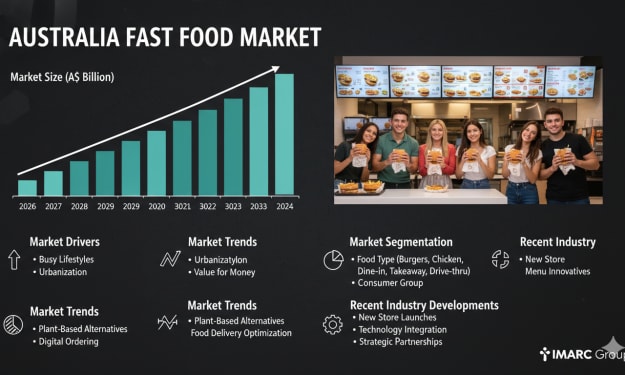
Australia Fast Food Market: Consumer Preferences, Convenience Demand & Digital Ordering
According to IMARC Group, the Australia fast food market reached USD 18.8 Billion in 2025 and is projected to grow to USD 26.5 Billion by 2034, exhibiting a compound annual growth rate (CAGR) of 3.80% during 2026–2034. This steady expansion reflects evolving consumption habits, urban convenience culture and digital transformation across Australia. Fast food, once defined primarily by traditional quick-service restaurant formats, now encompasses app-based ordering, drive-through innovation, delivery integration and menu diversification. As disposable incomes rise and consumers seek speed without sacrificing variety, Australia’s fast food ecosystem is adapting through technology, health-oriented reformulation and omnichannel engagement strategies.
By Shrestha Roy2 days ago in Futurism


Comments
There are no comments for this story
Be the first to respond and start the conversation.